The Jakarta Post
Please Update your browser
Your browser is out of date, and may not be compatible with our website. A list of the most popular web browsers can be found below.
Just click on the icons to get to the download page.


Popular Reads
Top Results
No results found. Please check your search term and try again
Can't find what you're looking for?
View all search results
Popular Reads
Top Results
No results found. Please check your search term and try again
Can't find what you're looking for?
View all search resultsPupuk Indonesia reasserts support for Indonesia’s Asia-Pacific ammonia hub ambition
Change text size
Gift Premium Articles
to Anyone
Share the best of The Jakarta Post with friends, family, or colleagues. As a subscriber, you can gift 3 to 5 articles each month that anyone can read—no subscription needed!
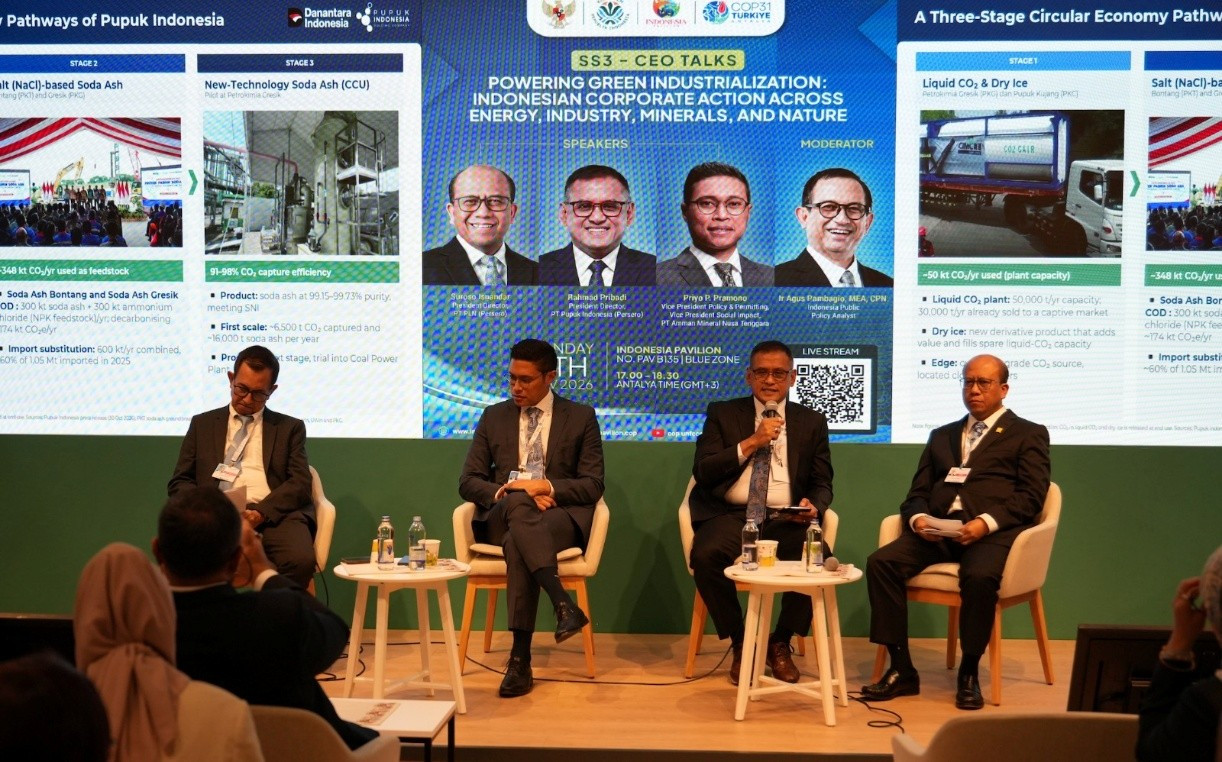 Pupk Indonesia president director Rahmad Pribadi (second right) addresses a panel session on Nov. 9 during the United Nations Climate Change Conference (COP31) in Antalya, Türkiye, highlighting ammonia’s role as a vital pillar of the energy transition. (Courtesy of Pupuk Indonesia)
P
T Pupuk Indonesia (Persero) unveiled on Nov. 9 its vision to expand the national ammonia ecosystem, a key component of the global clean energy transition, at the United Nations Climate Change Conference (COP31) in Antalya, Türkiye.
Through the initiative, the company aims to position Indonesia as an ammonia bunkering hub in the Asia-Pacific.
Pupuk Indonesia president director Rahmad Pribadi noted that while ammonia had traditionally been known as raw material for the fertilizer industry, the chemical compound possessed promising characteristics as a fuel of the future, particularly for the shipping sector.
"The initial narrative surrounding ammonia centers on its role in food production. However, the next chapter involves utilizing ammonia as an energy source. This represents a massive opportunity, as demand is projected to continue growing," said Rahmad.
Pupuk Indonesia plans to develop an ammonia bunkering hub in Batam, a highly strategic location near the Strait of Malacca and major international shipping lanes in close proximity to Singapore, the world’s largest bunkering port.
"Indonesia’s geography is both a strength and a climate asset. Batam is particularly attractive due to its proximity to one of the world’s busiest bunkering hubs,” he said.
“We see an opportunity to develop an ammonia refueling facility there, allowing vessels passing through the region to utilize ammonia as an alternative fuel."
Beyond Batam, Pupuk Indonesia sees potential for developing an ammonia ecosystem through production facilities operated by its subsidiary PT Pupuk Iskandar Muda (PIM) in Lhokseumawe, Aceh. The city’s position at the northern gateway to the Strait of Malacca serves as a strategic advantage for supplying ammonia to international shipping routes.
The company is also exploring the possibility of developing an ammonia bunkering facility in Bontang, East Kalimantan, to be integrated with the ammonia production facilities of regional subsidiary PT Pupuk Kaltim (PKT). These facilities and port infrastructure offer a foundation for expanding the national ammonia ecosystem.
As one of the largest ammonia producers in the Asia-Pacific, Middle East and North Africa (APAC-MENA) region with an annual ammonia production capacity of 7.1 million tonnes, Pupuk Indonesia is well-positioned to capitalize on the opportunity.
"In the past, we used ammonia to meet the public's food security needs. Moving forward, ammonia will become a vital pillar of the energy transition.
“We view this as a crucial energy transition and are committed to pursuing it seriously,” Rahmad said.
“Pupuk Indonesia holds a dual mandate: to support the nation in achieving food sovereignty and to drive industrialization toward more environmentally friendly practices,” he emphsized.
“Now this mandate has the potential to expand even further, as ammonia is set to be utilized as a fuel for the future."