The Jakarta Post
Please Update your browser
Your browser is out of date, and may not be compatible with our website. A list of the most popular web browsers can be found below.
Just click on the icons to get to the download page.


Popular Reads
Top Results
No results found. Please check your search term and try again
Can't find what you're looking for?
View all search results
Popular Reads
Top Results
No results found. Please check your search term and try again
Can't find what you're looking for?
View all search resultsIran says final deal still far off as Hormuz Strait shuttered
Change text size
Gift Premium Articles
to Anyone
Share the best of The Jakarta Post with friends, family, or colleagues. As a subscriber, you can gift 3 to 5 articles each month that anyone can read—no subscription needed!
 Set as preferred source
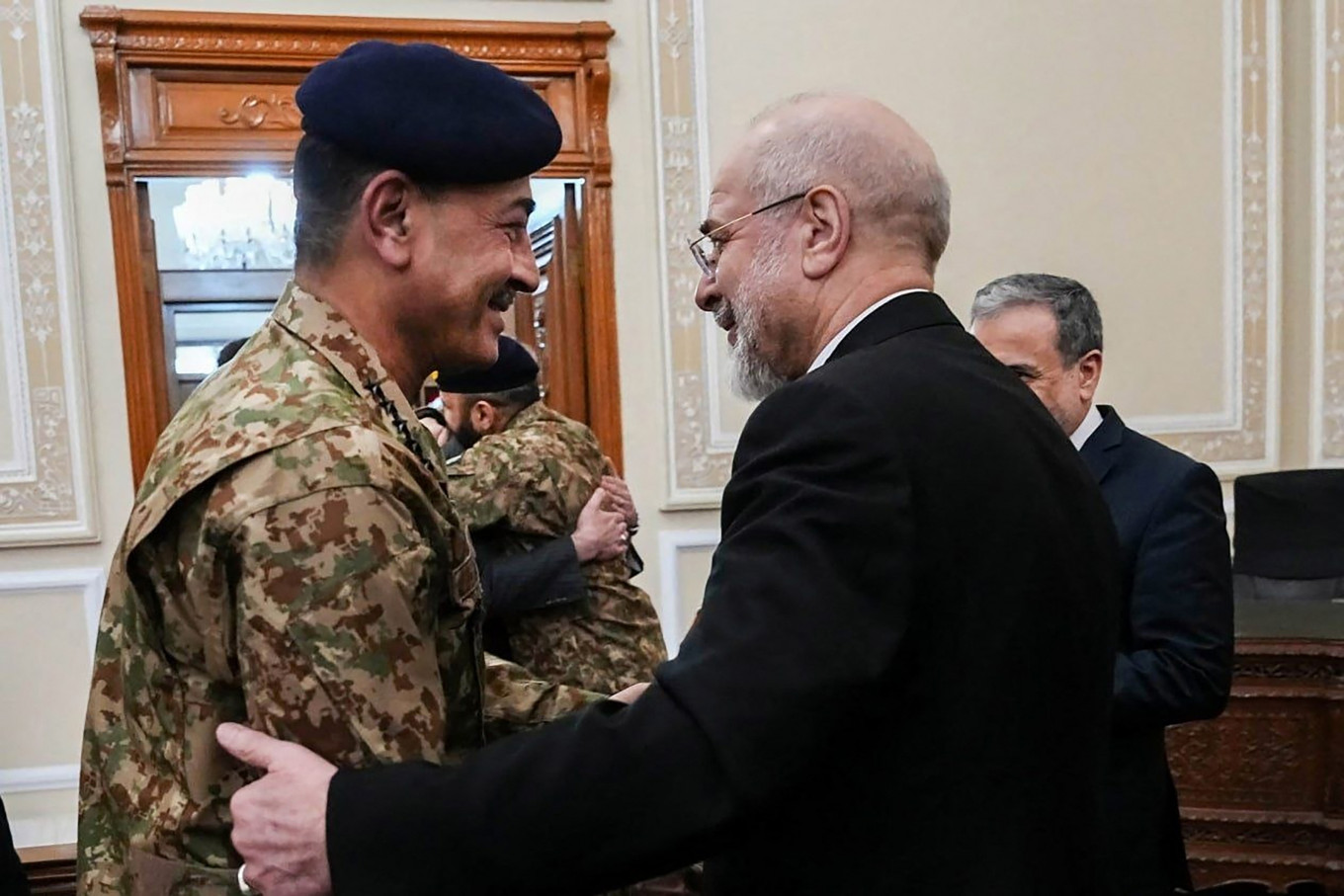 This handout photo taken and provided by the Office of Iranian Parliament Speaker on April 16, 2026, shows Iranian Parliament speaker Mohammad Bagher Ghalibaf (right) welcoming Pakistan's Army Chief Asim Munir before their meeting in Tehran. (AFP/Office of Iranian Parliament Speaker )
T
he strategic Strait of Hormuz was again closed on Sunday in the stand-off between Iran and the United States, with Iran's powerful parliament speaker signaling a final peace deal remained "far" off despite some movement in negotiations.
As mediation efforts continued following high-level talks in Pakistan that failed to reach a deal, Iran said it will not allow the crucial maritime trade chokepoint to re-open until the United States ends a blockade of Iranian ports.
Mohammad Bagher Ghalibaf, speaker of the Iranian parliament, said in a televised address on Saturday night that there had been "progress" with Washington "but there are many gaps and some fundamental points remain".
"We are still far from the final discussion," said Ghalibaf, one of Tehran's negotiators in the talks aimed at ending the war launched by Israel and the United States against the Islamic republic.
A two-week ceasefire is set to end on Wednesday unless it is renewed.
US President Donald Trump said "very good conversations" were going on with Iran but warned Tehran against trying to "blackmail" the United States.

On Friday, Tehran had declared the Strait of Hormuz, through which a fifth of the world's oil and liquefied natural gas usually transits, open after a temporary ceasefire was agreed to halt Israel's war with Iran's ally Hezbollah in Lebanon.
That prompted elation in global markets and sent oil prices plunging, but Tehran reversed course after Trump insisted the US blockade of Iranian ports would continue until a final deal was struck.
"If America does not lift the blockade, traffic in the Strait of Hormuz will definitely be limited," Ghalibaf said.
Iran's supreme leader Mojtaba Khamenei, who has yet to be seen since taking power after his father was killed in the war's opening strikes, said in a written message that Iran's navy "stands ready" to defeat the United States.
Trump accused Iran of getting "a little cute" with its recent moves and warned Tehran not to try to "blackmail" Washington by flip-flopping on the strait.
"We have very good conversations going on," the president told reporters at the White House, adding that the United States was "taking a tough stand".
'Targeted'
Iran's Revolutionary Guards warned that any attempt to pass through the strait without permission "will be considered cooperation with the enemy, and the offending vessel will be targeted".
A handful of oil and gas tankers crossed the strait early on Saturday during the brief reopening, tracking data showed, but others retreated and hardly any vessels were crossing the waterway by the late afternoon.
A UK maritime security agency said the Revolutionary Guards fired at one tanker, while security intelligence firm Vanguard Tech reported the force had threatened to "destroy" an empty cruise ship that was fleeing the Gulf.
In a third incident, the UK agency said it received a report of a vessel "being hit by an unknown projectile, which caused damage" to shipping containers but no fire.
The Indian foreign ministry said it had summoned the Iranian ambassador to lodge a protest over a "shooting incident" involving two Indian-flagged ships in the strait.
French UN peacekeeper killed
On the diplomatic front, Egypt, which has been involved in mediation efforts with Pakistan, appeared optimistic on Saturday with Foreign Minister Badr Abdelatty saying Cairo and Islamabad hoped to secure a final agreement "in the coming days".
A major sticking point has been Iran's stockpile of near-weapons-grade enriched uranium.
Trump said Friday that Iran had agreed to hand over its roughly 440 kilograms of enriched uranium. "We're going to get it by going in with Iran, with lots of excavators," he said.
Iran's foreign ministry has said the stockpile, thought to be buried deep under rubble from US bombing in last June's 12-day war, was "not going to be transferred anywhere" and surrendering it "to the US has never been raised in negotiations".
The Middle East war began on February 28 with a massive wave of US-Israeli attacks on Iran, despite Washington and Tehran being engaged in negotiations at the time.
The conflict rapidly spread across the region, with Iran targeting neighbouring Gulf countries that are home to US military bases, and Iran-backed Hezbollah dragging Lebanon into the war by launching rockets at Israel.
A French soldier was killed and three others wounded in an ambush on Saturday on UN peacekeepers in Lebanon that France's president blamed on Hezbollah, an accusation the group denied.
Israel's military reported that two of its soldiers had also been killed in combat in southern Lebanon since the start of a 10-day truce on Friday between Israel and Lebanon.