The Jakarta Post
Please Update your browser
Your browser is out of date, and may not be compatible with our website. A list of the most popular web browsers can be found below.
Just click on the icons to get to the download page.


Popular Reads
Top Results
No results found. Please check your search term and try again
Can't find what you're looking for?
View all search results
Popular Reads
Top Results
No results found. Please check your search term and try again
Can't find what you're looking for?
View all search resultsPrabowo's populist policies propel a 'doom-loop' in Indonesian markets
A battering from the global energy shock and a number of unorthodox decisions - from centralizing commodity exports under a sprawling sovereign fund that reports directly to Prabowo, to new jobs and growth mandates for the central bank - have rocked investor confidence.
Change text size
Gift Premium Articles
to Anyone
Share the best of The Jakarta Post with friends, family, or colleagues. As a subscriber, you can gift 3 to 5 articles each month that anyone can read—no subscription needed!
 President Prabowo Subianto inspects the implementation of the free nutritious meals program at State Junior High School (SMPN) 111 Jakarta on June 2, 2026. (Courtesy of/The Palace's Press Bureau (BPMI))
President Prabowo Subianto is losing the trust of investors and his growth agenda risks being undone by a plunging currency.
The special forces commander-turned-politician has run a chaotic administration since taking office in 2024, promising free meals for millions of school children and undoing decades of spending discipline to chase growth.
But a battering from the global energy shock and a number of unorthodox decisions - from centralizing commodity exports under a sprawling sovereign fund that reports directly to Prabowo, to new jobs and growth mandates for the central bank - have rocked investor confidence.
Those moves have taken the sheen off what was, just a couple of years ago, an emerging market poster child; today, credit default swaps imply Southeast Asia's largest economy will lose its investment-grade credit rating.
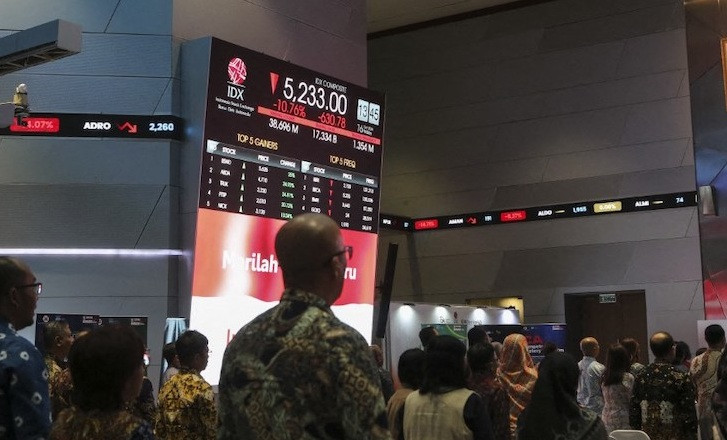
The country's stock market is the world's weakest performer in 2026, down more than 42%. The rupiah is one of the hardest-hit currencies, too, and has become both a symptom and a source of trouble, as its fall starts to drive even more selling.
It is down 8% this year, and 7% since the Iran war erupted. It now sits at 18,190 per US dollar, a record low, and in the past three weeks it gathered alarming momentum to make its steepest drop since 2020.

"Indonesia is suffering from a genuine confidence crisis, with serious governance red flags that overshadow any valuation argument," said Tan Altundag, investment manager for emerging equities at Pictet Asset Management, which has aggressively cut its exposure to Indonesian stocks.
"The rupiah at 18,000/USD is not just eroding real returns for foreign investors ... the currency slide risks becoming a self-reinforcing loop, pushing up inflation ... tightening financial conditions, and ultimately weighing on growth."
It is down even after a hefty 50-basis-point rate hike in May and a $12 billion drop this year in Indonesia's foreign exchange reserves, which the central bank uses to defend the currency. And now the effects are spilling over.
The foreign selling of stocks, a net $3.2 billion outflow to the end of May, is the heaviest since 2009 and data shows foreign ownership of government bonds, which stood at nearly 40% before the COVID-19 pandemic, has collapsed to a near 20-year low at just 12.6%.
"It's true, there is a doom-loop forming," said John Woods, Asia chief investment officer at Lombard Odier, a private bank.
"Persistent outflows, with foreign holdings in bonds and stocks at multi-year lows, would continue to pressure the rupiah, liquidity, and asset prices - prolonged outflows could slow infrastructure and growth plans."
Rating risks
Indonesia's credit and equity ratings are also on the line. Downgrades would turn investors into forced sellers and, in the case of credit, borrowing costs would be driven up.
Index provider MSCI is reviewing trading and transparency issues in equities and warned that a cut to frontier status is possible, though investors regard it as unlikely.
Moody's and Fitch have cut their debt rating outlooks to negative, citing reduced policymaking credibility, and S&P has said its rating will depend on efforts to improve fiscal buffers.
What is worrying markets most is that the energy shock caused by the US-Israeli war on Iran has been piling pressure on the economy - and, thanks to fuel subsidies, on the budget - but Prabowo has only doubled down on his expensive agenda.
Last week Indonesia passed sweeping laws, which have not been made public in full, that provide parliament with new powers to direct the central bank and add "real sector growth" to its mandate, which is viewed by analysts as a threat to its independence.
Prabowo nominated his nephew as a deputy governor of the central bank earlier this year.
Last month, he said the state would take over commodity exports under Danantara, a sovereign wealth fund that he established.
"The underlying concern is that the direction of policy is not great and is becoming less transparent," said Kieran Curtis, head of emerging markets local debt at Aberdeen in London.
"It is too early to say there has been damage from that policy, but it is not as efficient as exports finding their own market."
Negative spiral
Pressure has also come externally, from the Iran war's effect on energy and markets, especially credit default swaps, which can tend to exaggerate downgrade risks. But investors say it will take a major policy shift to prompt a reversal.
"Yes, it is possible for countries to pull themselves out of a negative spiral where they have put themselves in that position to begin with," said Mark Ledger-Evans, Asia-focused emerging markets fixed income portfolio manager at Ninety One, an investment management firm.
"In Indonesia's case, we believe it stems largely from the idea of pursuing growth rates which are not feasible, which then filters down into execution, and hence it's not so easy to pull out of the negative spiral without a re-think of the ideas."
The Chinese companies that helped build Indonesia's nickel industry into the world's dominant producer are already looking elsewhere for alternatives in response to policy pressures and investors - if they return - will want better prices.
"Indonesia is no longer being priced as a reliably orthodox emerging market," said Hemant Mishr, chief investment officer at fund manager S CUBE Capital, "but as one carrying rising policy risk."