The Jakarta Post
Please Update your browser
Your browser is out of date, and may not be compatible with our website. A list of the most popular web browsers can be found below.
Just click on the icons to get to the download page.


Popular Reads
Top Results
No results found. Please check your search term and try again
Can't find what you're looking for?
View all search results
Popular Reads
Top Results
No results found. Please check your search term and try again
Can't find what you're looking for?
View all search resultsIndonesia weighs $2 billion cut to Prabowo's signature free meals program
The government is preparing to scale back President Prabowo Subianto's flagship free meals program, with officials weighing another budget cut of more than $2 billion along with reductions in kitchens and beneficiaries, according to two sources familiar with the matter and an internal presentation.
Change text size
Gift Premium Articles
to Anyone
Share the best of The Jakarta Post with friends, family, or colleagues. As a subscriber, you can gift 3 to 5 articles each month that anyone can read—no subscription needed!
 Set as preferred source
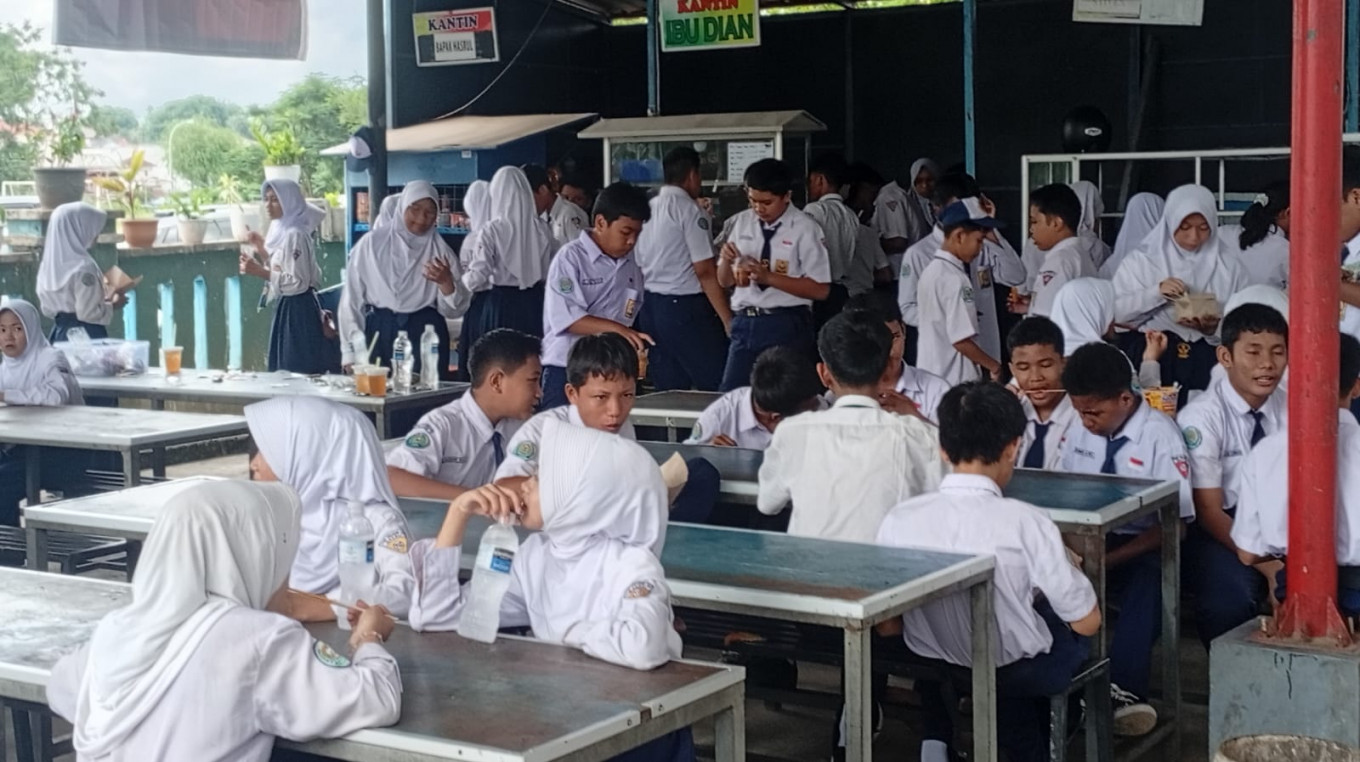 Students from SMPN 12 Batam public junior high school in Batam city, Riau Islands, enjoy their snacks at the school's canteen on Monday, June 8, 2026. (JP/Fadli)
I
ndonesia is preparing to scale back President Prabowo Subianto's flagship free meals program, with officials weighing another budget cut of more than US$2 billion along with reductions in kitchens and beneficiaries, according to two sources familiar with the matter and an internal presentation.
The planned move marks one of the clearest indications yet of mounting fiscal and governance pressures on Prabowo's most important and expensive campaign pledge, which has been central to concerns about Indonesia’s fiscal discipline.
Two sources familiar with the plans told Reuters the National Nutrition Agency (BGN), which runs the program, is targeting a reduction of at least 15 percent from its 268 trillion rupiah (US$16 billion) budget this year – equivalent to about 40 trillion rupiah – after identifying inefficiencies.
One of them said the cut could be 50 trillion rupiah.
The two sources said the exact reduction was not known. But a third source said an internal review could cut recipients to 49 million from 62.5 million, though the assessment is ongoing and subject to change.
The sources spoke on condition of anonymity as the matter was still private.

The Ministry of Finance is "awaiting a budget sharpening plan" from the NNA and will coordinate on any roll-out, a spokesperson told Reuters in a written reply on Thursday.
The BGN and the President's office did not immediately respond to Reuters' requests for comment.
The details of the rollback plan, including the cut in recipients and internal discussions, have not been reported before.
Recipients will be cut by tightening the social and economic criteria, according to a presentation meant for parliament seen by Reuters.
The agency will temporarily halt the addition of over 13,000 new kitchens to the rapidly expanding program, which started only in January 2025 and became one of the biggest such programs in the world, the presentation showed.
The rollback plan has been discussed with a parliamentary commission and a final decision is expected to be agreed in the next few weeks, the sources said.
'Total redesign'
"This program requires a total redesign, involving less-centralised system," one of the sources said, adding that the government should consider building school-based kitchens just like other countries such as Japan or China to reduce spending, rather than building new ones.
Investor and global ratings agency concerns over governance issues, financial mismanagement and the strain on Indonesia's budget have already weighed on sentiment around the program.
Prabowo and his ministers have previously brushed aside the concerns and pledged to press on with the initiative, which was launched in 2025 with great fanfare and rapid expansion. It initially had 335 trillion rupiah allocated to it in 2026, and set a target of 83 million recipients – a figure Prabowo stressed in a number of speeches.
The allocation was reduced to 268 trillion rupiah in May as the government sought more fiscal room in the aftermath of the Iran war. The new planned cut would reduce it further.
The presentation indicated the 83 million recipient target would not be enforced this year.
The rollback comes days after the former head of the nutrition agency was fired by Prabowo and later arrested on charges of mismanagement and alleged corruption.
"It’s not just because our fiscal is limited but due to the case [arrest], the agency has identified a great deal of unnecessary spending," the second source said.
"Budget cuts are necessary so the government could see objectively which spendings are actually essential," the second source added.
'Efficiencies, not cuts'
The third source said the changes should be seen as "savings" and "efficiencies" rather than outright budget cuts.
Of the more than 27,000 kitchens currently operating under government contracts, only around 21,000 are actually needed, the source said.
The agency previously announced some efficiency measures, which include a moratorium on new kitchens, refocusing of free meals' recipients, and halting distribution during school breaks.
But analysts said the government is trying to soften public perception and political impact on Prabowo by avoiding language that signals retrenchment.
In order to manage public perception, the government has avoided words with negative connotations such as "budget cut" and instead used words such as "budget efficiency," "refocusing" or "budget sharpening," said Yanuar Nugroho, a visiting senior fellow at Yusof Ishak Institute, a Singapore-based think tank.
"From a fiscal perspective, scaling back is indeed a rational move [...] politically, however, the impact could be multi-layered for Prabowo," Yanuar said, adding it could impact grassroots voters.
Arya Fernandes, a political analyst at the Centre for Strategic and International Studies, agreed and said the use of the word "cuts" could trigger concerns about fiscal pressure and the program's continuity.
The President's office did not immediately reply to a request for comment on the possible political fallout.