The Jakarta Post
Please Update your browser
Your browser is out of date, and may not be compatible with our website. A list of the most popular web browsers can be found below.
Just click on the icons to get to the download page.


Popular Reads
Top Results
No results found. Please check your search term and try again
Can't find what you're looking for?
View all search results
Popular Reads
Top Results
No results found. Please check your search term and try again
Can't find what you're looking for?
View all search resultsOutgoing IMF chief economist sees risks, shifting trade ties and continued uncertainty
Change text size
Gift Premium Articles
to Anyone
Share the best of The Jakarta Post with friends, family, or colleagues. As a subscriber, you can gift 3 to 5 articles each month that anyone can read—no subscription needed!
 Set as preferred source
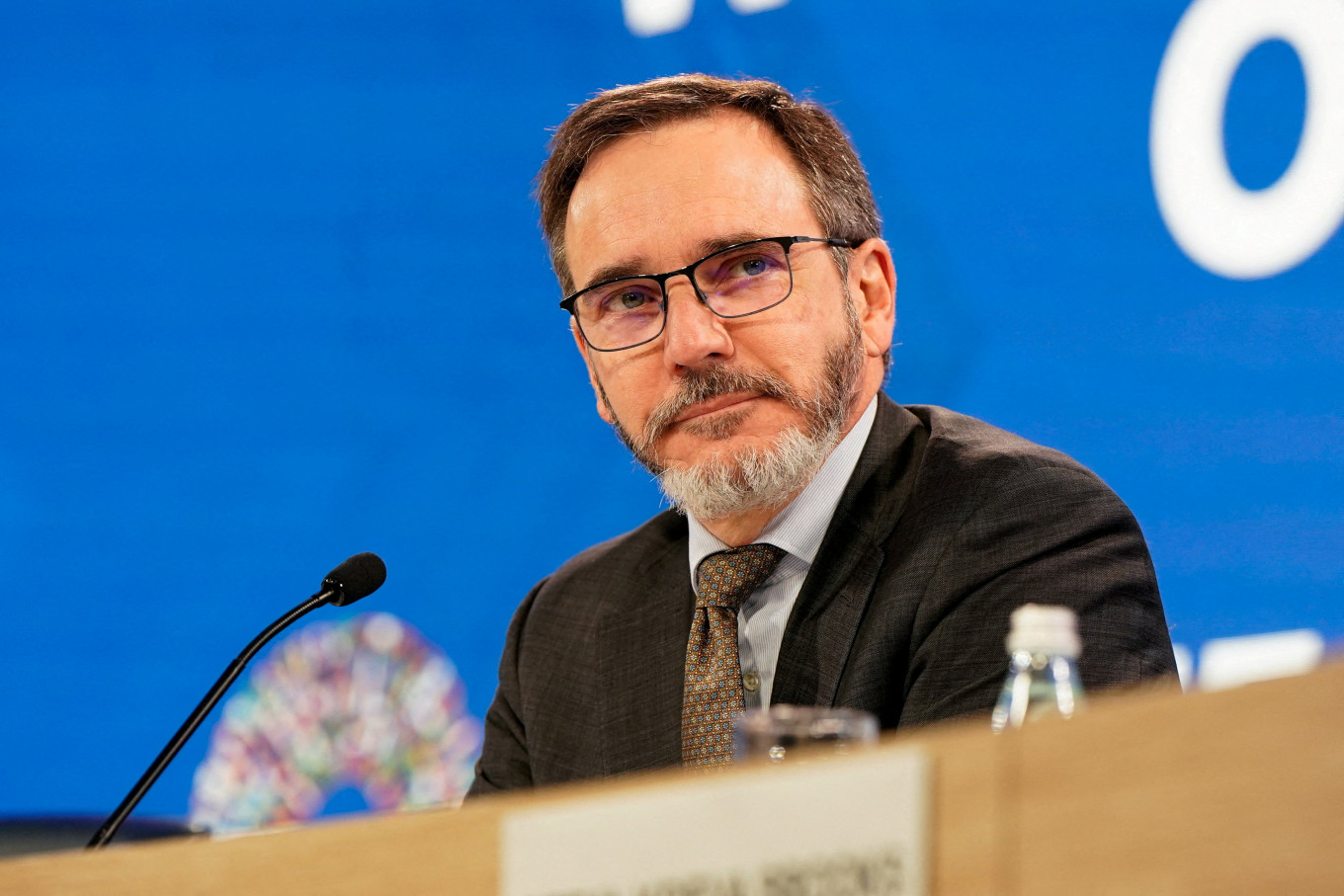 International Monetary Fund chief economist Pierre-Olivier Gourinchas attends the “World Economic Outlook” press briefing at the IMF/World Bank 2025 Annual Meetings in Washington, DC, on Oct. 14, 2025. (Reuters/Elizabeth Frantz)
S
trategic petroleum releases helped avert a sharper rise in oil prices as a result of the war in the Middle East, but the global economy faces significant downside risks if a fragile ceasefire between the US and Iran doesn't hold, IMF chief economist Pierre-Olivier Gourinchas said on Friday.
Those reserves were now fairly depleted, which meant countries would have less room for maneuver if the conflict flared again, Gourinchas told Reuters in an interview before he leaves the International Monetary Fund to return to the University of California, Berkeley next week.
Gourinchas, who has long warned that growing geopolitical tensions could lead to a more fractured global economy, gave no details about a fresh forecast to be released by the IMF on July 8, after he returns to academia.
But he suggested the global lender could return to offering a baseline forecast – instead of the three scenarios that it released in April. It was the second time during his tenure that the Fund chose to skip a baseline forecast, the first being in April 2025 after US President Donald Trump upended global trade with tariffs against imports from most countries in the world.
IMF spokeswoman Julie Kozack on Thursday left open whether the IMF would continue with the three growth scenarios or revert to a more traditional baseline forecast.
Last month, with the Strait of Hormuz still closed and benchmark oil prices above US$100 per barrel, she had said the global economy was moving from the more benign "reference forecast," which assumed a quick end to the conflict and growth of 3.1 percent in 2026, to an "adverse scenario" with 2.5 percent growth.

In both 2025 and 2026, there was little historical precedent on which to base a credible baseline forecast, Gourinchas said, which meant economists had to "be humble" and step back from baseline forecasts, opting instead for a range of outcomes mapped out in scenarios. But such cases should be rare.
"We don't want to do it too often," he said, although he conceded that uncertainty – and risks – remained high.
Gourinchas said quick releases of strategic reserves and changes in production by refiners had helped avert even steeper increases in oil prices, with just 3 percent of the global oil removed from the market instead of the 10-15 percent initially predicted.
But risks would rise and countries would have less oil in reserve to cushion further cuts in supply if the ceasefire fell apart and hostilities resumed.
Trump on Friday blamed Iran for an attack on a ship near Oman which he said had violated their ceasefire, highlighting the fragility of a preliminary deal to end the Iran war.
Shifting trade ties, deals without the US
Gourinchas said global trade flows and relationships were clearly shifting in the wake of Trump's tariffs, noting the European Union's completion of trade agreements with Latin America and India after decades of negotiations.
"All of a sudden, in less than one year, they're both signed. This is not a coincidence. You can't afford not to deepen trade relations with other countries out there," he said, noting that many of these emerging trade agreements did not include the United States.
At the same time, tariffs and other economic sanctions generally had only limited utility, he said, without specifically mentioning Trump's accelerated use of tariffs to address a wide range of policy disputes.
"There is a view that having these kinds of choke points or this critical leverage is really important, but I think what we are seeing is how quickly the global economy tries to find ways around them," he said.
"You do have leverage in the short term, and then actors on the other side respond. They are not passive, they find ways to either circumvent, accelerate their own innovation, develop new trade ties with other partners, and basically those tools become blocked," he said. "In the medium- to long-term, they almost never work."