TheJakartaPost
Please Update your browser
Your browser is out of date, and may not be compatible with our website. A list of the most popular web browsers can be found below.
Just click on the icons to get to the download page.


Popular Reads
Top Results
No results found. Please check your search term and try again
Can't find what you're looking for?
View all search results
Popular Reads
Top Results
No results found. Please check your search term and try again
Can't find what you're looking for?
View all search resultsPearson aims to help graduates learn and earn in the age of AI
A new study by Pearson, conducted in partnership with Amazon Web Services, Inc. (AWS), finds that more than half of employers worldwide are unable to find graduates with the AI skills they need.
Change text size
Gift Premium Articles
to Anyone
Share the best of The Jakarta Post with friends, family, or colleagues. As a subscriber, you can gift 3 to 5 articles each month that anyone can read—no subscription needed!
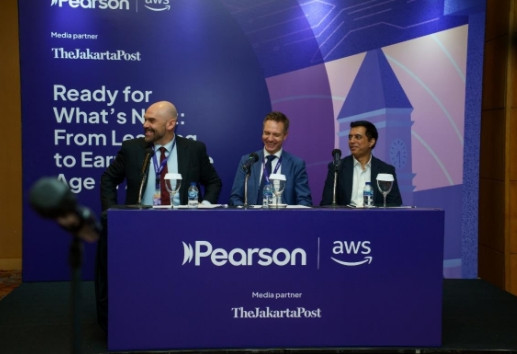 Pearson’s Asia-Pacific executives attend a private media interview on July 4, 2026, at the JW Marriott hotel in Mega Kuningan, South Jakarta (from left): enterprise and learning skills leader Craig McFarlane, head of institutional language learning David Lyons and head of higher education Eklavya Bhave.
I
ndonesia’s unemployment rate fell to 4.68 percent in February 2026, down 0.08 percentage points from a year earlier, according to official data from Statistics Indonesia (BPS). While the decline suggests steady progress in the labor market, a deeper challenge is emerging beneath the headline numbers: Many graduates are still struggling to find jobs because they lack the skills employers increasingly expect in the artificial intelligence era.
A new study by Pearson (FTSE: PSON.L), the world’s lifelong learning company, conducted in partnership with Amazon Web Services, Inc. (AWS), a subsidiary of Amazon.com, Inc. (NASDAQ: AMZN), finds that more than half of employers worldwide are unable to find graduates with the AI skills they need.
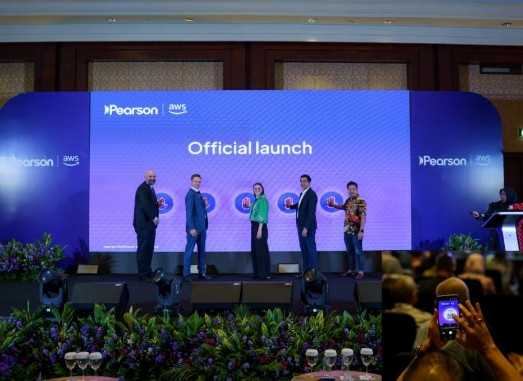
The findings were published in the report AI Readiness: Building the Bridge from Higher Education to Work, which surveyed more than 2,700 students, educators and employers across six countries. The report was launched on July 4 during the Pearson Higher Education Forum themed “Ready for What’s Next: From Learning to Earning in the Age of AI”, held at the JW Mariott Hotel Jakarta.
A growing disconnect
The report highlights a widening gap between what universities believe they are delivering and what employers say they need.

Nationwide graduate unemployment reached 6.23 percent in early 2025, while research by the University of Indonesia estimated that tens of thousands of graduates had stopped looking for work altogether.
At the same time, universities have been racing to incorporate AI into their teaching. According to Pearson's research, nearly four out of five university leaders believe their institutions are meeting employers' expectations for AI-related skills.
Employers, however, tell a different story.
Pearson found that only 24 percent of higher education institutions were keeping pace with rapid technological change. As a result, employers continue to report difficulty finding graduates who are genuinely prepared to work alongside AI.
“I think where the gap is, is the understanding of what AI is," said Eklavya Bhave, Pearson's Head of Higher Education for Asia Pacific.
"University academics may feel that because AI is included in the curriculum and students have access to AI tools, graduates are AI-ready. But employers don't really care about the curriculum. They care about the outcome," he said.
"What they want to know is whether graduates can solve real-world problems after they leave university."
According to Bhave, the disconnect stems largely from different definitions of AI readiness.
Beyond technical skills
Degrees remain valuable, but employers are placing greater emphasis on demonstrable capabilities, adaptability and practical experience.
"For graduates, understanding technology is important, but adaptability is equally important," MacFarlane said.
"Learning how to learn is becoming one of the most valuable skills because technology is evolving so, rapidly."
He encouraged graduates to continually develop new capabilities rather than relying solely on their university qualifications.
"If I were graduating today, I'd be asking myself: How can I keep upskilling? How can I understand what future employers need? How do I differentiate myself from everyone else graduating alongside me?"
The report argues that AI readiness extends far beyond knowing how to use generative AI tools.
Instead, it defines AI readiness as the ability to work effectively alongside intelligent systems by combining technical knowledge with strategic thinking, ethical decision-making and essential human skills such as communication, collaboration, judgment and adaptability.
"AI readiness is not just about pushing buttons," MacFarlane said. "It's about knowing how to use AI effectively within your work and your role. That's real AI readiness.”
Even as artificial intelligence automates many entry-level tasks, employers continue to value distinctly human capabilities.
“The critical thinking needed to evaluate the outputs from large language models and turn them into something more valuable, that's where people create value. That’s what employees are looking for," said MacFarlane.
David Lyons, Pearson's Head of Institutional Language Learning for Asia Pacific, added that human capabilities would become even more valuable as AI adoption accelerates.
"The human skills will really come to the fore," he said.
"We often talk about the half-life of skills. Some reports suggest it's now around two and a half years. That means skills become outdated very quickly, so continuously building new skills on top of strong foundational knowledge is becoming essential," Lyons explained.
Six barriers to jobs
Pearson's report identifies six friction points that repeatedly undermine the transition from higher education into employment.
The first is pace: Technology is evolving far faster than university curricula and institutional decision-making, creating an ever-widening gap between classroom learning and workplace requirements.
The second is connection:
Employers and universities often operate independently, with limited collaboration in designing learning experiences or assessing workplace needs.
According to Bhave, this represents one of Indonesia's biggest challenges.
"There is no clear feedback loop," he said. "What is really needed is authentic learning and authentic assessment. That only comes through strong relationships between higher education institutions and employers.”
The third friction point is capability: Universities cannot teach skills that their own faculty have not yet mastered. The report argues that faculty preparedness, not access to AI tools, is the biggest barrier to improving AI education.
The fourth is governance: Many institutions still lack clear, practical policies that help educators and students use AI responsibly and effectively.
The fifth friction is experience: Simply giving students access to AI tools does not automatically produce AI competence.
Employers expect graduates who can apply AI in real workplace situations rather than simply understand it in theory.
Bhave believes this may be Indonesia's most pressing challenge.
Finally, sixth is skills misalignment: Employers increasingly seek graduates with applied judgement, adaptability, teamwork and problem-solving abilities, yet many graduates continue to demonstrate primarily academic knowledge rather than workplace competence.
Preparing for an AI future
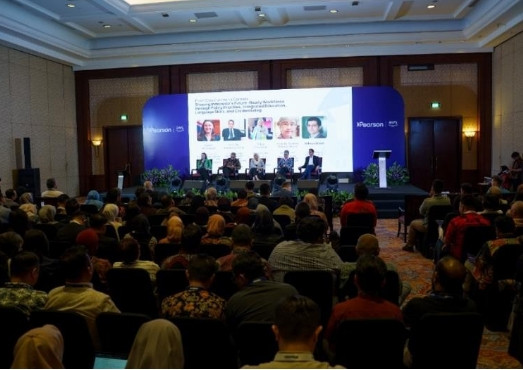
To explore possible solutions, Pearson's Jakarta forum brought together educators, employers and policymakers in a panel discussion titled From Classroom to Careers: Shaping Indonesia's Future-Ready Workforce, alongside workshops focused on K-12 education, higher education and employer partnerships.
The forum’s featured speakers emphasized that AI should not be viewed simply as another digital tool but as an opportunity to fundamentally improve learning itself.
"I think, most importantly, that AI enables us to personalize learning," Lyons said.
"We can provide much more personalized learning experiences and real-time feedback to learners. That creates a virtuous cycle where students continue improving based on immediate feedback."
For Pearson, the future of higher education lays not in producing graduates who merely know how AI works, but in producing graduates who know how to think with AI.
As AI continues to reshape the workplace, technical knowledge alone will no longer guarantee employability. Employers are increasingly looking for graduates who combine digital fluency with critical thinking, adaptability, sound judgement and a commitment to lifelong learning.
Closing that gap, Pearson believes, requires closer collaboration between universities and employers, stronger support for educators and a shared understanding of what AI readiness truly means in the modern workforce.
The full AI-readiness report by Pearson x AWS is available on the Pearson website.
This article is produced by JP Creative team in collaboration with Pearson Education