The Jakarta Post
Please Update your browser
Your browser is out of date, and may not be compatible with our website. A list of the most popular web browsers can be found below.
Just click on the icons to get to the download page.


Popular Reads
Top Results
No results found. Please check your search term and try again
Can't find what you're looking for?
View all search results
Popular Reads
Top Results
No results found. Please check your search term and try again
Can't find what you're looking for?
View all search resultsImports hold back US economic growth in Q2, but domestic demand robust
Business spending on equipment increased at a 15.2 percent pace, notching a second straight quarter of double-digit growth.
Change text size
Gift Premium Articles
to Anyone
Share the best of The Jakarta Post with friends, family, or colleagues. As a subscriber, you can gift 3 to 5 articles each month that anyone can read—no subscription needed!
 Set as preferred source
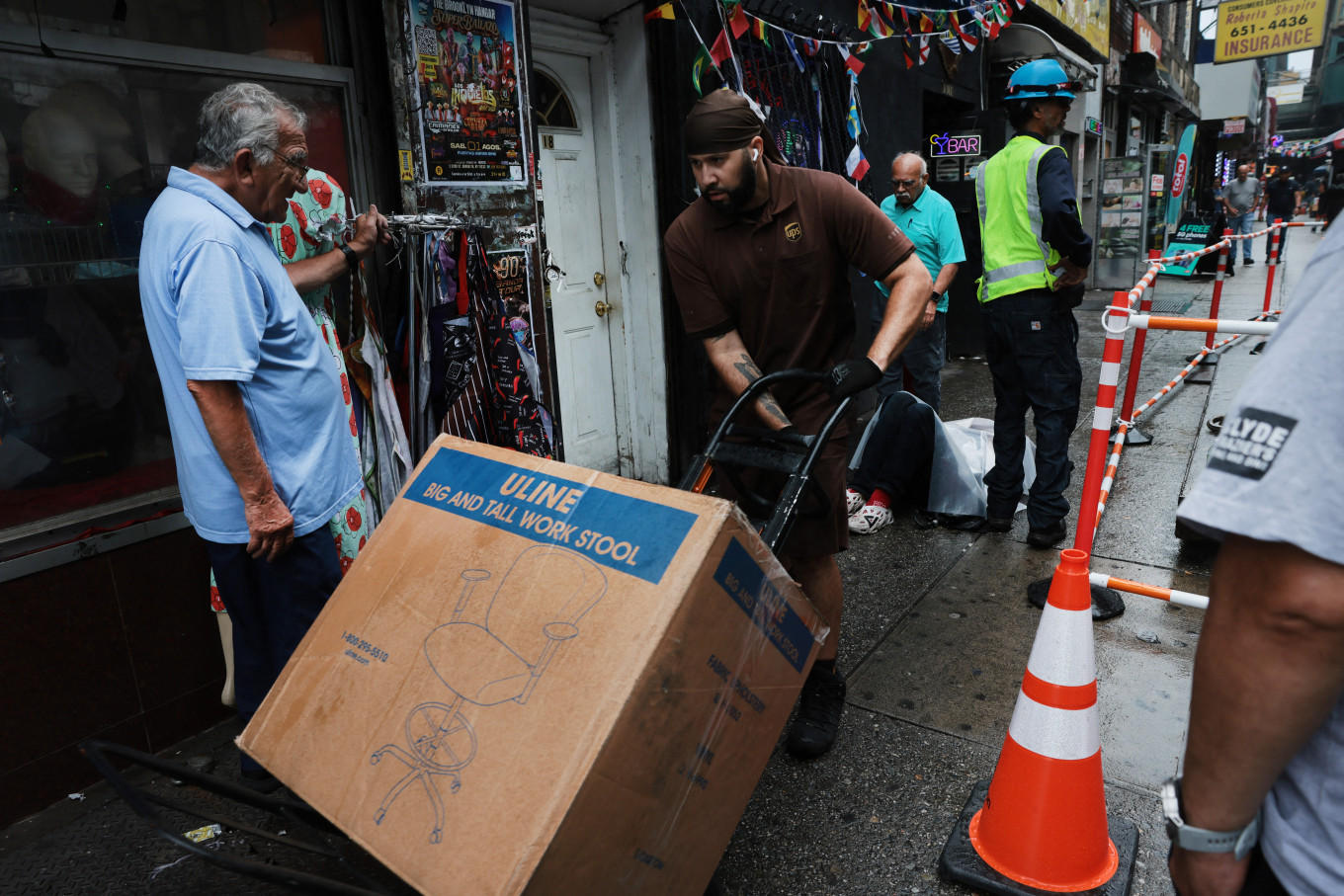 People walk through a shopping district on July 30, 2026 in the Quensborough of New York City. The Commerce Department reported on Thursday that the US economy expanded only at a 1.5 percent pace from April through June, as inflation from the war with Iran continues to weigh on the economy. (AFP/Getty Images/Spencer Platt)
U
S economic growth slowed in the second quarter as imports widened the trade deficit, but robust consumer spending and business investment related to the buildout of artificial intelligence infrastructure underscored strong domestic demand.
The moderation reported by the Commerce Department in its snapshot of gross domestic product on Thursday also reflected continued inventory drawdown to meet the strong demand as well as the reduction of the Strategic Petroleum Reserve, which weighed on federal government expenditures.
The report suggested the economy weathered the initial oil price shock from the Middle East conflict, though renewed hostilities between the United States and Iran posed a downside risk to growth in the second half of the year.
Generous tax refunds this year from President Donald Trump's "One Big Beautiful Bill," which helped to fuel consumer spending last quarter, are behind, leaving households without much of a cushion as average gasoline prices rise back above US$4 a gallon.
Income growth has cooled in tandem with a stable labor market, increasing moderately in June, and the saving rate is at a four-year low of 2.7 percent, adding to the economy's growing vulnerabilities, economists said. Consumers have been dipping into savings and saving less to maintain spending.
"Underlying growth was solid, but is unlikely to be sustained," said Oliver Allen, senior US economist at Pantheon Macroeconomics. "The boost from tax refunds is fading fast, underlying income growth is very weak, higher gas prices still are putting pressure on spending elsewhere, and the personal saving rate is well below its long-run average."

Gross domestic product increased at a 1.5 percent annualized rate last quarter, the Commerce Department's Bureau of Economic Analysis said in its advance estimate of second-quarter GDP.
Economists polled by Reuters had forecast GDP rising at a 2.1 percent pace. But the survey was conducted before the release of June's advance economic indicators report on Tuesday, which prompted some economists to cut their GDP estimates by as much as 0.8 percentage point to as low as a 1.5 percent pace.
The economy grew at a 2.1 percent pace in the first quarter.
Consumer spending, which accounts for more than two-thirds of US economic activity, surged at a 3.2 percent rate after abruptly slowing to a 0.5 percent growth pace in the January-March quarter.
In addition to larger tax refunds, spending was boosted by higher-income households that are benefiting from strong growth in asset prices. The recently ended FIFA World Cup tournament also likely added to the strength as did midterm election-related spending by nonprofits.
The AI investment boom, which is showing no signs of slowing despite investor concerns that valuations of many technology companies have become stretched, also helped to boost underlying demand. Business spending on equipment increased at a 15.2 percent pace, notching a second straight quarter of double-digit growth.
AI buildout pulling in imports
But the AI buildout is heavily reliant on imports, contributing to a widening in the trade deficit. The trade shortfall sliced off 1.01 percentage points from GDP growth, the most since the first quarter of 2025. Imports, which posted a second straight quarter of double-digit growth, were also lifted by businesses front-loading orders in anticipation of higher prices from tariffs and the Iran war.
A large increase in imports is normally offset by a rise in inventories. But inventories continued to be depleted because of the strong demand, subtracting 0.67 percentage point from GDP growth last quarter. Government spending contracted at a 0.8 percent pace as federal outlays fell at a 4.1 percent rate.
"Demand exceeded supply in the second quarter," said Carl Weinberg, chief economist at High Frequency Economics. "The gap between what people and companies wanted to buy and the amount of goods and services the economy could produce with the available supply of labor was filled by companies drawing down inventories and importing goods from abroad, despite tariffs."
Final sales to private domestic purchasers, which exclude trade, inventories and government spending, increased at a 3.9 percent pace. That was the fastest increase in this measure of domestic demand since the first quarter of 2023 and followed a 1.7 percent pace of growth in the January-March quarter.
The US central bank on Wednesday left its benchmark overnight interest rate in a 3.50-3.75 percent range. Three members of the US central bank's policy-setting committee dissented. They "preferred" a quarter-percentage-point hike.
Some economists expected the Fed to raise borrowing costs in September to quell inflation. The price index for gross domestic purchases, a key measure of inflation in the US economy, increased at a 5.7 percent pace last quarter.
That was the fastest in four years and followed a 3.6 percent rate of increase in the first quarter. The Personal Consumption Expenditures price index rose at a 5.1 percent rate. Excluding food and energy, the so-called core PCE inflation increased at a 3.4 percent pace. These PCE measures are tracked by the Fed for its 2 percent inflation target.
PCE inflation eased in June, increasing 3.7 percent on a year-on-year basis after surging 4.1 percent in May, a separate report from the BEA showed, as a fragile truce between the US and Iran took hold. Core inflation advanced 3.3 percent last month after rising 3.4 percent in May. PCE inflation has been running above target for the past five years.
"Chairman Warsh seemed to be trying to say yesterday that there is a significant degree of ambiguity regarding the true state of inflation, but the numbers at face value seem to be pretty straightforward," said Stephen Stanley, chief US economist at Santander US Capital Markets. "Unless the softer June result proves to be the start of a sharp break in the trend, it is hard to see how Chairman Warsh and the FOMC are going to be able to put off rate hikes for much longer."