The Jakarta Post
Please Update your browser
Your browser is out of date, and may not be compatible with our website. A list of the most popular web browsers can be found below.
Just click on the icons to get to the download page.


Popular Reads
Top Results
No results found. Please check your search term and try again
Can't find what you're looking for?
View all search results
Popular Reads
Top Results
No results found. Please check your search term and try again
Can't find what you're looking for?
View all search resultsThe missing middle: A path for Indonesia's tobacco value chain
Despite an annual tobacco production shortfall of just 75,000 to 100,000 tonnes, Indonesia imports more than twice that volume from abroad.
Change text size
Gift Premium Articles
to Anyone
Share the best of The Jakarta Post with friends, family, or colleagues. As a subscriber, you can gift 3 to 5 articles each month that anyone can read—no subscription needed!
 Set as preferred source
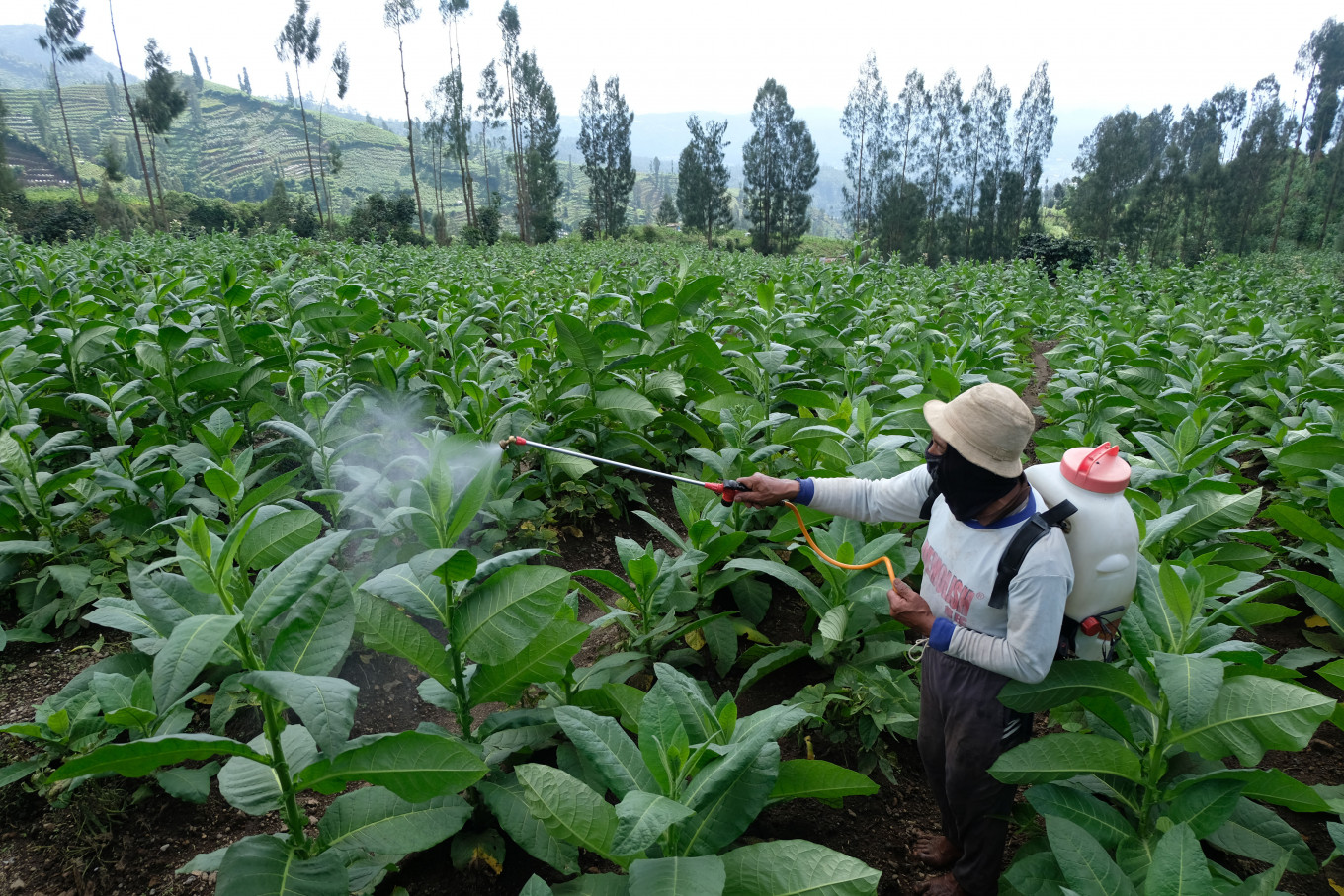 A farmer sprays fertilizer on tobacco plants at a field on the slope of Mount Sindoro
in Temanggung regency, Central Java, on July 3, 2024. (Antara/Anis Efizudin)
A farmer sprays fertilizer on tobacco plants at a field on the slope of Mount Sindoro
in Temanggung regency, Central Java, on July 3, 2024. (Antara/Anis Efizudin)
F
or the last 15 years, Indonesia's trade of unmanufactured tobacco under Harmonized System (HS) code 2401, has been running on deficit.
HS 2401 imports climbed from 129,140 tonnes in 2023 to a record 214,420 tonnes in 2025. Almost the entire share of total imported HS 2401 products over that period comprised HS 240120, partly or wholly stemmed or stripped tobacco leaf, at 77.6 percent. Unstemmed or unstripped leaf (HS 240110), which competes directly with what local farmers harvest, accounted for less than 3 percent of imports and has barely grown.
Domestic tobacco leaf production, on the other hand, was estimated at roughly 330,000 tonnes in 2025. Threshing retains roughly three-quarters of the original weight once the stem is stripped, leaving some 240,000 tonnes of lamina equivalent.
Meanwhile, the industry needs 315,000-340,000 tonnes of tobacco equivalent per year, leaving a production gap of roughly 75,000-100,000 tonnes. Yet 214,000 tonnes of threshed and cured tobacco still came in from abroad, more than double that shortfall.
To fill the gap, the industry imported dried lamina, dominated by flue-cured Virginia tobacco at 72 percent of total HS 240120, followed by other flue-cured tobacco (15.7 percent) as well as the Oriental (6.2 percent) and Burley (5.2 percent) varieties. This tracks usage, as Virginia and other flue-cured tobacco remain the staple blend for kretek (clove cigarettes), while Oriental and Burley tobaccos are typically used for American Blend cigarettes.
In principle, flue-cured tobacco is not a leaf type Indonesia cannot grow or process. Virginia tobacco is cultivated across the country, with West Nusa Tenggara, notably Lombok, the second-largest producing region at an estimated 91,440 tonnes in 2025. In practice, however, only a handful of companies in the country possess flue-curing capacity, meaning the constraint lays less in agriculture than in the industry's capacity to absorb and process what is already grown.

Before raw leaf can even reach the point where it might be threshed into lamina, it must be cured. To attract a premium price, especially from tobacco graders, lamina must meet specific standards. Nonetheless, expanding that standard means betting on an upstream supply that, for most farmers, is not reliable to begin with.
First, tobacco cultivation remains exposed to shifting weather: Wet conditions can cause tobacco to spoil prematurely and be more prone to viral and fungal diseases, compromising leaf quality before the curing stage.
Second, according to Agriculture Ministry data, 99.7 percent of all tobacco plantations are owned by smallholders, with the rest held by private and state-owned operators. Smallholder farmers are associated with limited capital and scale, constraining their ability to invest in the technology and consistent quality control needed to meet the characteristics that graders look for.
This also shows up in a 2022 study by Verona et al. on flue-cured tobacco in Lombok, which suggests that most farmers rely on wood-coal mixtures or wood alone to fuel the curing process, constrained by the rising cost and unreliability of alternatives like kerosene, coal or electricity, with less than 1 percent of farmers using cleaner options like liquefied petroleum gas (LPG).
As a result of this capacity gap, farmers usually only have two choices: selling their tobacco leaves in wet or cured form. Wet form provides certainty of sale, but the margin is very limited. Cured lamina offers a significant margin upside but exposes farmers to price risk, since the final grade is set only after they have already committed capital and labor to curing.
This risk is compounded by a market structure problem layered as asymmetric information, where grading standards are set unilaterally by buyers and most smallholders depend on middlemen for price information, unable to verify whether the price reflects true quality. Farmers are therefore left with little bargaining power, while purchasing power is concentrated among middlemen.
A 2026 study by Sahadewo et al. found that tobacco smallholders' input costs for cultivation are now nearly five times higher than what their counterparts spend to grow other crops. As imports remain high and local lamina goes unabsorbed, the price of domestic leaf falls and leaves farmers at risk, given the high sunk cost in production. The same study found that farmers often struggle to repay loans taken to finance these inputs, trapping them in a cycle of debt and dependency.
As the price remains uncompetitive, another plausible impact is that farmers may shift to other buyers who are willing to pay less than first-tier producers, including potentially unregulated producers, increasing the probability that unabsorbed leaf finds its way into the illegal cigarette trade instead.
Addressing this gap is less a technical question than a strategic one, depending on which future path the government chooses for the sector.
The first path is to strengthen Indonesia's position in the global tobacco value chain.
The government could ensure price discovery through auctions. Following India's model, third-party grading and visible bidding can minimize information asymmetry and give farmers price certainty. Following Brazil's model, it could also require industry to coinvest in upstream processing, such as curing warehouses, crop insurance and sustainable energy.
Done well, this may raise the scalability and competitiveness of Indonesia's tobacco globally, though it depends on sustained public investment and coordination that may be politically difficult to sustain.
The second path is to gradually reduce the country's reliance on tobacco as a livelihood by scaling down upstream cultivation and outsourcing the upstream to midstream process to external markets.
This should be done through a planned glide path, such as phased annual production quotas, anticipating any excess or shortage. The government could also assist farmers in redirecting cultivation toward alternatives such as nuts, chilies or corn, depending on regional land suitability.
This path carries its own risks, such as the industry's exposure to foreign exchange volatility and global supply chain disruption.
In conclusion, strengthening the value chain demands sustained investment and coordination, while scaling down dependency demands a costly transition for millions of smallholders.
Either way, policy in the tobacco industry is not an easy path to walk. Neither path is quick, but the primary processing capacity in the middle chain needs attention regardless of which one policymaker chooses.
*****
The writer is an industry and regional analyst at Bank Mandiri.