The Jakarta Post
Please Update your browser
Your browser is out of date, and may not be compatible with our website. A list of the most popular web browsers can be found below.
Just click on the icons to get to the download page.


Popular Reads
Top Results
No results found. Please check your search term and try again
Can't find what you're looking for?
View all search results
Popular Reads
Top Results
No results found. Please check your search term and try again
Can't find what you're looking for?
View all search resultsBetween the commodification of nature and biocultural violence
As Indonesia enters a new chapter in biodiversity financing, experts caution against repeating the errors of the carbon market.
Change text size
Gift Premium Articles
to Anyone
Share the best of The Jakarta Post with friends, family, or colleagues. As a subscriber, you can gift 3 to 5 articles each month that anyone can read—no subscription needed!
 Set as preferred source
 The Kasepuhan Pasir Eurih community in Sindanglaya village, Serang regency, Banten. Indonesia is home to thousands of indigenous communities who live closely with nature. (/ Image courtesy of Donny Iqbal)
I
ndonesia has seen an uptick in biodiversity financing, with the government encouraging the development of high-integrity biodiversity credits as an innovative funding instrument to fill the funding gap in conservation.
Earlier in January, Indonesia and the United Kingdom launched a deeper strategic partnership, with Climate, Energy and Nature as one of the main pillars. With support from the British government and the International Advisory Panel on Biodiversity Credits (IAPB), the Indonesian government has even formed a technical team, prepared a policy framework and developed a biodiversity credits pilot project.
At the same time, some experts have expressed skepticism about the scheme, pointing to problems that have arisen in the carbon market’s carbon credits, which works in a similar way.
Cindy Julianty, executive coordinator of Working Group ICCAs Indonesia (WGII), said biodiversity credits sounded promising on paper, as they were being promoted as a mechanism capable of attracting private investment to finance conservation, ecosystem restoration and biodiversity protection.
However, she noted that because the mechanism derived from the logic of the carbon market, biodiversity credits were often difficult to separate in practice from biodiversity offsets, which are mechanisms that allow biodiversity damage at one location to be “compensated” through protection or restoration at another location.
“In my opinion, the real issue that needs to be debated is not simply how to find new sources of funding. The more fundamental question is why, given the many options available, we have chosen to build a new market for biodiversity,” she said.

Indonesia’s biodiversity loss has been attributed to deforestation, expansion of extractive industries, conversion of forest and coastal areas, development that exceeds environmental carrying capacity, tenurial conflicts, weak law enforcement, as well as suboptimal recognition of indigenous peoples’ rights.
These problems, Cindy continued, did not arise from a lack of market instruments.
She pointed out how various funding mechanisms that actually target the root of the problem had not been implemented optimally, such as the suboptimal implementation of Access and Benefit Sharing (ABS) through the Nagoya Protocol, a lack of priority in reforming subsidies that drive biodiversity destruction as well as weak enforcement of the Polluter Pays Principle, which ensures that corporations and businesses that profit from the exploitation of nature bear the costs of the damage they cause.
She also noted how issues surrounding the recognition of indigenous peoples’ rights, tenurial conflicts, unequal benefit sharing and the implementation of free, prior and informed consent (FPIC) had still left much to be desired.
“Instead of strengthening these various instruments, we are moving quickly to build instruments whose scientific foundation, governance and impact is still being debated in various international forums.”
These concerns are heightened head of the People’s Conservation Summit from Sept. 1 to 3 in Yogyakarta, as Indonesia is positioned as among the countries that will develop a pilot project for high-integrity biodiversity credits.
However, Cindy noted that the biggest problem with biodiversity credits and biodiversity offsets was not merely governance, but rather the fundamental issue of assigning “value” to nature.

“In more than a decade of working with indigenous communities across Indonesia, I have never encountered a community that asked how much a forest costs,” she said.
“What I found was the belief that forests are living spaces, rivers are sources of life, the sea is an intergenerational heritage, and mountains are part of cultural identity that must be respected.”
In her view, the fundamental problem is commodification: in order for biodiversity credits to be traded, biodiversity must first be translated into a set of metrics that can be assigned an economic value.
As the complexity of ecosystems and cultural values are reduced to numbers, Cindy opines that the biodiversity value of Indonesia’s tropical rainforests cannot be equated with ecosystems in Europe just because they score similarly in a methodology. Even in Indonesia, she explains, the Papuan landscape cannot be treated on a par with the landscapes of Sumatra, Kalimantan, Sulawesi, Java or Nusa Tenggara simply because they have comparable indices.
Moreover, there is no universal unit capable of capturing all of this complexity, while various methodologies for measuring biodiversity credits are still being debated among scientists.
“When the complexity of life is reduced to marketable numbers, what’s at stake isn’t just the effectiveness of conservation but how humans interpret nature. It is at this point that I see what can be called biocultural violence,” she said.
While biocultural violence can be seen in the forms of eviction or territorial seizure, Cindy warns it can also work gradually through shifts in perspective, where nature is no longer seen as a shared living space but as a financial asset whose value is determined by the market.
“I don't see biodiversity credits as an innovation. There’s nothing truly new if the underlying logic remains the same: transforming nature into an economic object that can be measured, priced and then traded. The only thing that changes is the commodity,” she said.
“The colonial logic that views nature as an object of exploitation only appears in a more modern, more technocratic and more easily accepted form because it is wrapped in a science-based conservation narrative.”
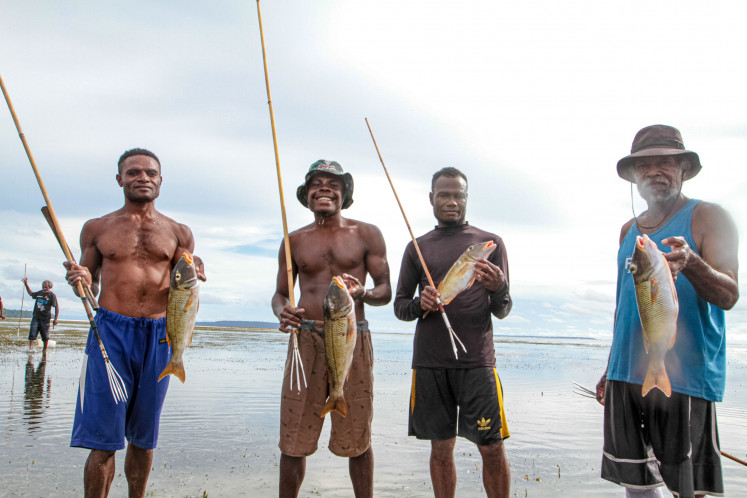
Indigenous communities, local farmers and traditional fishers have proven for millennia that biodiversity can be maintained without credit or offset mechanisms. What they need, Cindy says, is recognition of indigenous territories, certainty of tenure rights, protection from criminalization and direct access to funding that strengthens the management systems that have been safeguarding biodiversity long before the term “biodiversity credit” was coined.
“The biodiversity crisis did not arise because nature lacked a value but because for centuries, nature was treated as an object to be exploited for economic growth. Therefore, the conservation funding gap is impossible to fill if we only manage the impacts, not address the root causes,” she emphasized.