The Jakarta Post
Please Update your browser
Your browser is out of date, and may not be compatible with our website. A list of the most popular web browsers can be found below.
Just click on the icons to get to the download page.


Popular Reads
Top Results
No results found. Please check your search term and try again
Can't find what you're looking for?
View all search results
Popular Reads
Top Results
No results found. Please check your search term and try again
Can't find what you're looking for?
View all search resultsDollar drifts higher as traders eye Iran talks ahead of US jobs data
Change text size
Gift Premium Articles
to Anyone
Share the best of The Jakarta Post with friends, family, or colleagues. As a subscriber, you can gift 3 to 5 articles each month that anyone can read—no subscription needed!
 Set as preferred source
 Lee Seok Jin, manager of Financial Markets Division and FX Platform Business Dept, eats dinner while working a late-night shift in preparation for the launch of South Korea's 24-hour won-dollar trading market from July 6, at Hana Bank's dealing room in Seoul, South Korea, on June 16, 2026. (Reuters/Kim Hong-Ji)
T
he dollar drifted higher against the yen and euro on Friday, building on the previous day's gains as doubts about an Iran peace deal buffed the US currency's appeal as a haven.
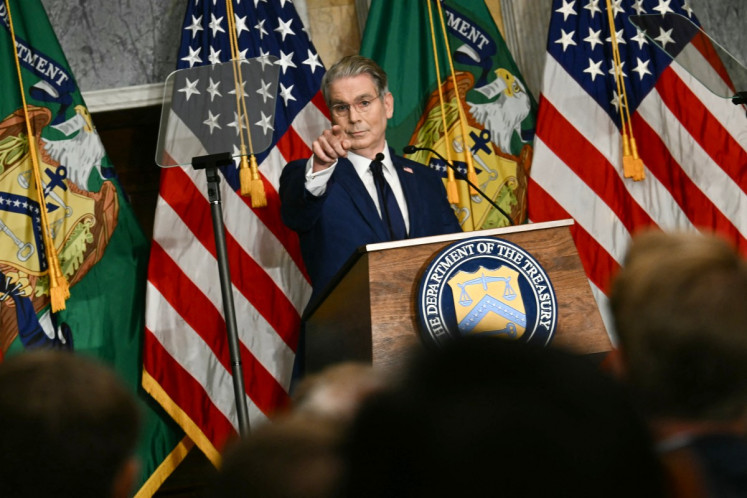
The greenback also drew support from higher Treasury yields after a Financial Times report citing sources close to Federal Reserve Chair Kevin Warsh pointed to the potential for a September interest rate hike, depending on incoming data.
The monthly US payrolls report, due later on Friday, could provide more clues on the Fed's rate path.
The dollar rose slightly to 158.505 yen in the Asian morning, after gaining 0.4 percent on Thursday, putting it on course to rise around 0.7 percent this week as it recovered from a bout of joint Japan-US intervention that sent the US currency tumbling from near a four-decade high above 163 yen on Thursday to a 13-week low of 155.20 on Monday.
Against the euro, the greenback edged up to $1.1521 after strengthening about 0.3 percent in the prior session.
Tensions continued to play out in the Gulf after Reuters reported a proposed deal between Iran and Oman to help end the US-Iran conflict could give Tehran control over inbound traffic through the Strait of Hormuz.

The US did not immediately comment on the proposal. President Donald Trump has said that a deal to reopen the strait was imminent, but US officials have repeatedly insisted that they would never agree to Iranian control of access to the world's most important trade route for energy supplies.
Brent crude rose a little over a dollar on Friday to trade at $83.55 per barrel, after settling up more than $3 in the previous session.
The heightening inflation risks weighed on Treasuries, sending yields higher.
"USD was supported by higher oil prices [following] news that a deal between the US and Iran to reopen the strait is further away than hoped," said Kristina Clifton, an economist at Commonwealth Bank of Australia.
She and other analysts also pointed to the FT report saying Warsh was open to a September hike if inflation data is strong, although Clifton added, "We expect the Fed to wait until December before starting a modest tightening cycle."
A divided US central bank left rates unchanged last month, but Warsh said he was committed to bringing inflation down.
US nonfarm payrolls are forecast to have risen by 80,000 last month after an increase of 57,000 in June, according to a Reuters survey of economists. The unemployment rate is expected to hold steady at 4.2 percent.
Against sterling, the dollar strengthened slightly to $1.3449.
The Australian dollar weakened a touch to $0.7029 and the kiwi dollar edged down to $0.5866.