The Jakarta Post
Please Update your browser
Your browser is out of date, and may not be compatible with our website. A list of the most popular web browsers can be found below.
Just click on the icons to get to the download page.


Popular Reads
Top Results
No results found. Please check your search term and try again
Can't find what you're looking for?
View all search results
Popular Reads
Top Results
No results found. Please check your search term and try again
Can't find what you're looking for?
View all search resultsCurrency markets subdued as oil shock lifts global yields
Change text size
Gift Premium Articles
to Anyone
Share the best of The Jakarta Post with friends, family, or colleagues. As a subscriber, you can gift 3 to 5 articles each month that anyone can read—no subscription needed!
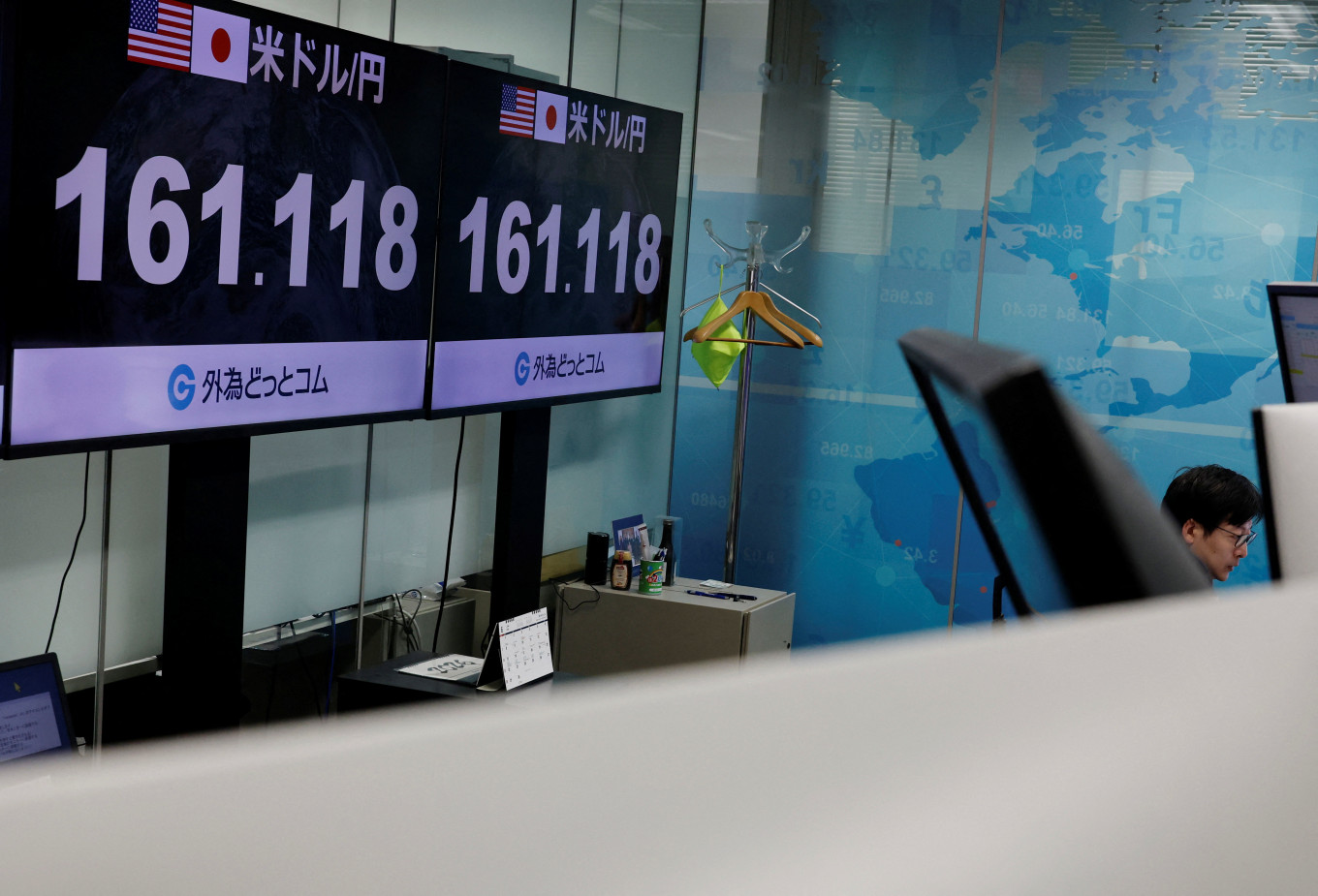 An employee of the foreign exchange trading company Gaitame.com works in front of monitors displaying the current Japanese Yen exchange rate against the US dollar, at their dealing room in Tokyo on June 19, 2026. (Reuters/Kim Kyung-Hoon)
C
urrency markets treaded water in cautious trading on Thursday as investors weighed a fresh surge in oil prices and global bond yields, while the yen's powerful rally also took a breather ahead of United States PPI and inflation readings.
Brent crude futures remained firmly above US$100 a barrel after breaching the level on Wednesday, as Iran and the US engaged in the biggest wave of attacks on shipping by both sides since the start of the war, threatening to worsen the disruption of energy supplies from the Middle East.
The fresh energy-induced inflation pressure sent global bond yields back on an upward trajectory, with benchmark 10-year Treasury yields hitting their highest levels since 2023 as a buyback program of longer-dated bonds also disappointed.
The greenback found some marginal relief, leaving the euro and sterling slightly weaker at $1.1633 and 1.3547, respectively.
That also paused the Japanese currency's climb to fresh seven-month highs, with the yen last trading a shade weaker at 153.70 after being mostly stuck in a tight trading range ahead of an expected Bank of Japan rate hike next week.
The dollar index, which measures the greenback against a basket of currencies, was last traded at 98.81, inching away from a three-week low.

Attention is now firmly on macros to round out the week. Market focus will later shift to US inflation readings, including producer prices later on Thursday, and CPI on Friday, the last set of key data releases ahead of the FOMC meeting on Sept. 15 to 16.
"I think the market feels like it's been put on notice around these numbers," Sally Auld, chief economist at National Australia Bank, said in a podcast.
"We all feel like that's going to be reasonably consequential as to how quickly or not we might see an interest rate increase from the Federal Reserve."
Central bank decisions loom
The European Central Bank looks set to raise interest rates on Thursday for the second time this year, and is expected to signal that it is ready to tighten further if the inflation outlook does not improve.
Meanwhile the Bank of Japan is also expected to hike interest rates to 1.25 percent on Sept. 18 and then to 1.75 percent in the second quarter of 2027 as earlier than previously thought amid persistent concerns over broadening price pressures and yen weakness.
The US inflation readings will be closely watched for clues on the Federal Reserve's next policy move amid concerns that inflation pressures remain sticky, which will leave the central bank in a difficult position, said Lloyd Chan, senior currency analyst at MUFG.
"While higher inflation may warrant tighter policy, additional rate hikes would also increase government borrowing costs at a time when fiscal deficits and debt servicing burdens are already under scrutiny."
Traders are now pricing a roughly 60 percent chance of a Federal Reserve rate hike this month after Friday's stronger-than-expected nonfarm payrolls report.
Elsewhere, the New Zealand dollar was 0.2 percent stronger at $0.5848, while the Australian dollar was flat at $0.7215.
China's offshore yuan was flat at 6.705 per dollar, hovering near its strongest level in nearly four years, after data showed China's producer and consumer price inflation rose amid higher energy costs.