The Jakarta Post
Please Update your browser
Your browser is out of date, and may not be compatible with our website. A list of the most popular web browsers can be found below.
Just click on the icons to get to the download page.


Popular Reads
Top Results
No results found. Please check your search term and try again
Can't find what you're looking for?
View all search results
Popular Reads
Top Results
No results found. Please check your search term and try again
Can't find what you're looking for?
View all search resultsHow Indonesia’s stainless, carbon steel fare amid global headwinds
Though still ranking third among Indonesia's export commodities by value, iron and steel products declined nearly 5 percent yoy in January-August 2026 due to both external and internal pressures.
Change text size
Gift Premium Articles
to Anyone
Share the best of The Jakarta Post with friends, family, or colleagues. As a subscriber, you can gift 3 to 5 articles each month that anyone can read—no subscription needed!
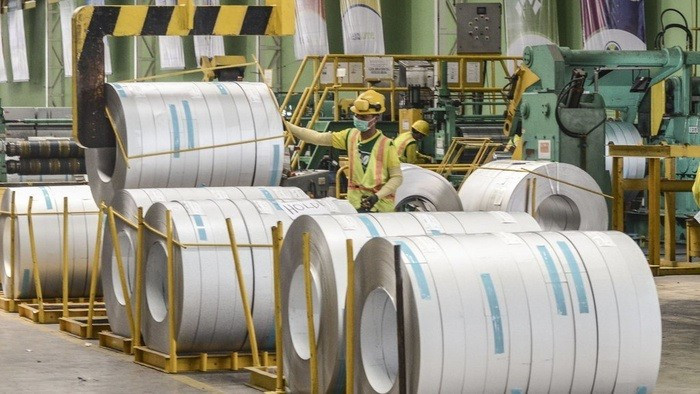
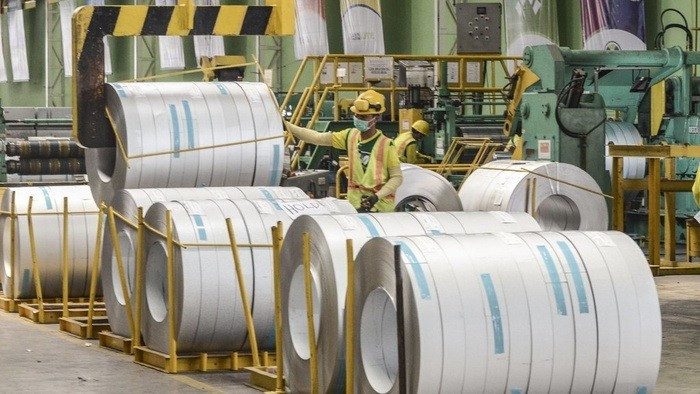 A worker inspects the quality of sheet metal rolls on Oct. 4, 2019, at a steel factory in the Jababeka Industrial Estate in Cikarang, Bekasi, West Java. (Antara/Fakhri Hermansyah)
I
ron and steel products rank among Indonesia's top non-oil and gas export commodities, holding third place with a total export value of US$27.97 billion in 2025. However, throughout the first half of 2026, the national steel industry faced pressure on both the external and internal fronts: the former for stainless steel, which is more export-oriented, and the latter for carbon steel, which is oriented more toward the domestic market.
Export market pressures stemmed from global market uncertainty and the implementation of trade barriers by the European Union's Carbon Border Adjustment Mechanism (CBAM), effective from Jan. 1. Meanwhile in the domestic market, they faced competition from low-priced products from global market.
How did these factors impact the trade performance of Indonesia's stainless steel and carbon steel commodities from January to August?
The downstream minerals policy has driven significant investment in domestic smelter construction, transforming Indonesia from a net importer into a net exporter of iron and steel products. According to data from Statistics Indonesia (BPS), the country’s trade balance for iron and steel commodities has consistently shown a positive value since 2021.
According to BPS, the value of iron and steel exports between January and August this year reached $17.8 billion, a 4.9 percent year-on-year (yoy) decline compared to the $19.2 billion recorded over the same period in 2025. Export volume during the first eight months of the year contracted 5.1 percent yoy to total 14,300 tonnes.
This shows a possible increase in the prices of iron and steel commodities in the global market that pushed export volume down while increasing export value.

A more detailed look at the data on stainless steel exports shows the commodity hit $5.8 billion with 13.2 percent yoy growth in the January-August period. It is by large still the top export commodity compared with other types of steel, such as carbon steel with export value at $2.1 billion and growth at 0.9 percent yoy. Stainless steel continued to make a big contribution to Indonesia’s exports during that period.
From the import side of iron and steel commodities, value rose 16 percent yoy to reach $7.1 billion, while volume also grew significantly at 18.2 percent yoy to total 10.8 million tonnes. The biggest contributor to imported goods was carbon steel, with export value at $1.3 billion and growth at 112.3 percent yoy.
It is evident that the domestic market has substantial demand for iron and steel commodities with the growing volume of carbon steel imports, posing a challenge to local producers.
Though the overall trade performance of stainless steel and carbon steel over the first eight months of the year was relatively good, an issue occurred: Indonesia’s trade balance in iron and steel commodities showed a contraction of 11.7 percent yoy, the first time these commodities recorded a negative trade balance.
Another concerning issue is the significantly growing volume of carbon steel imports, adding pressure to the domestic market. This may hint that there is still some homework for Indonesia’s steel industry. The government and national iron and steel industry associations must begin discussions on this matter.
Business associations have voiced concerns about industry conditions in the first semester of this year that needs to be addressed by the government. The carbon steel industry, for example, relies heavily on domestic demand and receives pressure from the global market with highly competitive prices. As for the stainless steel industry, it faces cost driver pressure from Europe’s CBAM and other potential carbon-based trade barriers from other countries in the future.
Looking ahead, the carbon steel industry still needs protection against dumping practices from the global market into domestic market. While the government has already implemented several instruments, including an antidumping duty for several steel products, their enforcement needs to be improved.
Energy incentives are also still needed by domestic producers, as geopolitical tensions are still relatively high this year and may continue into next year.
The stainless industry needs support to face the future possibility of carbon-based trade barriers from several countries. One of the solutions suggested to reduce the cost generated by a carbon-based trade barrier is to integrate a domestic regulation system for carbon tax to offset the price of CBAM certificates.
The government needs to remove any obstacle to measurement, reporting and verification (MRV) emission with international standards to help domestic industry claims about the emissions that are generated validly by international standards. Meanwhile, implementation of environmental, social and governance (ESG) as well as renewable electricity in the domestic steel industry needs to support the commitment within the steel industry for the cause of green industry.
*****
The writer is an industry and regional analyst at Bank Mandiri.