The Jakarta Post
Please Update your browser
Your browser is out of date, and may not be compatible with our website. A list of the most popular web browsers can be found below.
Just click on the icons to get to the download page.


Popular Reads
Top Results
No results found. Please check your search term and try again
Can't find what you're looking for?
View all search results
Popular Reads
Top Results
No results found. Please check your search term and try again
Can't find what you're looking for?
View all search resultsAsian shares wobble as tech rout boosts bonds, dents rate hike bets
Change text size
Gift Premium Articles
to Anyone
Share the best of The Jakarta Post with friends, family, or colleagues. As a subscriber, you can gift 3 to 5 articles each month that anyone can read—no subscription needed!
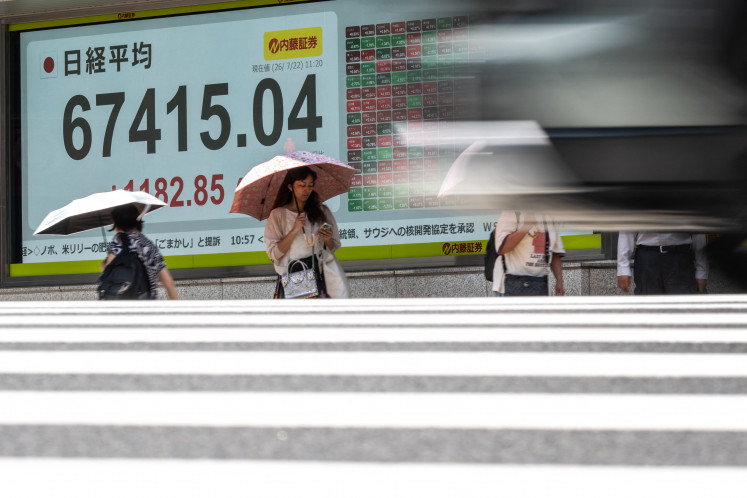
 Pedestrians walk past an electronic quotation board displaying the Nikkei Stock Average on the Tokyo Stock Exchange in Tokyo on July 22, 2026. (AFP/Philip Fong)
A
sian shares fell on Friday as concerns over the enormous funding needs of AI hammered tech and led to the biggest daily rally in Treasuries in more than three years, with investors fleeing to sovereign bonds and safe-haven currencies.
Markets also sharply pared back expectations of further policy tightening from the Federal Reserve, stripping out almost a full quarter-point rate hike for next year amid concerns a bursting AI bubble could derail the data-center investment boom and hobble the US economy. A December rate rise is no longer fully priced, with the implied probability falling to 85 percent.
That was despite elevated oil prices, with Brent hitting a five-month peak at US$114 a barrel on Friday. Houthi attacks in Saudi Arabia stoked concerns of further disruption to energy supplies as fears grow that the conflict in the Middle East could escalate sharply.
MSCI's broadest index of Asia-Pacific shares excluding Japan fell 0.3 percent on Friday, bringing its weekly loss to 2.7 percent and marking a fourth straight week in the red. Japan's Nikkei dropped 1.3 percent and was down a whopping 5 percent for the week.
South Korea's KOSPI skidded 1.7 percent, on course for a 4.3 percent weekly decline, with memory chipmaker SK Hynix down 2.5 percent on the day. Taiwan's stock market was closed due to a typhoon.
An index of mainland Chinese blue chips lost 1.1 percent on Friday to hit the lowest level since July 2025. The index was down about 20 percent from its peak in late June. Hong Kong's Hang Seng edged up 0.1 percent after dropping 3 percent on Thursday.

"AI is under the cosh," said Charlie McElligott, managing director for cross-asset strategy at Nomura Securities International in New York, in a note.
"US Treasury bonds are — gasp — working as your hedge again, as the market seems to be real-time repricing the probabilities of a US growth scare off the back of the AI reset."
On Wall Street, the Nasdaq slumped more than 2 percent as Meta shares lost nearly 8 percent after the Facebook parent posted its first cash outflow in more than a decade due to its AI-related expenditures, and announced plans to issue non-voting shares in a two-for-one split to raise capital to spend on the technology.
Tesla shares fell 3.1 percent as the electric car maker cut its 2026 capital spending plans.
"The question is whether selling accelerates or markets stage another familiar reversal," said Chris Weston, head of Research at Pepperstone.
"There's nothing more emotive than a falling market where buyers refuse to engage. Sellers don't need a fresh catalyst when deteriorating price action itself encourages more selling."
As equities tumbled, money flowed into safe-haven US Treasuries, sending yields plunging across the curve overnight. The benchmark 10-year Treasury yield slid more than 19 basis points, the biggest drop since March 2023, before steadying at 4.9591 percent on Friday, back below the closely watched 5 percent level.
That was also due in part to the ongoing sell-off in French bonds, whose benchmark yield climbed 6 basis points overnight to 5.0601 percent, the highest level since 2002.
"The US 10yr yield gapped back below 5 percent with some conviction. We're not convinced it keeps on going," said Padhraic Garvey, ING's regional head of research for the Americas.
"We're minded to expect it to snap back above [5 percent], as we still have inflation/fiscal deficit/AI boom underpinnings to navigate. And we have the US midterm elections approaching as an excuse for trouble. But it will need some degree of calm in the risk space first."
The 2-year Treasury yield slumped nearly 19 bps overnight and were last flat at 4.6566 percent.
Government bonds in Asia also rallied. The yield on 10-year Japanese government bonds fell 9 basis points to 2.790 percent, while Australia's 10-year yield dropped 10 bps to 5.164 percent.
In currency markets, safe havens such as the yen and Swiss franc gained. The dollar fell 0.2 percent to 156.44 yen on Friday, after slumping 0.9 percent overnight.
The dollar also slipped 0.1 percent to 0.8196 Swiss francs, the lowest in a month, after an overnight fall of 0.5 percent.
Gold failed to catch any safe-haven demand though, and was flat at $4,021.99 an ounce on Friday after a nearly 3 percent drop overnight.