The Jakarta Post
Please Update your browser
Your browser is out of date, and may not be compatible with our website. A list of the most popular web browsers can be found below.
Just click on the icons to get to the download page.


Popular Reads
Top Results
No results found. Please check your search term and try again
Can't find what you're looking for?
View all search results
Popular Reads
Top Results
No results found. Please check your search term and try again
Can't find what you're looking for?
View all search resultsSingapore to explore new tech to weather global ‘resource nationalism,' minister says
To navigate these headwinds, the city-state is strengthening the diversity of its energy sources, and taking steps to ensure it has the infrastructure required to support them, he said at the opening of the Singapore International Energy Week conference at Marina Bay Sands.
Change text size
Gift Premium Articles
to Anyone
Share the best of The Jakarta Post with friends, family, or colleagues. As a subscriber, you can gift 3 to 5 articles each month that anyone can read—no subscription needed!
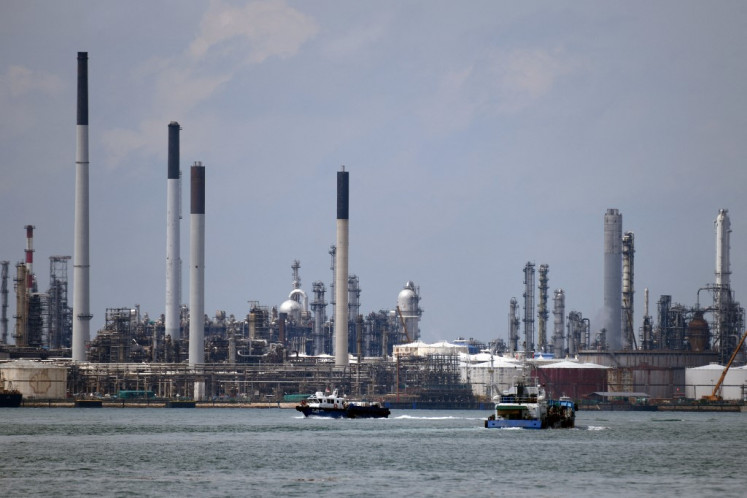
 Boats sail past the Shell refinery on Pulau Bukom off Singapore on Nov. 11, 2020. The price of Brent crude oil jumped on Sept. 28, 2021 above 80 USD for the first time in almost three years on expectations for surging demand and concerns about supplies. (AFP/Roslan Rahman)
S
ingapore is preparing to weather the increasingly challenging global energy landscape marked by supply crunches and growing resource nationalism, said Minister for Energy, Trade and Industry Tan See Leng on Monday.
To navigate these headwinds, the city-state is strengthening the diversity of its energy sources, and taking steps to ensure it has the infrastructure required to support them, he said at the opening of the Singapore International Energy Week conference at Marina Bay Sands.
And even as Singapore strives to ensure its energy security in the near-term with new fossil fuel partnerships, it will also step up its deployment of low-carbon options such as solar energy to meet future energy needs in a climate-friendly way, the minister was quoted by The Straits Times.
Singapore is also exploring emerging energy options that are not yet commercially viable, including nuclear and geothermal energy.
“We must ensure our system resilience continues to be a source of confidence, harness energy to bolster our competitiveness, pursue low-carbon energy pathways, and deepen connectivity with our partners… while keeping costs in check,” Tan said.
His remarks come two days after Indonesia reduced natural gas supplies to Singapore.

The amount of gas cut is less than 2 percent of the Republic’s total daily gas demand, Singapore’s energy regulator the Energy Market Authority (EMA) later clarified. Singapore relies on natural gas to meet about 95 percent of its needs.
Tan said the trend of resource nationalism is particularly concerning, especially if it undermines established contractual agreements.
He added that such moves increase business risk and deter investments in the energy sector, with negative long-term implications for energy importers like Singapore.
He also cited the disruption of global energy flows caused by the closure of the Strait of Hormuz. Coming just four years after the 2022 energy crisis, the situation could escalate further following recent attacks on Saudi Arabia.
When Singapore started importing gas, all of its gas was piped from neighbouring countries. Today, about half of the Republic’s gas is imported as liquified natural gas (LNG) from a global portfolio of sources, such as the US and Australia, said Tan.
Indonesia is one of Singapore's main sources of natural gas, providing it with 145.3 billion cubic feet in 2024, according to data from the US Energy Information Administration.
On Thursday, energy minister Bahlil Lahadalia said he was mulling curbing gas exports to prioritise domestic consumption, while warning Jakarta would act against countries that "do not respect" Indonesia.
President Prabowo Subianto on Wednesday berated "countries that like to insult" his nation over the haze crisis. He did not name specific countries.
Indonesia has for months struggled to contain fires that deforestation monitor Nusantara Atlas said have consumed more than 1.9 million hectares in the nine months to September.