





Enjoy This Gifted Article!
You're reading this thanks to a The Jakarta Post subscriber.
Access is available for 30 days. For unlimited access, consider subscribing.
Please Update your browser
Your browser is out of date, and may not be compatible with our website. A list of the most popular web browsers can be found below.
Just click on the icons to get to the download page.

Can't find what you're looking for?
View all search resultsCan't find what you're looking for?
View all search resultsThe Democrats’ flipping of Congress could increase pressure on the White House, but Trump retains broad authority over trade and foreign policy, leaving Indonesia and other exporters exposed to protectionist US import tariffs.
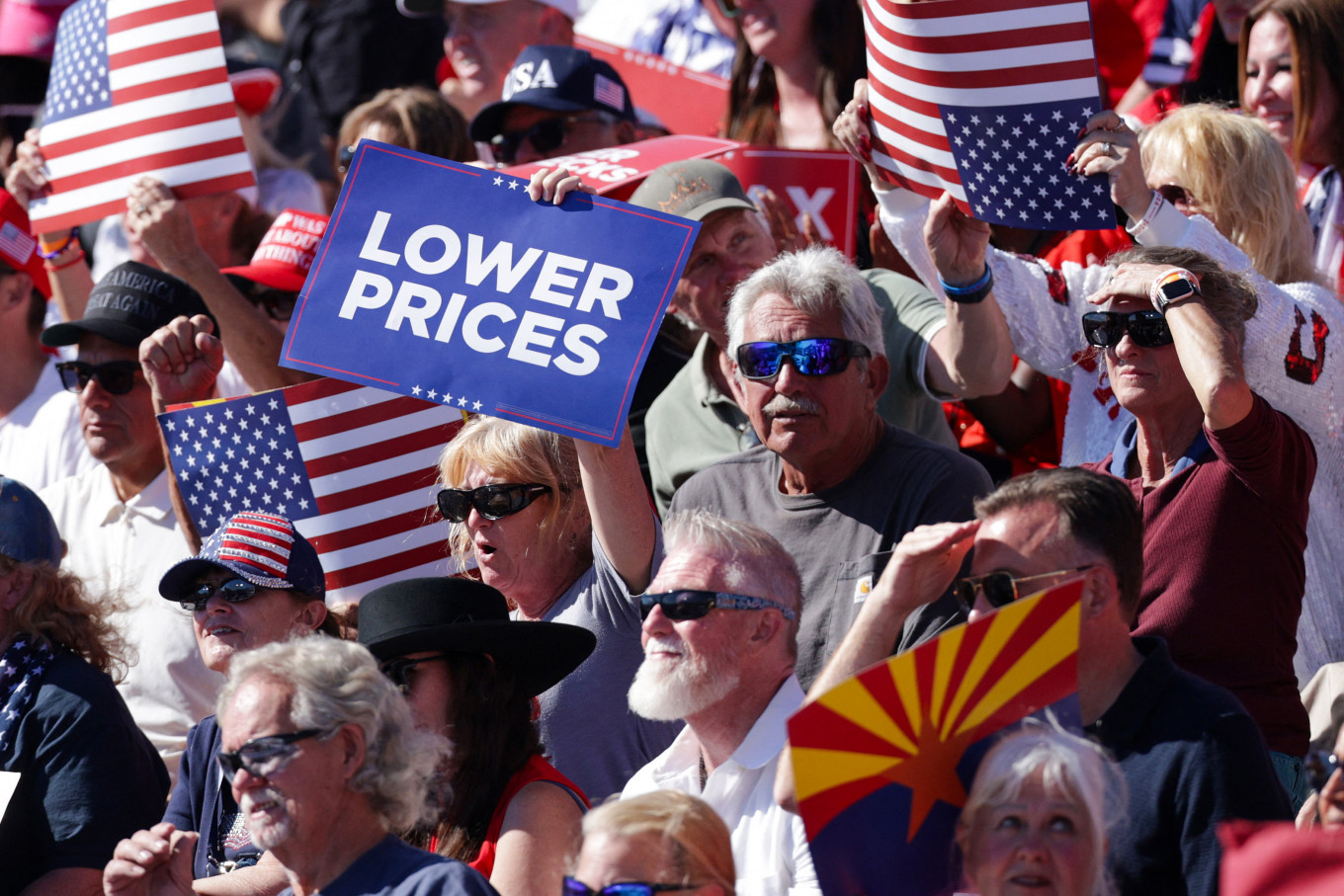 Attendees listen as United States President Donald Trump speaks on Oct. 14 during a campaign rally at Laughlin/Bullhead International Airport in Bullhead City, Arizona, the US. (AFP/Alex Wong)
he Democrats’ sweeping victory in both chambers of the United States Congress in last week’s midterm elections dealt a blow to US President Donald Trump, raising the question in Southeast Asia of whether Washington might soften its trade policy toward the region.
While the new balance of power could complicate Trump’s ability to advance his agenda over the next two years, analysts see little room for Congress to rein in his tariff push, with the implications for broader trade and foreign policy remaining unclear.
“I do not think it will make as much difference as might be expected,” said Deborah Elms, head of trade policy at the Asia-based Hinrich Foundation.
“He loves tariffs. He believes they will deliver jobs in manufacturing to the US.”
Read also: Trump tries to brush off midterms rout as Democrats celebrate
Speaking to The Jakarta Post on Thursday, she cautioned that Trump, criticized at home, might double down on trade in the coming two years, particularly if his domestic agenda becomes bogged down by congressional opposition and investigations pile pressure on his administration.

The president also retains the power to veto legislation passed by Congress. As democrats did not secure a two-thirds majority in both chambers, they will be unable to override a presidential veto, making any attempt to legislate away Trump's tariff powers difficult.
Nor is opposition to tariffs necessarily uniform among Democrats, some of whom support protectionist measures but differ from Trump over which countries or industries should be targeted.
“Trade and tariffs are his signature issue, so I’m not convinced that enough Republicans will break with the president or that Trump would allow anything less than a veto-proof result to stand,” Elms said.
Trump’s tariff regime rattled global markets last year when he imposed “reciprocal” tariffs of 10 percent to 50 percent on some 90 countries, with the aim of shrinking the US trade deficit.
After the US Supreme Court ruled in February that the emergency powers could not justify the so-called “Liberation Day” levies, Washington subsequently moved to a temporary global tariff before announcing duties of 10 to 12.5 percent on some 60 trading partners under Section 301, accusing trading partners of failing to stop imports made with forced labor, which requires no vote in Congress.
Stephen Olson, a visiting fellow at the Singapore-based ISEAS-Yusof Ishak Institute, said in an analysis published on Nov. 1 that the results could offer Southeast Asian exporters “only limited relief” from Trump’s protectionist trade policies, potentially empowering Congress to push for tariff exemptions and carve-outs but unlikely to halt new tariff measures or reverse the administration’s broader trade agenda.
However, any deeper shift in US trade policy will have to wait until the 2028 presidential election, he wrote.
Joshua Kurlantzick, a senior fellow for Southeast Asia and South Asia at the Council on Foreign Relations, saw some potential for the midterm results to soften the White House’s approach.
Democrats' gains could force the White House to rethink tariffs as voter opposition grows, with more Americans linking import duties to higher prices and Republican lawmakers facing greater pressure to distance themselves from the policy, he said.
“Trump’s power at home is more limited now, and GOP members of Congress now, including those who’ve always hated tariffs, are going to be much freer to speak their minds,” Kurlantzick told the Post on Thursday.
“But I’d be more concerned Trump will restart the Iran war, which would have major consequences for Asia,” he added.
Southeast Asia, which relies heavily on energy shipments from the Gulf, faces mounting economic risks from the war.
Iran's closure of the Strait of Hormuz in response to US and Israeli strikes has disrupted a vital shipping route, threatening oil and gas supplies and driving up energy and freight costs, with knock-on effects on food and commodity prices across the region.
For Indonesia, a net oil importer that buys roughly 1 million barrels of crude a day, the disruption has added pressure to its import bill and foreign exchange reserves.
The Democrats’ flipping of Congress could strengthen oversight of and impose greater constraints on Trump's foreign policy, although the extent of any shift remained uncertain today, said Pieter Pandie, a researcher at the Jakarta-based Centre for Strategic and International Studies (CSIS).
The consequences would take time to emerge, as newly elected members of Congress are not due to take office until next year, Pieter told the Post on Friday.
The outcome is a setback for Trump, whose Republican Party had previously controlled both chambers, where it would create greater opportunities for Democrats to scrutinize and constrain the administration’s foreign policy.
However, it did not necessarily translate into a corresponding loss of presidential discretion over foreign policy, he said. The president retains considerable latitude to act without prior approval from Congress, while any legislation attempting to constrain his administration’s policies can still be countered by a presidential veto.
For Indonesia, he said, the implications for Washington's approach to the Middle East and the Indo-Pacific, particularly its relationship with China, are worth watching.
Read also: Indonesia braces for new trade measures as US temporary tariff expires
Trump is due to make his first overseas trip since the midterms in mid-November, traveling to Manila for the ASEAN summit before heading to China for the APEC summit in Shenzhen.
For Southeast Asian nations, the visits will offer an early indication of how the administration intended to manage its regional relationships following the electoral setback, analysts said.
Hinrich Foundation’s Elms said Trump’s administration is likely to raise the implementation of existing trade deals, including the Agreement on Reciprocal Trade (ART) with Indonesia, during regional meetings.
But how Washington would accelerate implementation remained unclear, as the White House needed more time to settle its position, she added.
Share your experiences, suggestions, and any issues you've encountered on The Jakarta Post. We're here to listen.
Thank you for sharing your thoughts. We appreciate your feedback.
Quickly share this news with your network—keep everyone informed with just a single click!
Share the best of The Jakarta Post with friends, family, or colleagues. As a subscriber, you can gift 3 to 5 articles each month that anyone can read—no subscription needed!
Get the best experience—faster access, exclusive features, and a seamless way to stay updated.


