The Jakarta Post
Please Update your browser
Your browser is out of date, and may not be compatible with our website. A list of the most popular web browsers can be found below.
Just click on the icons to get to the download page.


Popular Reads
Top Results
No results found. Please check your search term and try again
Can't find what you're looking for?
View all search results
Popular Reads
Top Results
No results found. Please check your search term and try again
Can't find what you're looking for?
View all search resultsIndonesia’s 100 GWp solar ambition needs bigger funding, policy overhaul: IESR
The government’s 100 GWp solar project could require up to US$100 billion, 27 percent higher than the $73 billion it projects, as well as regulatory reform to support the solar supply chain, according to an IESR researcher specializing in energy system transformation.
Change text size
Gift Premium Articles
to Anyone
Share the best of The Jakarta Post with friends, family, or colleagues. As a subscriber, you can gift 3 to 5 articles each month that anyone can read—no subscription needed!
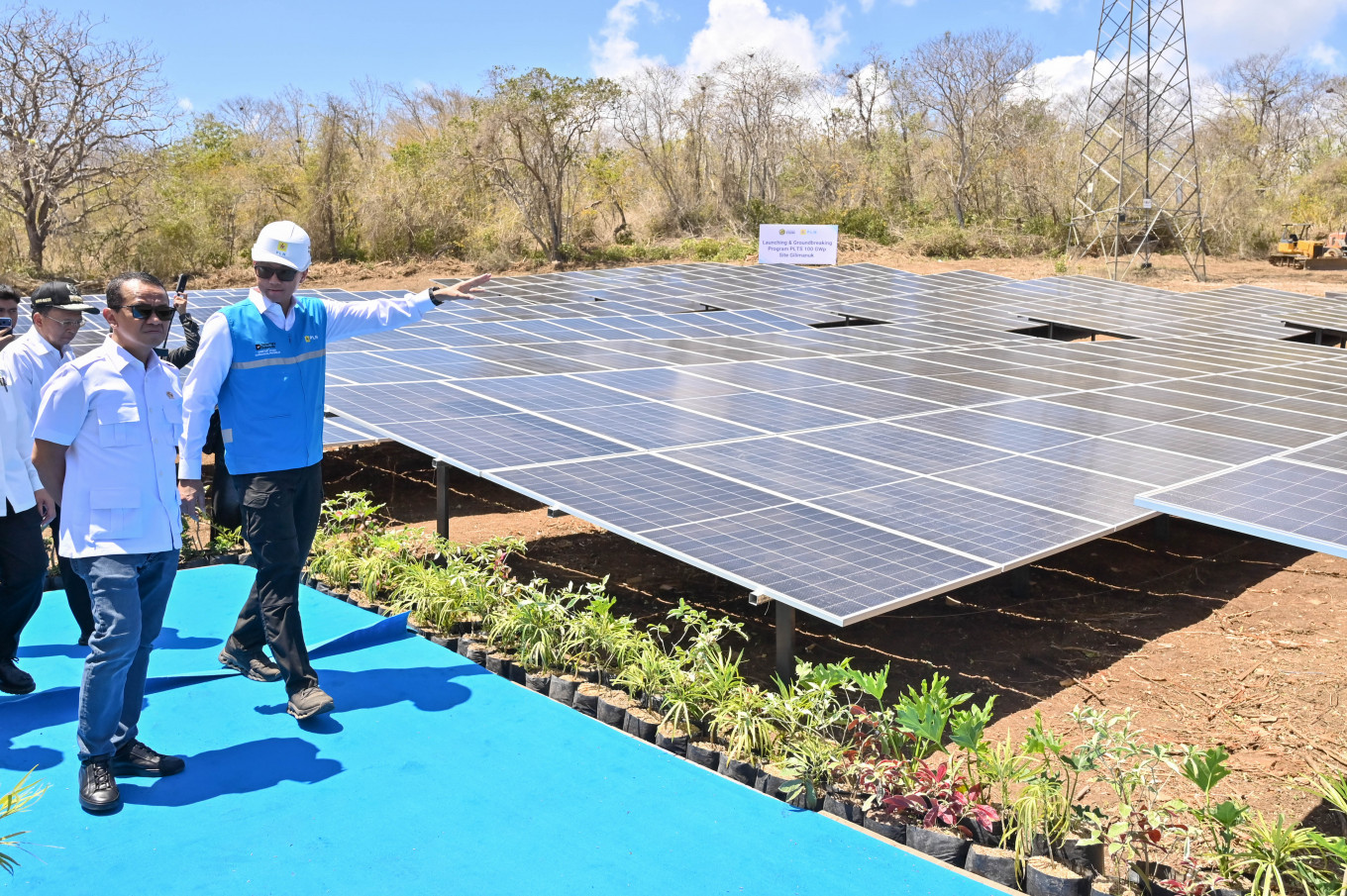 Energy and Mineral Resources Minister Bahlil Lahadalia (center), Bali Governor Wayan Koster (left) and PLN President Director Darmawan Prasodjo (right) inspect the construction site of the 100-gigawatt-peak (GWp) Gilimanuk solar power plant in Jembrana, Bali, Tuesday (Aug. 25, 2026). (Antara/Fikri Yusuf)
I
ndonesia will need to significantly ramp up its investment to deliver its planned 100-gigawatt-peak (GWp) solar expansion by 2029, as the country races to meet an ambitious target that will require sweeping policy reforms, an energy think tank has warned.
First announced in August 2025 by President Prabowo Subianto, the government formally launched the 100-GWp solar program initiative this August, setting a three-year deadline for the expansion.
Energy and Mineral Resources Minister Bahlil Lahadalia estimated that the program would require approximately US$73 billion in total investment, equivalent to more than Rp 1.14 quadrillion.
However, the Institute for Essential Services Reform (IESR) puts the financing requirement higher, potentially pushing the total beyond $100 billion.
“IESR estimated the government’s required investment to be close to $80 billion for utility-scale solar generation alone. Including battery storage and transmission, it could push the total above $100 billion,” said Deon Arinaldo, director of IESR’s energy system transformation program, during a discussion in Central Jakarta on Oct. 30.
The financing challenge is compounded by Indonesia’s limited renewable energy investment, he noted. The Energy and Mineral Resources Ministry recorded only $1.8 billion in investment in the broader new and renewable energy sector in 2024, which rose to $2.4 billion last year.

“Reaching the utility-scale target within three years would require annual renewable investment to increase roughly 15-fold,” Deon said.