The Jakarta Post
Please Update your browser
Your browser is out of date, and may not be compatible with our website. A list of the most popular web browsers can be found below.
Just click on the icons to get to the download page.


Popular Reads
Top Results
No results found. Please check your search term and try again
Can't find what you're looking for?
View all search results
Popular Reads
Top Results
No results found. Please check your search term and try again
Can't find what you're looking for?
View all search resultsJean Couteau's essential new volume describes the modern Balinese dilemma
Bali, 50 Years of Changes: A Conversation with Jean Couteau by Eric Buvelot examines Bali's transformation – from a traditional agrarian to a capitalist service society. This enthralling exchange reveals complex and often paradoxical scenarios. The book is a quantum leap forward in comprehending modern Balinese.
Change text size
Gift Premium Articles
to Anyone
Share the best of The Jakarta Post with friends, family, or colleagues. As a subscriber, you can gift 3 to 5 articles each month that anyone can read—no subscription needed!
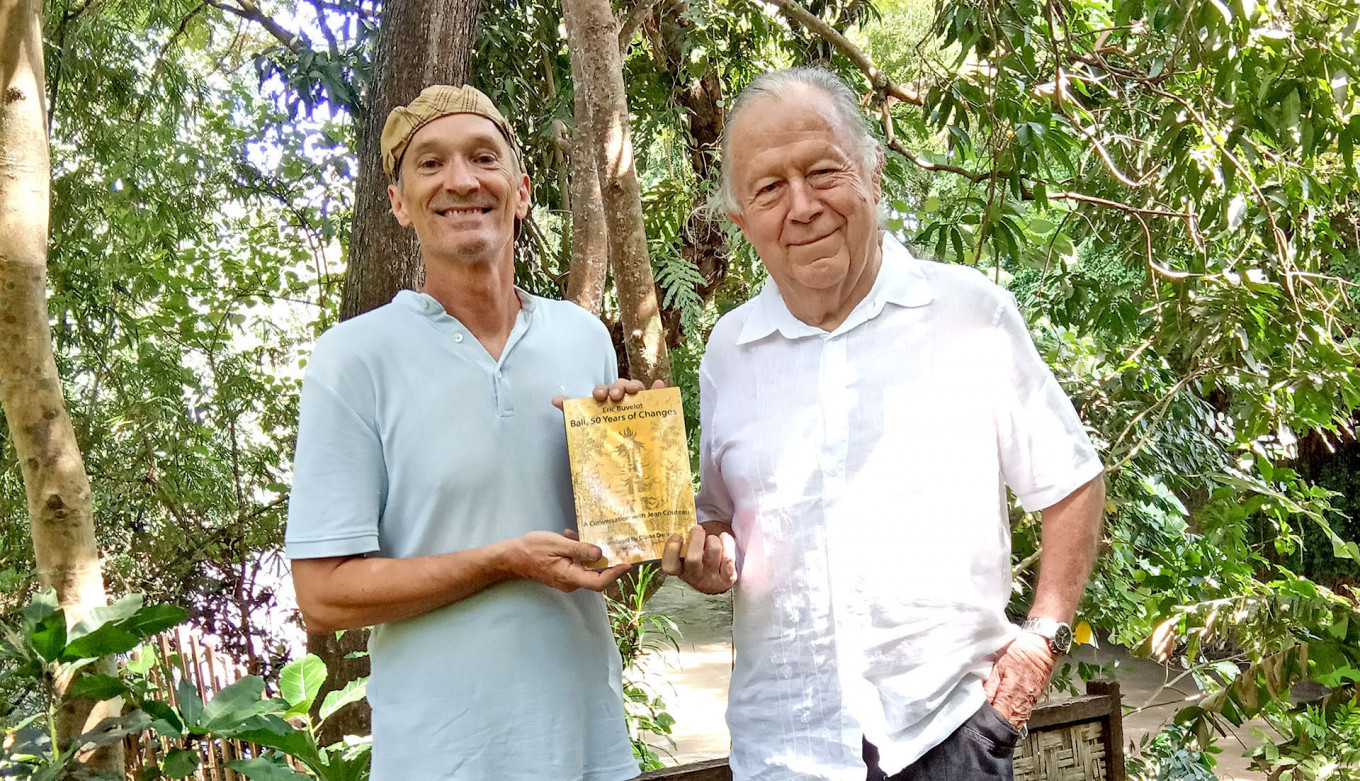 All about Bali: Eric Buvelot and Jean Couteau (right) pose with their book, first published in France in 2021, now available in English published by Glass House Books. (Courtesy of Buvelot Couteau) (Courtesy of Buvelot Couteau)
B
ali, 50 Years of Changes: A Conversation with Jean Couteau by Eric Buvelot examines Bali's transformation – from a traditional agrarian to a capitalist service society. This enthralling exchange reveals complex and often paradoxical scenarios. The book is a quantum leap forward in comprehending modern Balinese.
"During the past century, the world has invited itself to Bali, and in doing so, has broken the society's traditional balance," says Jean Couteau, a well-known multilingual writer (Indonesian, French, English), specialist of Bali and national columnist for Kompas newspaper.
Most of Bali's transformation has occurred since the 1970s when the island opened to tourism. In this book, an edited 270-page transcript of 20 hours of interviews granted to Buvelot over seven months, Couteau does not limit himself to statements. Instead, he delves into the multifaceted and often problematic dynamics that deeply impact Balinese culture and people's psyche.

"In the 1970s until the mid-1980s, there was a low level of urbanization; intellectual formation was based on religious symbolism rather than on strict religious tenets," Couteau said.
"[Tourism] was still ‘bringing something’ more than ‘taking something’, land had not yet become a commodity, and homogeneity in cultural life and behavior prevailed," Couteau adds. It was a change he had witnessed directly for over 40 years.
A lecturer at the Denpasar Institut Seni Indonesia (Indonesian Institute of the Arts) and graduate of the prestigious EHESS in Paris, Couteau's sphere of knowledge spans history, religion, politics, economics, nationalism, sexuality, women's rights, identity, the environment, invented traditions, ethnocentrism and more.
The book's dynamic to-and-fro, question-and-answer conversation engages from cover to cover. Buvelot's distinct ability to ask prying questions and intuitively respond to Couteau's insights enables the discussion to venture into ever deeper territory.


More from The Weekender

Farewell, good breast
A cancer diagnosis brings more than the fear of illness. It raises difficult questions about how to protect those we love while revealing unexpected reserves of tenderness and resilience.

Siapa Anda? Mengapa Anda?
What begins as a small grammatical curiosity becomes a larger question about language, culture and the way we understand ourselves in relation to others - and, ultimately, about what we risk losing in a world increasingly impatient with reflection, ambiguity and the humanities.

A passport to the kingdom of the sick
A breast cancer diagnosis, a journey to the kingdom of the sick and a determination to describe what lies there without metaphor, euphemism or the word “fight.”