The Jakarta Post
Please Update your browser
Your browser is out of date, and may not be compatible with our website. A list of the most popular web browsers can be found below.
Just click on the icons to get to the download page.


Popular Reads
Top Results
No results found. Please check your search term and try again
Can't find what you're looking for?
View all search results
Popular Reads
Top Results
No results found. Please check your search term and try again
Can't find what you're looking for?
View all search results"Robert Johnson" of Indonesia's Orkes Melayu music finally comes out from the shadows
After months of woodshedding, the band gathered enough materials that they would use to join a recording session at Irama Records studio in Menteng, Central Jakarta, supervised and engineered directly by founder of the legendary label, Suyoso "Mas Yos" Karsono.
Change text size
Gift Premium Articles
to Anyone
Share the best of The Jakarta Post with friends, family, or colleagues. As a subscriber, you can gift 3 to 5 articles each month that anyone can read—no subscription needed!
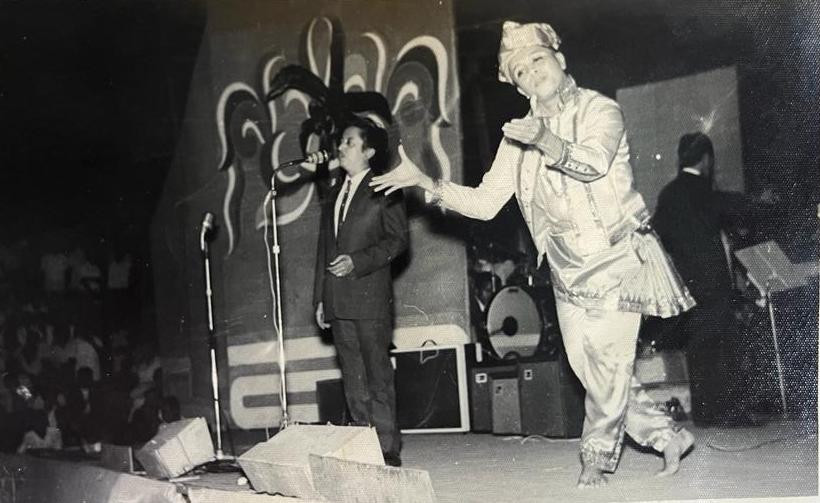 In this undated photo, Orkes Melayu singer and composer M. Mashabi performs for an audience. (The Jakarta Post/Courtesy of Abu Bakar Mashabi)
I
n the early 1960s, two of the best talents in the Indonesian music scene, songwriter and band leader Adi Karso, known for his hits "Papaya Cha-Cha-Cha" and "Balonku" and Gambus musician Munif Bahasuan, the son of a rich businessman from Tanah Abang, Jakarta, teamed up to form Orkes Melayu (Malay Orchestra) Kelana Ria.
After months of woodshedding, the band gathered enough materials that they would use to join a recording session at Irama Records studio in Menteng, Central Jakarta, supervised and engineered directly by founder of the legendary label, Suyoso "Mas Yos" Karsono.
Between 1961 and 1964, Kelana Ria recorded 48 songs that were spread over four records, Kafilah, Yam El Shamah, Ya Mahmud and Ya Hamidah.

The four recordings changed the trajectory of Indonesian popular music.
Songs like "Termenung, " written and performed by Ellya Khadam became an instant hit and were staples on the playlist of state-run broadcaster RRI. Many deem "Termenung" as the first proper Orkes Melayu hit.
Another song, "Ratapan Anak Tiri," became so popular that a film producer decided to make a movie based on its lyrics. The film became a blockbuster in the early 1970s.
The album also turned Munif – who composed and sung a number of songs on the four records, including two with Arabic lyrics – into a superstar and his name will forever be associated with the mix of Arabic, Indian and Latin music that Kelana Ria popularized.



More from The Weekender

Siapa Anda? Mengapa Anda?
What begins as a small grammatical curiosity becomes a larger question about language, culture and the way we understand ourselves in relation to others - and, ultimately, about what we risk losing in a world increasingly impatient with reflection, ambiguity and the humanities.

A passport to the kingdom of the sick
A breast cancer diagnosis, a journey to the kingdom of the sick and a determination to describe what lies there without metaphor, euphemism or the word “fight.”

The weight of time
Richard Mille’s newest ultralight timepiece pares down haute horlogerie to its mechanical necessities, proving that sophistication often comes from knowing what to leave out.