The Jakarta Post
Please Update your browser
Your browser is out of date, and may not be compatible with our website. A list of the most popular web browsers can be found below.
Just click on the icons to get to the download page.


Popular Reads
Top Results
No results found. Please check your search term and try again
Can't find what you're looking for?
View all search results
Popular Reads
Top Results
No results found. Please check your search term and try again
Can't find what you're looking for?
View all search results'Mosaico': Walking among millennia of Italy's mosaic art
Colorful tiles adorn many structures in numerous Italian cities, revealing the history of mosaic art spanning millennia across the boot-shaped peninsula.
Change text size
Gift Premium Articles
to Anyone
Share the best of The Jakarta Post with friends, family, or colleagues. As a subscriber, you can gift 3 to 5 articles each month that anyone can read—no subscription needed!
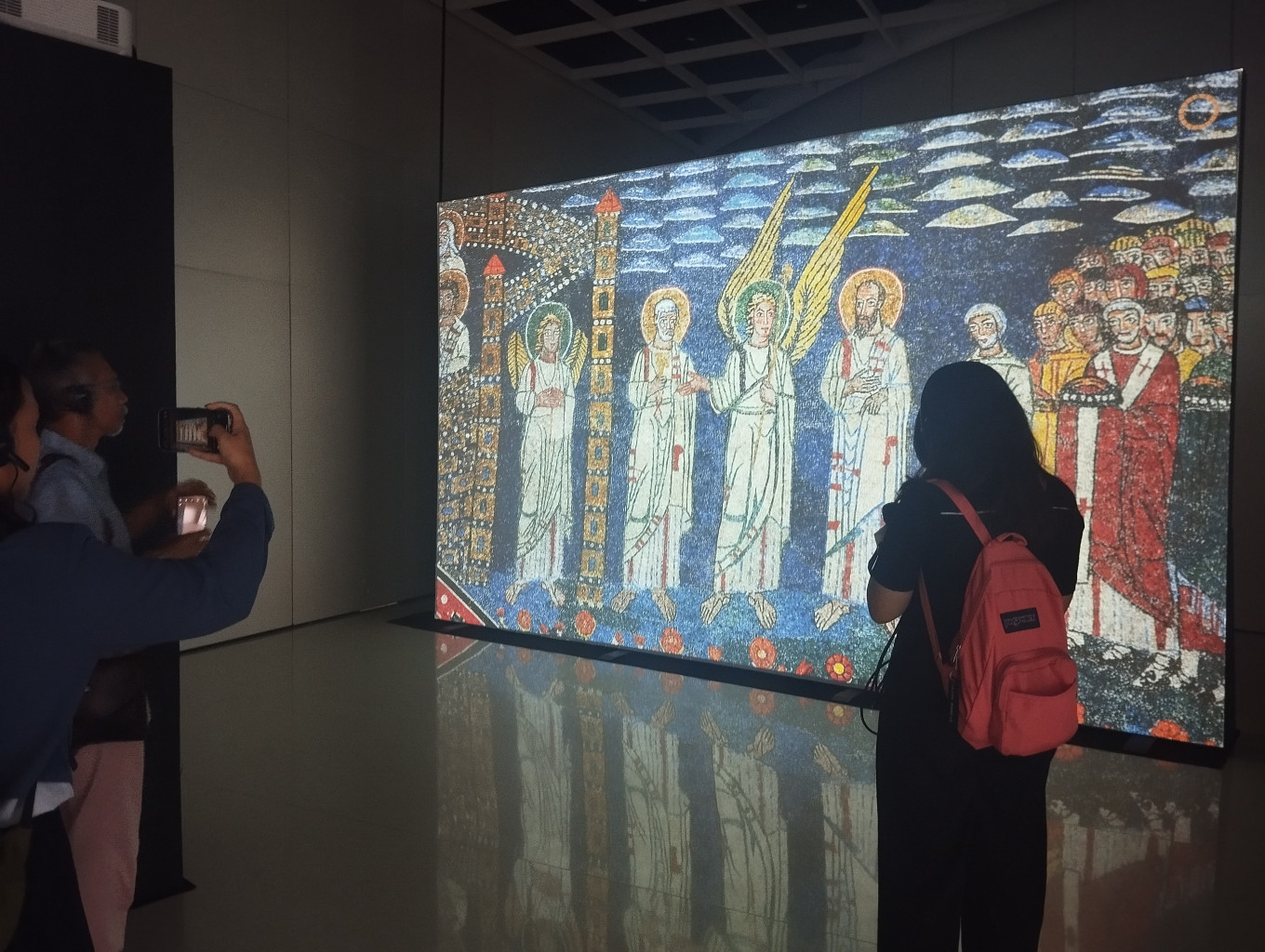 Timeless beauty: Visitors view a mosaic art on Aug. 6, 2024 in the “Mosaico: Italian Code of a Timeless Art” exhibition at Ciputra Artpreneur in Kuningan, South Jakarta, held to celebrate 75 years of bilateral relations between Indonesia and Italy. (JP/Nur Janti)
T
o celebrate 75 years of bilateral relations between Indonesia and Italy, the Italian Cultural Institute of Jakarta is holding a multimedia exhibition featuring the country’s famed mosaic art at Ciputra Artpreneur in Kuningan, South Jakarta.
Running from Aug. 7 to 28, “Mosaico: Italian Code of a Timeless Art” was organized in collaboration with the Italian Embassy and PT Piaggio Indonesia, maker of the popular Vespa brand.
The transmedia exhibition invites visitors to explore the profound interconnections between Italy’s culture, history and creativity through mosaic art through a convergence of archive material, graphic animation, audiovisual footage, drone and underwater films, as well as a specially composed soundtrack that is provided before entering the gallery.

Although stone and glass cannot speak, the ancient tiles nevertheless tell the tale of how mosaic art developed in Italy, particularly in Rome, Pompeii, Aquileia, Ravenna, Palermo, Monreale, Piazza Armenia and Baiae.
“Mosaic art is an artistic technique that has been discovered since 3,000 BC, starting from Mesopotamian mosaics and finally spreading throughout the Greek and Roman empires,” Maria Battaglia, director of the Italian Cultural Institute, said on Aug. 6.
One of the works showcased in the exhibition is the cycle of the Creation series that adorns the Palatine Chapel, built in the Italo-Byzantine architectural style in Palermo, Sicily.
The mosaic art, set in a golden background, covers all surfaces of the chapel, illustrating stories about the lives of Jesus Christ, Saint Peter and St. Paul. The image of Christ is enveloped in light, which is associated with life: to live and walk in the light, to escape from the darkness to become children of the light.



More from The Weekender

Siapa Anda? Mengapa Anda?
What begins as a small grammatical curiosity becomes a larger question about language, culture and the way we understand ourselves in relation to others - and, ultimately, about what we risk losing in a world increasingly impatient with reflection, ambiguity and the humanities.

A passport to the kingdom of the sick
A breast cancer diagnosis, a journey to the kingdom of the sick and a determination to describe what lies there without metaphor, euphemism or the word “fight.”

The weight of time
Richard Mille’s newest ultralight timepiece pares down haute horlogerie to its mechanical necessities, proving that sophistication often comes from knowing what to leave out.