The Jakarta Post
Please Update your browser
Your browser is out of date, and may not be compatible with our website. A list of the most popular web browsers can be found below.
Just click on the icons to get to the download page.


Popular Reads
Top Results
No results found. Please check your search term and try again
Can't find what you're looking for?
View all search results
Popular Reads
Top Results
No results found. Please check your search term and try again
Can't find what you're looking for?
View all search resultsBetween melting and weaving: Dawn Ng and Marcos Kueh shape time
Through melting ice and digitally woven textiles, the Singaporean and Malaysian artists offer contrasting reflections on impermanence, memory and cultural identity in Museum MACAN's current exhibition.
Change text size
Gift Premium Articles
to Anyone
Share the best of The Jakarta Post with friends, family, or colleagues. As a subscriber, you can gift 3 to 5 articles each month that anyone can read—no subscription needed!
 Set as preferred source
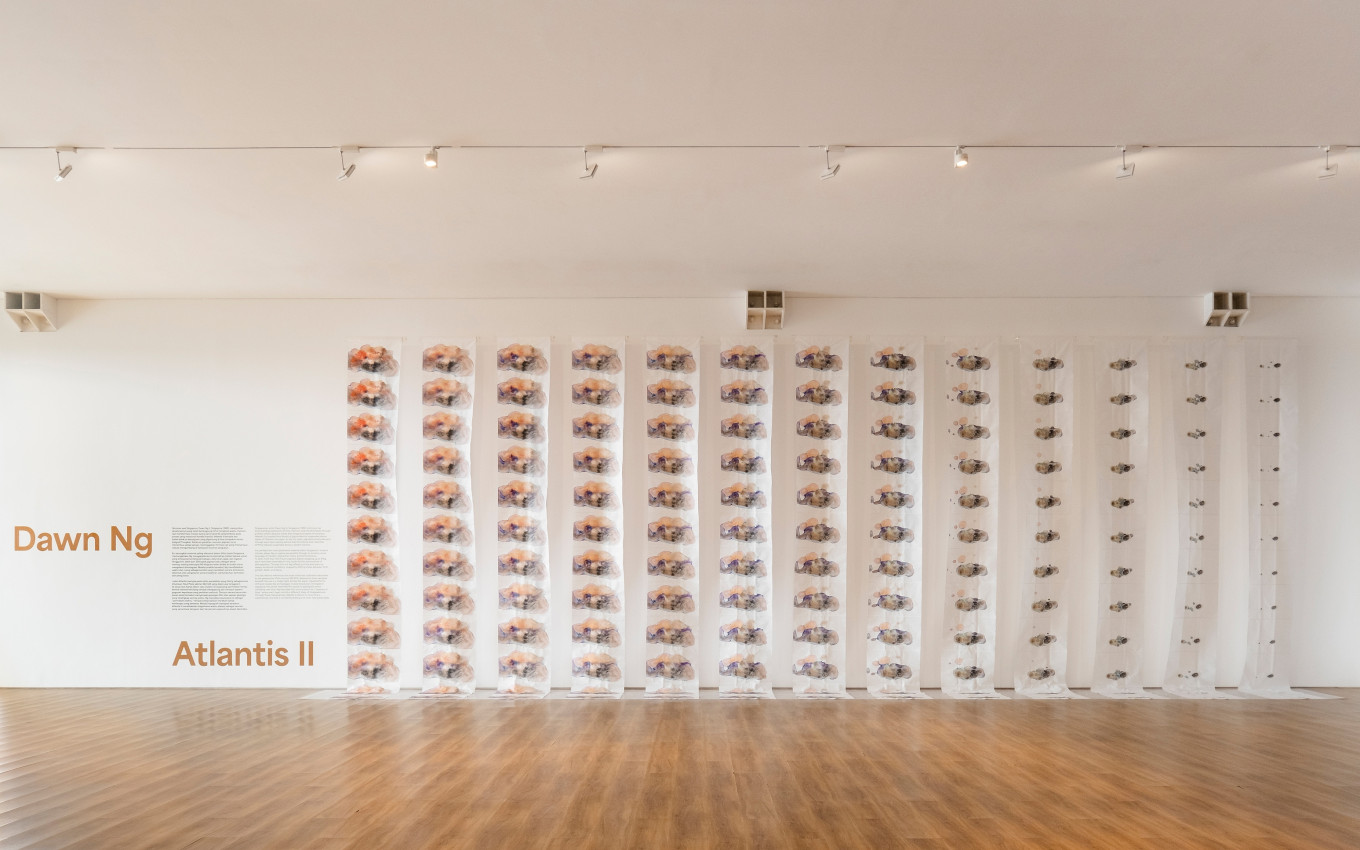 Melting moments: An overall view of Atlantis II (2026) by Singaporean artist Dawn Ng is displayed at the Where Are We in Time: A Season Across Shifting Landscapes exhibition at Museum MACAN in Central Jakarta. The exhibition runs until Oct. 4, 2026. (Courtesy of Museum MACAN/Liandro Siringoringo)
S
ingaporean artist Dawn Ng and Malaysian artist Marcos Kueh could hardly be more different in the way they make art. One entrusts her work to melting ice and the quiet rhythms of nature; the other programs industrial weaving machines with mathematical precision. Yet, in Where Are We in Time: A Season Across Shifting Landscapes, Museum MACAN's current exhibition running until Oct. 4, both arrive at the same question: How does time shape what remains?
Their answers unfold through radically different materials and processes. Where Ng embraces chance and disappearance, Kueh constructs meticulously ordered textiles. Between them emerges a dialogue on impermanence, memory and the ways cultural identity is continually reshaped.
Melting worlds

The title Atlantis inevitably evokes Plato's mythical island, a civilization believed to have vanished beneath the sea after succumbing to greed and hubris. While generations of historians and enthusiasts have searched for its possible location, Dawn Ng is less interested in the legend than in what it represents: the inevitability of disappearance.
Rather than illustrating Atlantis, she stages its gradual dissolution.
Working with monumental blocks of ice infused with watercolor pigments and dyes, Ng suspends the frozen masses above stacks of Chinese rice paper. As the ice slowly melts, gravity draws the pigments through layer after layer of paper, each sheet receiving a softer impression than the one before. Color disperses, forms dissolve and what remains are delicate traces of an image already slipping away.
Across the paper, pigments bloom into drifting archipelagos, receding coastlines and shifting seas. The imagery never settles into a fixed landscape. Instead, it records a process, inviting viewers to witness time itself becoming visible.

More from The Weekender

The app life
Living in China, where all of life's needs have been telescoped into the mobile phone, feels like the future the rest of the world is queuing for.

The quiet chapter: the society of silent book clubs
Silent book clubs are rising in Jakarta as a new way to socialize through a shared love of literature, without the pressure of conversations.

The long plié
Having discovered ballet in her forties, a writer-cum-dancer learns that mastery is less about talent than the willingness to return, and the joy that comes from learning and growing.