The Jakarta Post
Please Update your browser
Your browser is out of date, and may not be compatible with our website. A list of the most popular web browsers can be found below.
Just click on the icons to get to the download page.


Popular Reads
Top Results
No results found. Please check your search term and try again
Can't find what you're looking for?
View all search results
Popular Reads
Top Results
No results found. Please check your search term and try again
Can't find what you're looking for?
View all search resultsThe speech that redrew the lines
As Indonesia embraced Reform in 1998, BJ Habibie envisioned a military with a smaller political role. Nearly three decades later, his words have taken on renewed significance.
Change text size
Gift Premium Articles
to Anyone
Share the best of The Jakarta Post with friends, family, or colleagues. As a subscriber, you can gift 3 to 5 articles each month that anyone can read—no subscription needed!
 Set as preferred source
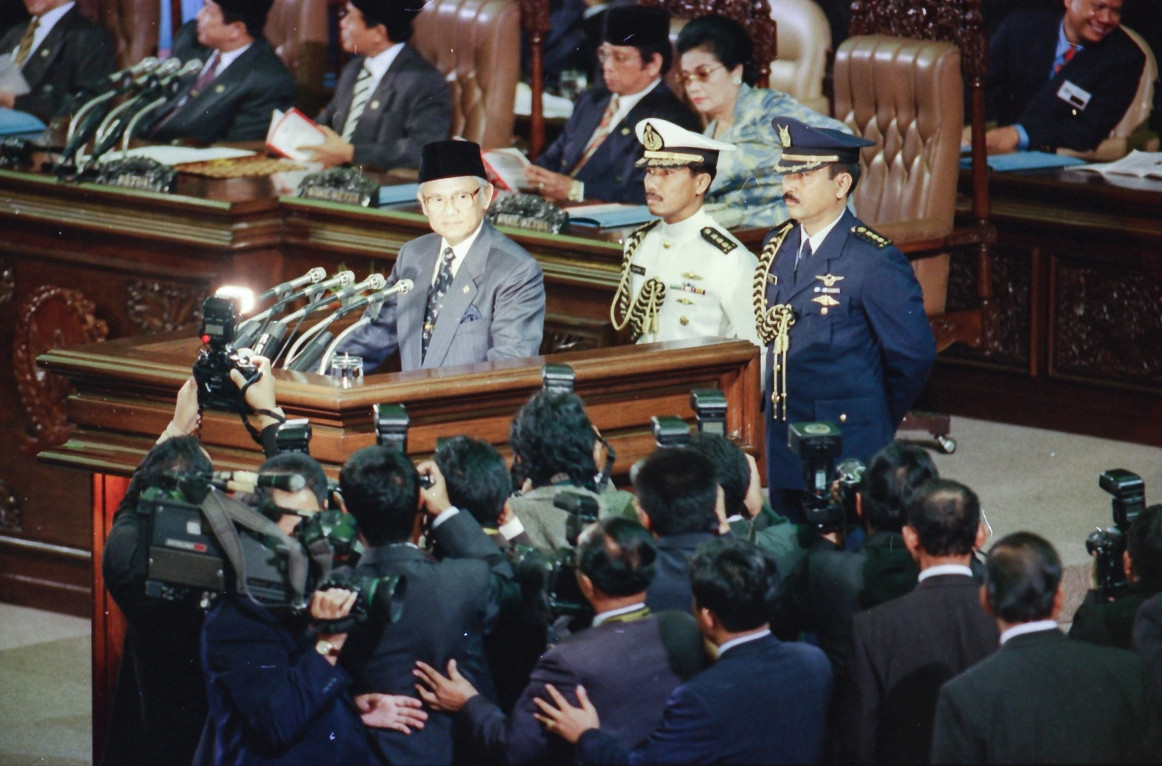 President BJ Habibie addresses the House of Representatives on Aug. 15, 1998, in Jakarta, where he called for military reform and a new democratic paradigm during the early days of Reform. (The Jakarta Post Archive/Bayu Ismoyo)
A
t first glance, it is a routine State of the Nation address. In hindsight, the photograph captures the moment BJ Habibie gave voice to one of the Reform movement's defining ambitions: placing civilian supremacy above military power.
Less than three months after succeeding Soeharto, president Habibie stood before the House of Representatives on Aug. 15, 1998, in Jakarta, with Indonesia still reeling from economic crisis and political upheaval. In his first State of the Nation address, he argued that building a democratic civil society required something long considered unthinkable: reforming the military itself.
For nearly three decades under the New Order, the then-Indonesian Armed Forces (ABRI) operated under its dwifungsi (dual function) doctrine, allowing officers to occupy political and civilian posts while extending military influence throughout government, from the House and the cabinet to provincial administrations and villages. Habibie acknowledged that legacy but insisted Indonesia needed "a new paradigm with more emphasis on a democratic and well-being approach". The military, he said, had to redefine its sociopolitical role to meet the demands of a changing era.

His remarks were welcomed by the military leadership. Then-ABRI commander Gen. Wiranto said the armed forces were prepared to share political power, while Lt. Gen. Susilo Bambang Yudhoyono, then chief of sociopolitical affairs, acknowledged that the military's long-standing security approach had become obsolete, as reported in The Jakarta Post the following day. Habibie's speech helped set Indonesia on a path that would eventually dismantle dwifungsi, remove the military's appointed seats in the House and redefine civil-military relations.
Today, the photograph feels less like a relic than a question posed to every generation. The revised Indonesian Military (TNI) Law has expanded civilian positions open to active officers, while military personnel are again taking on a growing range of public roles. Reform redrew the line between soldiers and civilians. The question is no longer where that line was drawn, but how firmly Indonesia chooses to uphold it.
--
Editor's Note: This article is part of The Jakarta Post's new archive series, In Retrospect, which revisits photographs from our archive to uncover the stories behind them and their enduring relevance in Indonesia today.

More from The Weekender

Is AI really making us better workers?
AI can make our work faster and more polished. But by eliminating the struggle, mistakes and imperfections, it may also be eliminating some of the ways we learn and become better workers.

Travels in the land of Gen Z
To become a professor to Gen Z today is to take a disorienting journey to an exotic land. First of two parts.

More trains, more stations, but Greater Jakarta still isn’t connected
Jakarta now has more trains and stations. But getting to them from Depok, Bogor, Tangerang or Bekasi still means an ojek or a car ride.