The Jakarta Post
Please Update your browser
Your browser is out of date, and may not be compatible with our website. A list of the most popular web browsers can be found below.
Just click on the icons to get to the download page.


Popular Reads
Top Results
No results found. Please check your search term and try again
Can't find what you're looking for?
View all search results
Popular Reads
Top Results
No results found. Please check your search term and try again
Can't find what you're looking for?
View all search resultsMeet ‘kimpul’, Indonesia’s forgotten tuber gone viral
As global food trends sweep social media, creators are giving new life to the once-overlooked local ingredient.
Change text size
Gift Premium Articles
to Anyone
Share the best of The Jakarta Post with friends, family, or colleagues. As a subscriber, you can gift 3 to 5 articles each month that anyone can read—no subscription needed!
 Set as preferred source
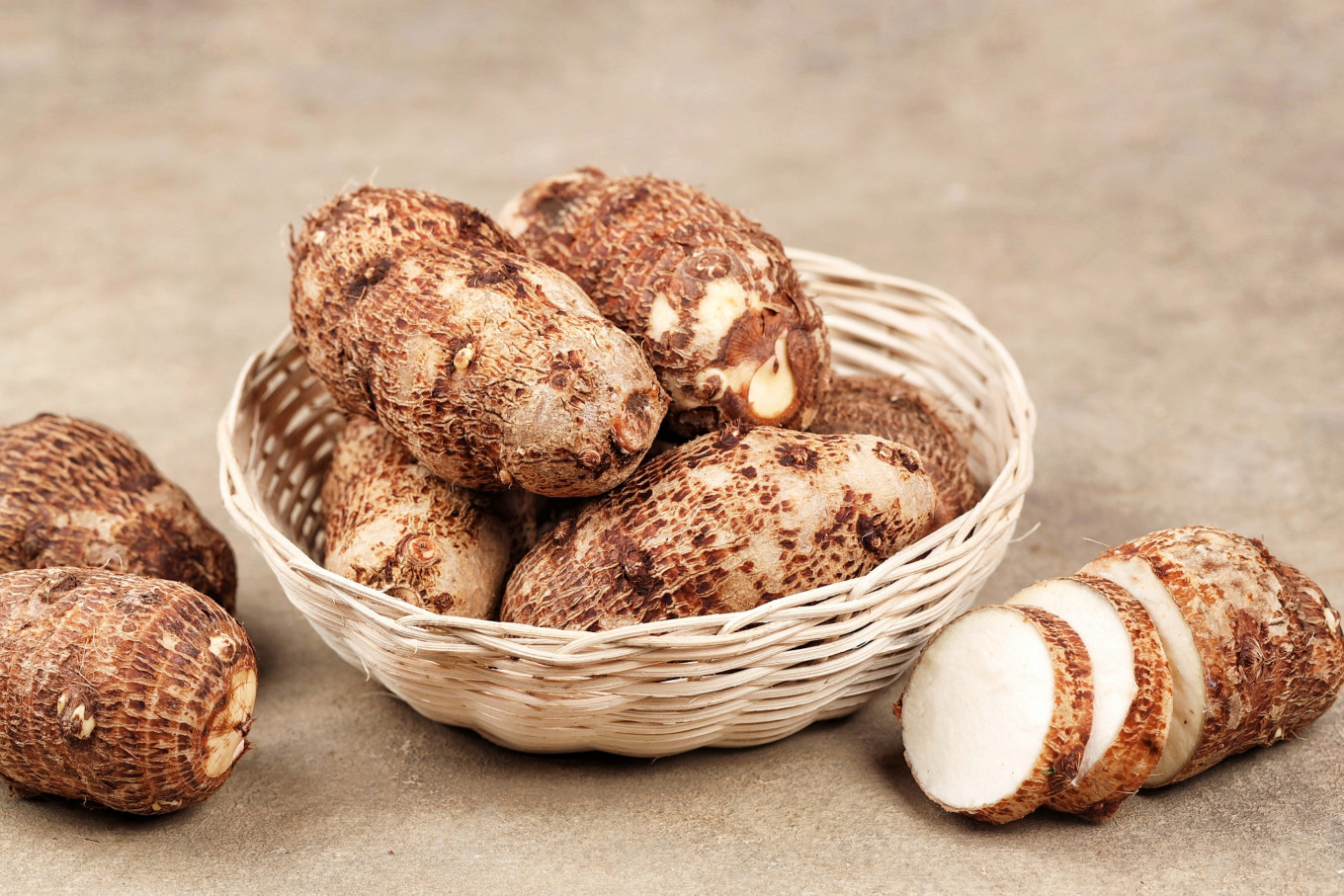 Humble tuber: Fresh cocoyam, known as 'kimpul' or Belitung taro in Indonesia, is seen in this photo. Long eaten as a local carbohydrate and rice alternative, 'kimpul' is low in fat and has a low glycemic index, while also containing dietary fiber, resistant starch, minerals, vitamin B3 and bioactive compounds. (Shutterstock/Nunung Noor Aisyah )
W
henever a viral food trend takes over social media, from Dubai chewy cookies and Melbourne’s Mont Blanc coffee now storming the local internet to cheesecake and the never-ending matcha craze, one thing stands out: none of these rely purely on ingredients native to Indonesia.
More recently, however, food influencers and cafes have started promoting local ingredients through modern creations, giving them a chance to ride the same wave.
Suratini, 47, who goes by Tin, went viral on Instagram when she swapped conventional ingredients for kimpul (Xanthosoma sagittifolium), earning her the moniker “Ibu Kimpul” across platforms.

She uses her now-viral catchphrase, “Karena tidak punya, maka saya ganti kimpul (Because I don’t have it, I replaced it with cocoyam)”, to introduce a dish she has made with the tuber, whether a drink with boba pearls or a cream soup.
But kimpul, also known as Belitung taro, is hardly a new discovery. The tuber has long been consumed locally as a source of carbohydrates and an alternative to rice.
Evy Damayanthi, a nutrition lecturer at IPB University, says kimpul is low in fat and has a low glycemic index, according to National Geographic Indonesia. It also contains dietary fiber, resistant starch, minerals, vitamin B3 and bioactive compounds.
The same article notes that the tuber is still cultivated in several parts of the country, including Semarang and Klaten in Central Java, particularly around the slopes of Mount Merapi, and parts of Sumatra and West Nusa Tenggara.



More from The Weekender

The app life
Living in China, where all of life's needs have been telescoped into the mobile phone, feels like the future the rest of the world is queuing for.

The quiet chapter: the society of silent book clubs
Silent book clubs are rising in Jakarta as a new way to socialize through a shared love of literature, without the pressure of conversations.

The long plié
Having discovered ballet in her forties, a writer-cum-dancer learns that mastery is less about talent than the willingness to return, and the joy that comes from learning and growing.