The Jakarta Post
Please Update your browser
Your browser is out of date, and may not be compatible with our website. A list of the most popular web browsers can be found below.
Just click on the icons to get to the download page.


Popular Reads
Top Results
No results found. Please check your search term and try again
Can't find what you're looking for?
View all search results
Popular Reads
Top Results
No results found. Please check your search term and try again
Can't find what you're looking for?
View all search results7.4-magnitude quake off North Sulawesi kills one
The US Geological Survey (USGS) said the tremor hit at a shallow depth of 35 kilometres in the Maluku Sea between the Sulawesi and Maluku island groups in the early morning.
Change text size
Gift Premium Articles
to Anyone
Share the best of The Jakarta Post with friends, family, or colleagues. As a subscriber, you can gift 3 to 5 articles each month that anyone can read—no subscription needed!
 Set as preferred source
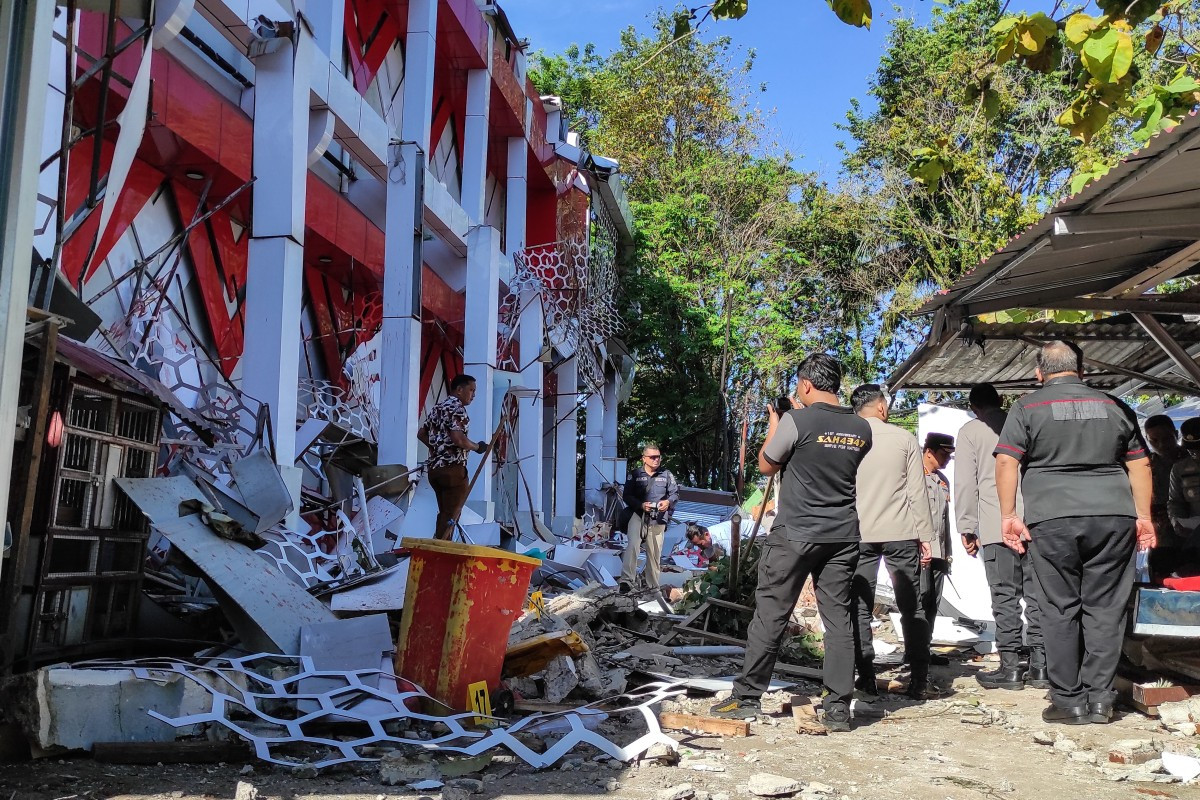 Police officers look at a building of the North Sulawesi's National Sports Committee of Indonesia (KONI) damaged following a severe 7.4-magnitude offshore quake in Manado, North Sulawesi on April 2, 2026. (AFP/Tonny Rarung)
A
major 7.4-magnitude quake struck off the coast of North Sulawesi on Thursday, killing at least one person, causing waves of up to 75 centimetres (2.5 feet) and triggering a tsunami warning that was subsequently lifted.
The US Geological Survey (USGS) said the tremor hit at a shallow depth of 35 kilometres in the Maluku Sea between the Sulawesi and Maluku island groups in the early morning.
The Meteorology, Climatology and Geophysics Agency (BMKG) said there were tsunami waves reported in five locations, the highest at 0.75 m (2.46 ft) in North Minahasa in North Sulawesi and 11 aftershocks were monitored, the largest at a magnitude of 5.5. It warned the public to stay alert.
BMKG chief Teuku Faisal Fathani told a press conference its modelling indicated there was tsunami potential for waves of 0.5 m to 3 m (1.6 ft to 9.8 ft) high.
One person was killed when a building collapsed in the city of Manado in North Sulawesi province, a local search and rescue official told AFP.
"The quake was felt strongly and around Manado... one person died and one person had a leg injury," George Leo Mercy Randang told AFP by telephone.

The victim was "buried under the rubble" of a collapsed building, he said.
The Hawaii-based Pacific Tsunami Warning Center (PTWC) initially said hazardous tsunami waves were possible within 1,000 kilometres (621 miles) of the epicentre along the coasts of Indonesia, the Philippines and Malaysia.
Within half an hour of the quake, waves up to 75 centimetres were recorded in North Minahasa and 20 centimetres in Bitung, both in the north of Sulawesi island, according to the BMKG.
Thirty-centimetre waves were also logged in North Maluku province.
The PTWC lifted its warning just over two hours after the tremor, saying the tsunami threat "has now passed."
Ternate resident Budi Nurgianto, 42, said he was inside his house when the tremor struck, sending people panicking outside.
"The quake was felt strongly. I heard it first from the walls of the house that shook," he said.
"When I went outside, there were many people outside. They were panicked. The quake was felt (for) quite long, more than a minute.
"I even saw some people leaving their house without having finished their shower."
Metro TV showed video footage of damaged buildings and a Manado resident told Reuters people ran out of their houses in panic. There was no visible damage in her neighbourhood, but items fell off shelves and power had been cut, the resident said.
The Philippines’ seismology agency Phivolcs said there was “no destructive tsunami threat” to the country based on its latest data, while Malaysia's meteorological department said there was no immediate tsunami threat to the country but it was monitoring developments.
BMKG head Teuku Faisal Fathani told journalists in Jakarta there were 11 aftershocks, the biggest with a magnitude of 5.5.
An AFP journalist in Manado on Sulawesi, about 300 kilometres west of Ternate by sea, said the shaking woke him and others in the city of around 450,000 people.
"I immediately woke up and left my house. People (were) immediately scrambling outside. There is a school and the pupils rushed outside," he said.
The shaking persisted for "quite long" but he did not witness "significant damage", he added.
The PTWC had initially warned that tsunami waves of up to one metre were possible for parts of Indonesia, with smaller waves possible for the Philippines, Malaysia, Japan, Taiwan, Guam and Palau.
"Government agencies responsible for threatened coastal areas should take action to inform and instruct any coastal populations at risk," the agency said.
The Japan Meteorological Agency said it expected "slight changes" in the sea level along the Pacific coast from northern Hokkaido to southern Okinawa, but has not issued any warnings.
The earthquake centres of the Philippines and Malaysia have also not issued tsunami alerts.
Indonesia and neighbouring countries experience frequent earthquakes due to their location in the Pacific "Ring of Fire" -- an arc of intense seismic activity where tectonic plates collide that stretches from Japan through Southeast Asia and across the Pacific basin.
In 2004, a magnitude-9.1 quake struck Aceh province, causing a tsunami and killing more than 170,000 people in Indonesia.