The Jakarta Post
Please Update your browser
Your browser is out of date, and may not be compatible with our website. A list of the most popular web browsers can be found below.
Just click on the icons to get to the download page.


Popular Reads
Top Results
No results found. Please check your search term and try again
Can't find what you're looking for?
View all search results
Popular Reads
Top Results
No results found. Please check your search term and try again
Can't find what you're looking for?
View all search resultsEarly wildfire surge raises alarm in Indonesia
Change text size
Gift Premium Articles
to Anyone
Share the best of The Jakarta Post with friends, family, or colleagues. As a subscriber, you can gift 3 to 5 articles each month that anyone can read—no subscription needed!
 Set as preferred source
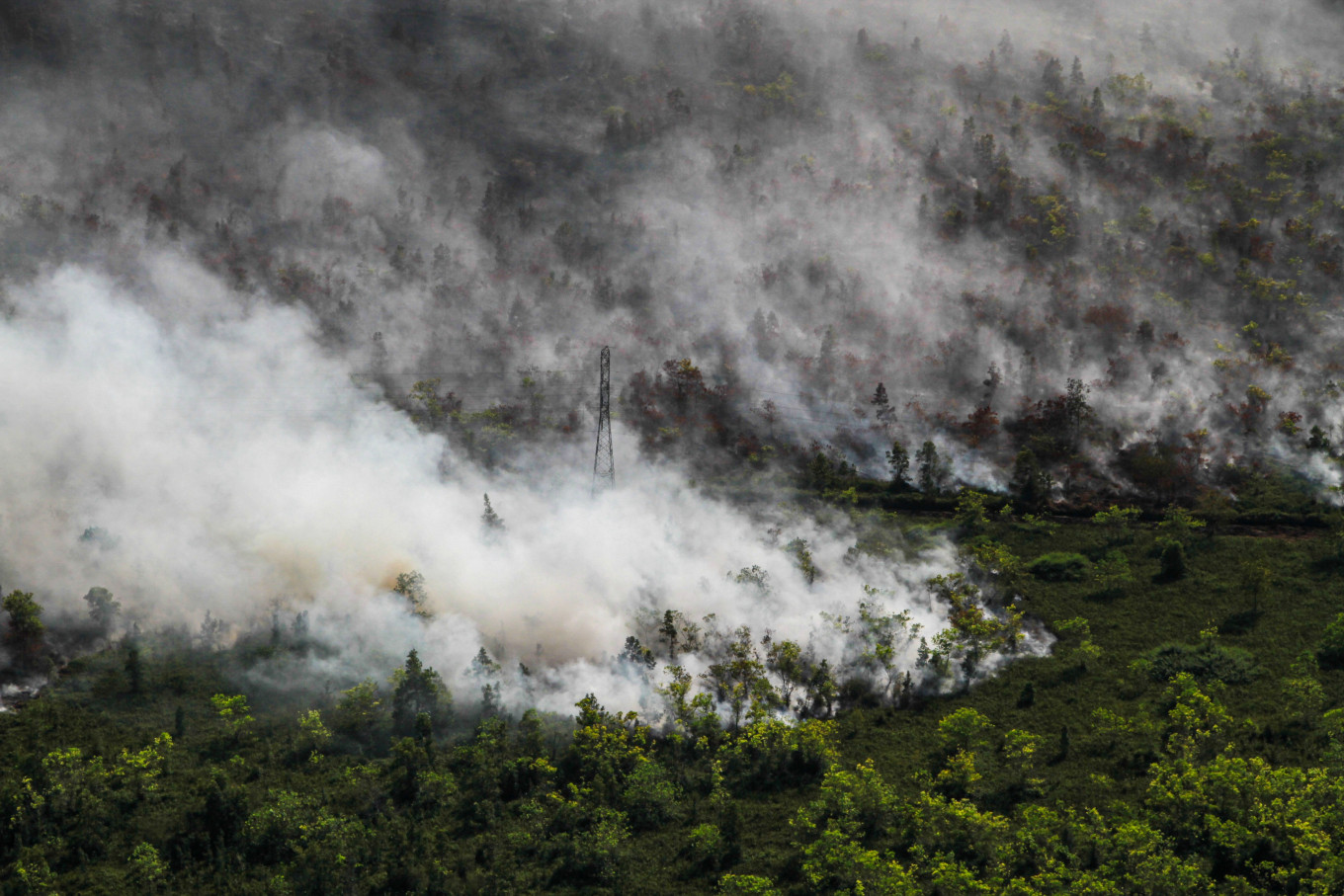 Thick smoke rises from a forest and land fire on Tuesday in Tumbang Nusa village, Pulang Pisau regency, Central Kalimantan, Indonesia. The Central Kalimantan provincial government has declared a forest and land fire emergency through Oct. 31. As of Monday, fires had burned 1,715.14 hectares across 907 incidents in the province. (Antara/Auliya Rahman)
I
ndonesia may be heading toward its worst wildfire season in years as fire activity surges ahead of peak burning months, fueled by a prolonged dry spell expected to intensify under a strong El Niño.
Government data and independent analysis show that burned areas and fire hot spots have surpassed levels recorded during the same period in 2019, when Indonesia suffered one of its most destructive fire seasons in recent history.
According to the Forestry Ministry's Sipongi wildfire monitoring platform, around 107,000 hectares of land and forest, an area nearly twice the size of Jakarta, burned nationwide in the first half of the year. The figure is 120 percent higher than during the same period in 2019.
Independent forest monitoring platform Nusantara Atlas recorded 116,000 fire hot spots across the country since January, about 6,000 more than during the corresponding period in 2019. More than 3,100 hot spots were detected between Aug. 3 and Aug. 4 alone, with the highest concentrations in East Nusa Tenggara, West Kalimantan, Riau and South Papua.
The warning signs are already evident in several regions. In West Kalimantan, which has recorded the country's largest burned area this year, authorities have extended a haze emergency alert until Nov. 15 after detecting more than 200 hot spots in a single day late last month.
Read also: Crop failures threaten Indonesia as dry season drags on

The Meteorology, Climatology and Geophysics Agency (BMKG) has forecast a strong El Niño to persist through the first quarter of 2027. Combined with a positive Indian Ocean Dipole, the climate pattern is expected to prolong drought conditions across much of Indonesia, increasing the risk of more widespread fires.