TheJakartaPost
Please Update your browser
Your browser is out of date, and may not be compatible with our website. A list of the most popular web browsers can be found below.
Just click on the icons to get to the download page.


Popular Reads
Top Results
No results found. Please check your search term and try again
Can't find what you're looking for?
View all search results
Popular Reads
Top Results
No results found. Please check your search term and try again
Can't find what you're looking for?
View all search resultsEditorial: Paying for your college
Underpinning the current controversy over the new law that frees universities to charge tuition fees is the perennial question of whether higher education is a right that should be accorded to all citizens or a privilege for the few
Change text size
Gift Premium Articles
to Anyone
Share the best of The Jakarta Post with friends, family, or colleagues. As a subscriber, you can gift 3 to 5 articles each month that anyone can read—no subscription needed!

Underpinning the current controversy over the new law that frees universities to charge tuition fees is the perennial question of whether higher education is a right that should be accorded to all citizens or a privilege for the few.
Those opposing the Law on the Legal Entity of Education Institutions, endorsed by the House of Representatives last week, believe that attending college is a basic human right, a natural extension of the existing right to a free education for all.
Those who support the new law, on the other hand, believe that college is really the privilege for a few citizens: It is for those who can afford it and for those who have the necessary intelligence and ability to complete the gruesome and often taxing academic experience.
The fact of the matter is that college, or any education for that matter, comes at a price.
Nothing is ever free, even as we continue to refer to our "free education" system. There is a price to pay in organizing schools or universities, and someone -- if not the students or their parents -- have to bear the costs.
The concept of free education refers to the fact that the costs will not be a burden for students or parents, but rather for someone else -- usually the state.
In Indonesia, the state has the constitutional duty to ensure that every child is able to attend the first 12 years of school for free. Taxpayers collectively pay for this education and not the parents.
But the question is whether this state subsidy should be extended to those who pursue higher education.
This is something that society should decide, and this is exactly the debate that the House of Representatives went through before enacting the law last week.
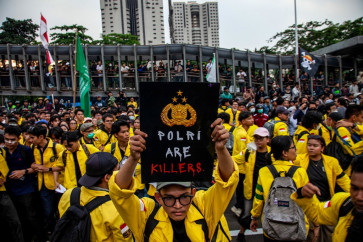
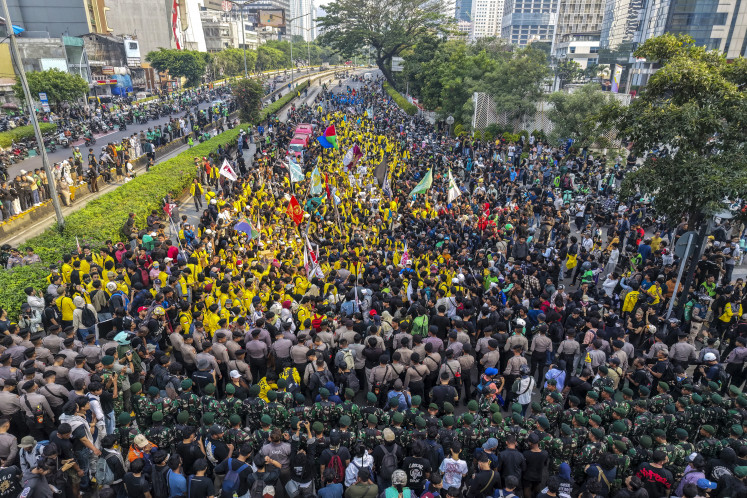
Typically, the real debate only began as soon as the House endorsed the bill, rather than before; and typically too, some protests by students have turned violent and ugly.
Until the recent past, the University of Indonesia (UI), arguably one of the best higher learning institutions in the country, had enjoyed a huge state subsidy that kept tuition more affordable for those lucky enough to be enrolled.
UI students in the past enjoyed the best of both worlds: High quality education at an affordable rate.
But UI, along with other state colleges that have received generous state assistance, could only enroll up to 70,000 students a year, compared to the number of applicants which was at least 10 times that each year.
The less unfortunate ones have had to turn to privately run universities, paying higher tuitions fees. While a handful of these private universities have built solid academic reputations, most were liable to be costly. Certainly, compared to the state-run colleges, you got less value for your money.
Like many state subsidized programs, most of the money did not necessarily go to the needy. In fact, a quick look at the parking lot of UI's Depok campus indicates the presence of many free riders.
They don't need the subsidy, and the money could instead have gone to more needy students. The subsidy scheme for universities was another gross example of the misallocation of scarce resources.
The new law regulating the legal entity of the universities should be seen as an attempt to correct this anomaly.
State universities that have been the biggest recipients of government subsidies will have to become not only financially sustainable but also financially independent.
Some "commercialization" as the opponents of the law call it, is not only inevitable, but also necessary.
The majority of students must pay the full cost of higher education because they can afford it. A minority, those who have the intelligence but are poor, should be given financial assistance.
The message that the new law has sent is that the rules of the game have changed. With all its flaws, the law is still much better -- and certainly more fair -- than the previous mechanism where subsidies were arbitrarily given and went primarily to those who least deserved it.
We are all for inexpensive higher education, but we must also be realistic and make sure that those who can, pay, and those who cannot, shall receive assistance.
The challenge for Indonesia is not in making college as inexpensive as possible, but in making many more places available at an affordable price. The new law will go a long way in meeting this challenge.