TheJakartaPost
Please Update your browser
Your browser is out of date, and may not be compatible with our website. A list of the most popular web browsers can be found below.
Just click on the icons to get to the download page.


Popular Reads
Top Results
No results found. Please check your search term and try again
Can't find what you're looking for?
View all search results
Popular Reads
Top Results
No results found. Please check your search term and try again
Can't find what you're looking for?
View all search resultsIn search of best infrastructure development
Infrastructure development is the main issue on our economic growth agenda
Change text size
Gift Premium Articles
to Anyone
Share the best of The Jakarta Post with friends, family, or colleagues. As a subscriber, you can gift 3 to 5 articles each month that anyone can read—no subscription needed!

I
nfrastructure development is the main issue on our economic growth agenda. Although it is common to hear calls for more infrastructure development, I find people frequently misunderstand the real meaning of infrastructure.
The common misperception is caused by excessive simplification of the term infrastructure, or overuse of the term in the incorrect context. We understand that the physical development of infrastructure will stimulate the economy, but to say that all infrastructure development translates into economic growth is essentially wrong.
Infrastructure is a group of physical and non-physical fundamental systems that support a population of people and help sustain their productivity.
Building roads or sewer systems is part of infrastructure development. Expanding power and utility services is infrastructure and trains and railway systems are considered infrastructure as well.
Improved sewer and water systems may benefit people in terms of hygiene and sanitation, but this specific improvement hardly contributes to direct economic growth.
In the last several years in America, non-physical development has been considered vital to providing safe and efficient coordination of infrastructure services.
This recent development includes various improvements to emergency responses and communication hierarchies and centralized management systems for infrastructure.
If we are to formulate a national plan for economic growth, then we have to start looking at what specific infrastructures we need to develop. In practice, not all investments in infrastructure are effective and able to produce real economic results.
To understand how infrastructure coincides with the economy, infrastructure development should be divided into two different platforms: production and logistics.
On production, infrastructure provides access to power and utilities. Farming and manufacturing in Indonesia still require a larger power supplies and utility services such as clean water and drainage. The lack of infrastructure support, particularly in drainage systems, has resulted in harvest failures that caused the recent price hike of primary consumer goods.
Developing drainage systems for agriculture is never about the application of high-technology. As opposed to power development, utility and drainage systems have been constructed for hundreds of years, but reliable drainage systems remain a continuous problem in Indonesia.
Economic growth in manufacturing and industry also relies on consistent access to power. The main challenge for power development in Indonesia is improving power’s accessibility in distant areas.
Along with the current development of coal power plants, we need to develop new sources of power, either in renewable or alternative energy. But if we consider our geographic conditions, wind power will be more beneficial and applicable in remote areas.
The fact that wind power is widely available everywhere at no cost will be beneficial for Indonesia in the long run. In 2009, China installed 13.8 gigawatts (GW) of new wind energy devices, later increasing the total to 25.8 GW.
China is still developing wind power capacity and is projecting at least 150 GW of power in the next 10 years, possibly up to 230 GW. If the project is completed, by 2020 China could replace 200 coal-fired power plants, reducing 410 million tons of carbon dioxide emissions and 150 million tons of coal consumption.
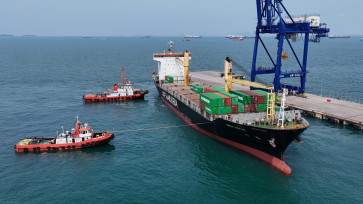
The second platform in which infrastructure helps the economy is logistics. Construction of roads, bridges, railways, airports, docks and harbors is considered the kind of infrastructure development that supports all kinds of economic activities, including the maritime, agricultural and manufacturing industries.
There have been many land transportation projects developed nationwide, but statistically speaking, current conditions are actually far from efficient for logistics.
The average travel cost for goods in Indonesia is 34 US cents/kilometer. This is actually 150 percent more than the average cost in Asia, which is 22 US cents/kilometer.
We know that a big project is currently underway to build a bridge connecting Java and Sumatra, but with respect to our geographic conditions, Indonesia needs more infrastructure development for water transportation.
If we are willing to improve Tanjung Priok and reengineer the harbor so that it is 5 meters deeper, the harbor’s ship capacity will increase threefold.
Logistics in Indonesia are so inefficient that it actually costs more to deliver containers from Semarang to Jakarta than it does from Jakarta to Singapore.
We still need to build roads in rural areas and improve other types of land transportation, but we must not neglect the fact that Indonesia is separated by wide seas and oceans.
Economic growth can only be achieved if we build the right project at the right time. In either logistics or production platforms, choosing the right infrastructure project is very important. Overall physical and non-physical conditions have to be evaluated, including the feasibility of the project.
Infrastructure projects typically require large sums of money, and to avoid losses a financial arrangement has to be specifically planned and distributed to the right platform.
The US is now suffering from economic losses due to unhealthy budget allocations in infrastructure. The famous $787 billion stimulus bill allocated a $150 billion budget for infrastructure.
The initial plan was, as US President Barack Obama described it, “the largest new investment in our nation’s infrastructure since Eisenhower built an interstate highway system in the 1950s.”
Eventually only $64 billion (43 percent of the $150 billion) was absorbed by infrastructure projects such as public transport, railways, roads, bridges, aviation and wastewater systems. This happened mostly because some of the projects were misplaced and not applicable at the time.
Planning for the best and most feasible projects is the main key to achieving success in infrastructure development. If the market or the people are not ready, then a giant budget will produce nothing in return.
The writer is a member of the American Society of Civil Engineers (ASCE), an association of professionals in infrastructure development.