The Jakarta Post
Please Update your browser
Your browser is out of date, and may not be compatible with our website. A list of the most popular web browsers can be found below.
Just click on the icons to get to the download page.


Popular Reads
Top Results
No results found. Please check your search term and try again
Can't find what you're looking for?
View all search results
Popular Reads
Top Results
No results found. Please check your search term and try again
Can't find what you're looking for?
View all search resultsIndonesian businesspeople explore Italian farming machinery
A group of Indonesian businesspeople recently visited Italy with an invitation from Jakarta's Italian Trade Agency (ITA) to explore the Italian market for farming machinery
Change text size
Gift Premium Articles
to Anyone
Share the best of The Jakarta Post with friends, family, or colleagues. As a subscriber, you can gift 3 to 5 articles each month that anyone can read—no subscription needed!

A
group of Indonesian businesspeople recently visited Italy with an invitation from Jakarta's Italian Trade Agency (ITA) to explore the Italian market for farming machinery.
The businesspeople along with a representative from the Indonesian Farmers Association (HKTI) and a journalist from The Jakarta Post had the opportunity to visit the International Exhibition of Agriculture and Groundskeeping Machinery (EIMA) in Bologna, Northern Italy, about an hour flight from Rome. This exhibition ' the world's biggest ' hosted 1,800 exhibitors from 45 countries and lasted from Nov.11 to 16.
Everything from the tiniest parts of farming machines to the biggest tractors were exhibited at the exhibition that took place at BolognaFiere, an exhibition center that is 10 times bigger that the Jakarta International Expo in Kemayoran, North Jakarta.
'The Indonesian market has been showered by cheap farming equipment but much of it is rather low quality. So this is a perfect opportunity to expand and explore the market,' Johny Sinaga, one of the businesspeople, said, during the exhibition.
Another member of the Indonesian delegation, Neni Nuraeni, who is the marketing manager of PT Rajawali Kencana Abadi, said the Bologna visit was a defining step for her company in seeking the right products and business partners.
'But this is only half the journey. There will be several other meetings and presentations before we can sell these machines in Indonesia,' she said.
Johny acknowledged that the market in Indonesia for quality Italian farming machinery was still small. While commenting on the market in Indonesia he said, 'One or two out of 10 customers have asked about these quality farming machines.'
There is a small Indonesian market for such high quality Italian machines because the Italian companies are competing with companies that create cheaper farming machinery. This low cost strategy for manufacturing machinery has already been applied by most of the local and regional players.
Besides the expensive prices for Italian machinery, Johny continued, another challenge was establishing after-sales services so that customers would feel secure about buying the products.
'My job wouldn't stop after selling the machinery. I would also be responsible providing after-sales services,' he said.
Johny suggested that once he was able to partner with an Italian company that offered competitive prices along with good after-sales services then he could stand head-to-head with the local and regional competitors.
In response to this, Italian machine manufacturers agreed that competing with less expensive farming equipment that permeates the industry in Indonesia was their biggest challenge in the Asian market.
Paolo Pettirossi, area export manager for Dondi, an Italian manufacturer leading the distribution of rotary ditchers, said his company could not jeopardize the quality of their machinery by applying the same sort of cheap-price strategy that has been applied by many of the competitors in Asia.
'The main problem is the price for the customer. We are now looking for some good importers to sell our good-quality products,' said Pettirossi.
He acknowledged that to date the market was full and that therefore the company was searching for new marketing strategies.
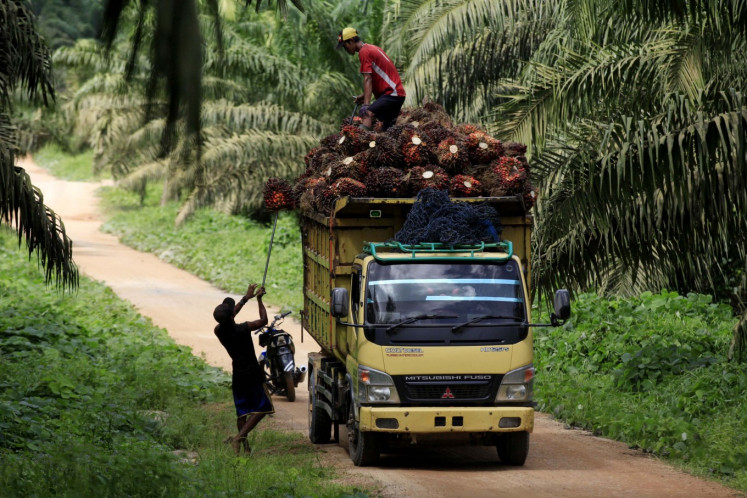
One of the strategies that was being considered was directly approaching the biggest players in the region, palm oil plantations. Pettirossi said Dondi was trying to understand the needs of the industry before designing its marketing strategies.
The same path had been taken by Nardi, another big name in the farming machinery manufacturing industry in Italy.
'Palm oil is a growing industry in Indonesia and the suitable machine that we sell for this industry is the spring machine,' said Vittorio Nardi, an area export manager at Nardi.
Nardi said that over the past five years the company had managed to sell 20 machines. And 'that is why we need a distributor in the area', he said.
Similar to Pettirossi, Nardi said the cheaper equipment that is widely used in Indonesian farms is still a big challenge for his company. He plans to overcome this hurdle by educating consumers before entering the market. 'Having good quality products will help your productivity,' is his central message.
Indonesia's farming machinery market has long been showered by equipment from Asian countries like China, Thailand and India that is less expensive than equipment produced by Western manufacturers. The simplest hand tractor from China, for instance, goes for less than half the price of the Western counterpart, which ranges from Rp 10 million to Rp 15 million per unit.
Such a competitive market ' compounded by the fact that many European countries are still working their way out of the recession ' left few choices to the Italian farming machinery manufacturers and their Western counterparts aside from considering new strategies to enter the growing market in Asia.
The trade commissioner of Jakarta's Italian Trade Agency, Samuele Porsia, outlined the strategy currently being implemented by the Italian companies: approach major palm oil corporations first in an attempt to set an example that the rest of the industry will follow.
'We are trying to convince our Indonesian customers that our equipment is of a high value. However, we realize that we can't compete with the cheap machinery. Therefore, we are making offers to the big players so they can improve productivity by upgrading,' he said.
Porsia said the agency had been very active trying to arrange for Indonesian businesspeople to conduct business with their Italian counterparts. He said the agency had managed to assist dozens of Indonesian businesspeople who went to Italy for business meetings.
'In particular, we encourage businessmen from both countries to build joint venture business,' he said.
In order to promote Italian commodities, the agency has issued a booklet that showcases quality Italian commodities that are available in Indonesia.
Porsia acknowledged that to date the farming machinery business was still small compared to other businesses like leather goods and footwear but he was convinced that the farming machinery business would soon experience growth.
Even though some of the Italian businesspeople at EIMA were struggling to figure out how to sell their high-quality equipment to Indonesian farmers, FederUnacoma ' the Italian Agricultural Machinery Manufacturers Federation ' was not having any trouble at all.
HKTI's executive director Andriyono Kilat Adhi said he signed a contract with FederUnacoma to procure 400 land tractors for Indonesian farmers.
'FederUnacoma has agreed to send us 400 tractors to help increase our farmers' productivity. Let us hope that the tractors will be used properly,' Andriyono said recently.
He said he had met with representatives from FederUnacoma during the EIMA exhibition. Currently, he added, he had been asked to write a full report on the specific types of land that were used by the Indonesia farmers who would be using the equipment.
For example, Andriyono continued, the type of land for rice fields in Karawang, West Java, would be different from the land in Sumatra or Sulawesi. These differences in soil would determine the kind of tractors that the farmers would get.
However, he added, once the tractors arrived they would not be put to personal use.
'The tractors will be used by farmers' associations. They will be using it in turns,' he said.
Andriyono said that once the report was done then they would send it to FederUnacoma for examination. A team from FederUnacoma would likely visit Indonesia next year for verification and to conduct a training program for Indonesian farmers on how to operate the tractors.
A group of Indonesian famers would be selected to visit Italy for further study and training. These training and study sessions would focus on increasing productivity.
Commenting on this, Porsia said the contract was part of the cooperation between FederUnacoma and HKTI and was the result of the agency's arrangements.
'They have been moving ahead with their cooperation. The contract has been signed and a team from FederUnacoma will visit Indonesia next year,' Porsia concluded.