TheJakartaPost
Please Update your browser
Your browser is out of date, and may not be compatible with our website. A list of the most popular web browsers can be found below.
Just click on the icons to get to the download page.


Popular Reads
Top Results
No results found. Please check your search term and try again
Can't find what you're looking for?
View all search results
Popular Reads
Top Results
No results found. Please check your search term and try again
Can't find what you're looking for?
View all search resultsThe Asian grammar of power
If Trump is willing to listen, he will be far more likely to communicate effectively with Asians and achieve positive results from this tour.
Change text size
Gift Premium Articles
to Anyone
Share the best of The Jakarta Post with friends, family, or colleagues. As a subscriber, you can gift 3 to 5 articles each month that anyone can read—no subscription needed!
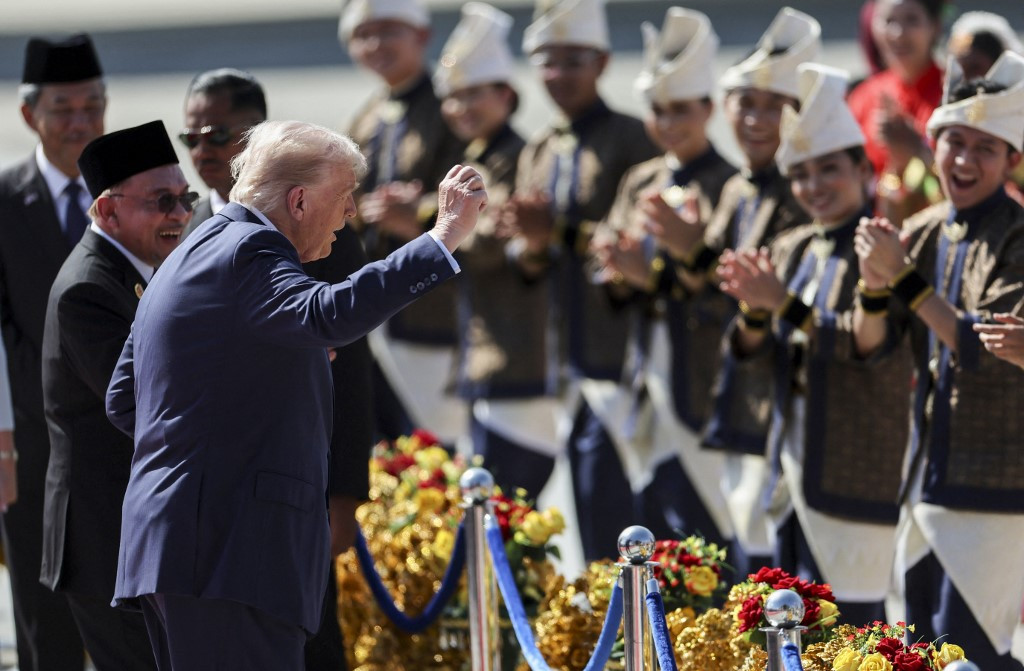 United States President Donald Trump (center) joins performers for a dance during the welcome ceremony next to Malaysia's Prime Minister Anwar Ibrahim (left) as he arrives on Air Force One at Kuala Lumpur International Airport in Sepang, Malaysia, on Oct. 26, 2025. (AFP/Hasnoor Hussain)
U
nited States President Donald Trump is visiting Malaysia, Japan and South Korea this week and enjoying another batch of spotlights as he usually does. However, many in Asia feel uncomfortable, and it is unclear whether he is communicating effectively with Asians.
He prides himself on being a smart realist, often invoking a tough, transactional style that he and his followers associate with Machiavelli. Yet political traditions in Asia are different. Many insist that power is most effective when it wins compassion from the people rather than mere obedience, and when it places legitimacy before spectacle and coercion.
If Trump is willing to listen, he will be far more likely to communicate effectively with Asians and achieve positive results from this tour.
In the Confucian world, politics is not simply a technology for extracting compliance; it is a moral craft aimed at building trust. The classics contrast two archetypes. The politics of force relies on intimidation, punishment and fear. The politics of virtue relies on example, justice and benevolence. The first may secure short-term concessions; the second consolidates long-term stability. It is hard-earned knowledge in Asia about how human communities really work, whether in a village, a corporation or an international order.
Confucius pictured the virtuous ruler as the North Star: steady, unmoved by provocation and therefore a reference point that others naturally orbit. The metaphor still resonates. A leader who demonstrates self-control, fairness and respect does not need to shout. His or her consistency is the message; dignity is the policy.
When leaders embody credibility, attention arrives on its own. Respect, therefore, is not a luxury sentiment; it is the operational core of durable rule. Fear can halt dissent for a season, but it cannot command devotion. People may comply with what they resent, yet they rarely defend it when it is threatened.

Respect grows when leaders demonstrate fairness to opponents, courtesy to partners and restraint toward the weak. The goal is not to appear soft or weak; it is to be unassailable because one is recognized as just. A ruler’s dignity must rest on respect, not fear and on trust, not calculation. That kind of dignity multiplies power because others choose to align with it.
Asian statecraft also insists that good policy depends on good timing. Mencius said that success requires mastery of “heaven, earth and human harmony,” that is, time, space and morale. Though he ranked harmony the highest, the lesson also teaches that even a brilliant plan fails if pursued at the wrong moment or in the wrong place.
Modern strategists echo this with a different vocabulary. To act effectively is to sequence, to pace, to wait for the moment when small moves change the board. Impulse may thrill crowds, but timing changes outcomes.
All of this points to a familiar but often neglected truth: The best victories are those that make conflict unnecessary. A Chinese military strategist, Sun Tzu, called it winning without fighting in his work The Art of War. That requires alliance management based on reciprocity rather than intimidation, and public diplomacy that makes the US admired rather than merely feared. It means replacing tariff theatrics with fair, predictable rules; linking national strength to shared prosperity; and widening the circle of stakeholders who want the US to succeed because their own futures are tied to its integrity. Coexistence is not capitulation. It is a strategy for multiplying friends and shrinking the space in which enemies can operate.
Asian thought never romanticized the people; it respected them. Confucius taught that the people are the foundation of the state. Machiavelli, in a surprising convergence, observed that the goodwill of the people is the best fortress. Both were realists about human nature. Support cannot be commanded indefinitely; it must be renewed by performance and justice. Leaders who obsess over applause lose the independence required for real judgment. Leaders who scorn public sentiment eventually discover they have no one left to govern. The balance is to heed the people without becoming hostage to passions.
Because leaders are fallible, robust governance requires a culture of counsel. Emperor Taizong of the Tang dynasty in China welcomed ministers who contradicted him. Wang Geon, the first king and the founder of the Goryeo kingdom in Korea, institutionalized frank remonstrance.
The purpose was not to humiliate rulers but to save them from their blind spots. In a modern democracy, this spirit becomes freedom of speech, independent media and checks and balances. Encouraging criticism is not a concession to enemies; it is a pledge to one’s own future self, the moment when evidence proves yesterday’s certainty wrong. A leader secures enough confidence to invite dissent and converts potential crises into self-corrections.
Humane rule perfects realism by supplying it with legitimacy, timing and consent. Power without virtue burns fast and leaves ash. Virtue without power fails to protect the good it intends. The art is to align capability with character, to let moral authority steer strategic action. That alignment turns temporary deals into lasting settlements, transactional coalitions into real alliances and domestic factions into a governed public. It makes a nation not merely strong, but worthy of its strength.
The wisdom in Asia might be useful even to the US president when he or she talks with counterparts from Asia. It is for making others stronger, not smaller; for thickening the peace, not rehearsing the fight; for turning fear into respect and rivalry into responsible competition.
The ruler who governs with virtue leads without shouting. The leader who earns trust commands without coercion.
If Trump leaves Asia believing that intimidation is the short-sighted approach that nibbles away at greatness, he will have good talks and relations with Asian leaders.
If he leaves convinced that legitimacy amplifies power, that timing is strategy and that respect is security, he will achieve a lot of successes, including a Nobel Prize. That would be a genuine triumph not just for Trump, but for diplomacy itself.
---
The writer is an adjunct professor at Sogang University. The views expressed are personal.