TheJakartaPost
Please Update your browser
Your browser is out of date, and may not be compatible with our website. A list of the most popular web browsers can be found below.
Just click on the icons to get to the download page.


Popular Reads
Top Results
No results found. Please check your search term and try again
Can't find what you're looking for?
View all search results
Popular Reads
Top Results
No results found. Please check your search term and try again
Can't find what you're looking for?
View all search resultsBeyond the theories: What Indonesian classrooms need
Indonesia possesses the capacity not merely to catch up with the West, but to forge its own distinctive path forward.
Change text size
Gift Premium Articles
to Anyone
Share the best of The Jakarta Post with friends, family, or colleagues. As a subscriber, you can gift 3 to 5 articles each month that anyone can read—no subscription needed!
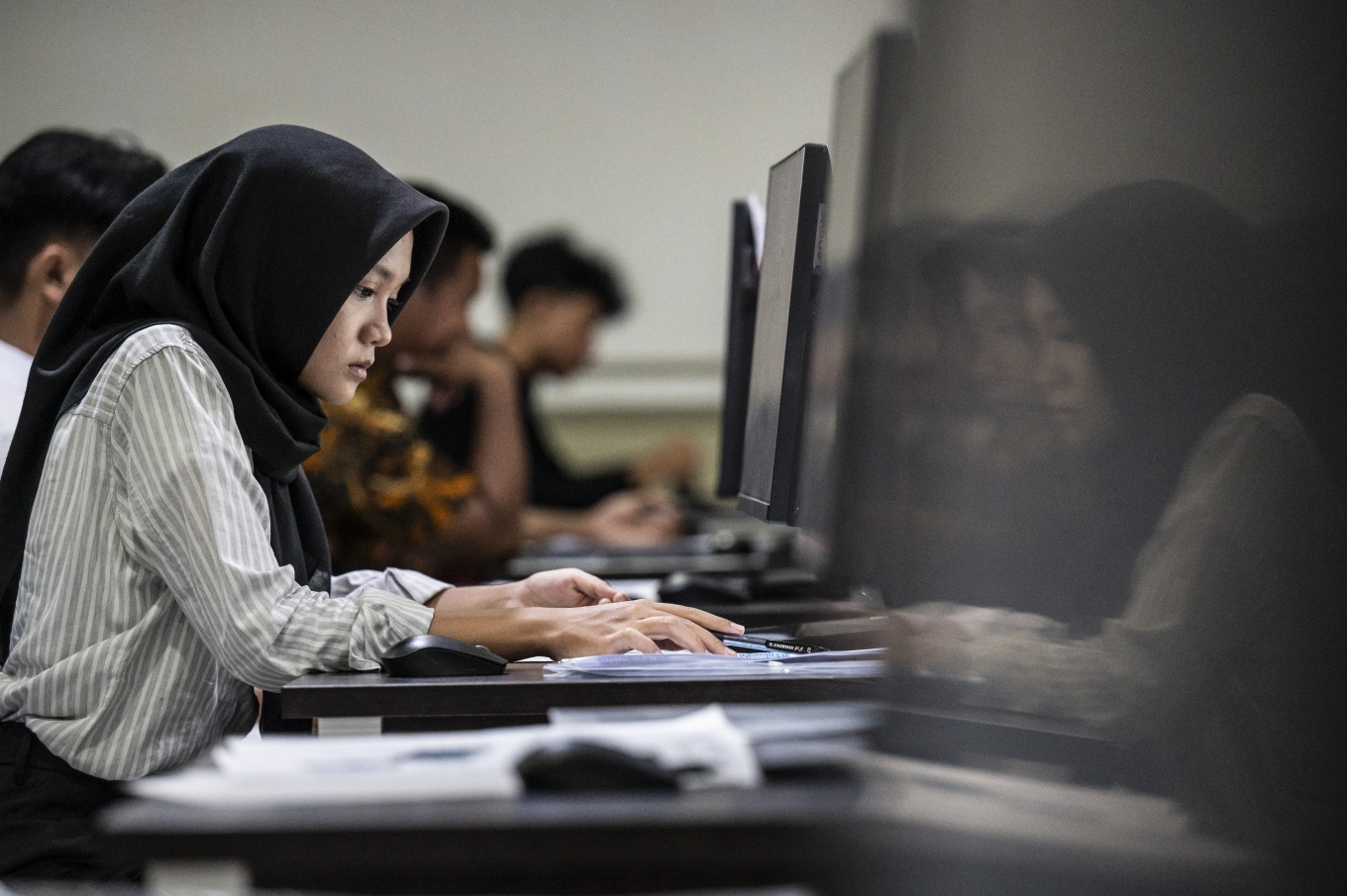 A participant takes the 2025 Computer-Based Written Exam for the National Selection-Based Test (UTBK-SNBT) at Diponegoro University (UNDIP), Tembalang, Semarang, Central Java, on April 30, 2025. (Antara/Aprillio Akbar)
I
vividly remember my first visit to Indonesia in December 1987, when I delivered seminars on finance and economics at the University of Indonesia (UI) and Gadjah Mada University (UGM). It was merely a month after the global stock market crash, yet what stayed with me was not the memories of the financial market turmoil, but the classroom encounters that have since profoundly influenced my pedagogical approach.
While the Socratic method encourages open debate, Asian classrooms, particularly in Indonesia, tend to emphasize collaboration over confrontation. Indonesian students excel in teamwork, drawing on the cultural value of gotong royong (mutual cooperation) deeply embedded in its social fabric, to harmonize diverse perspectives and work cohesively.
This collective mindset not only enhances creativity and problem-solving in academic settings but also aligns closely with the demands of Indonesia’s business environment, where success relies on collaboration, consensus-building and strong interpersonal relationships.
Those experiences taught me that education is never a one-size-fits-all endeavor. Years later, as Asia rises to prominence in the global economy, I see its youth emerge as future leaders, and the lesson I learned remains clear: local context matters. Educational institutions must go beyond teaching theories and create frameworks that connect global knowledge with regional realities, including fostering partnerships that transcend borders.
What began as a series of lectures in Indonesia evolved into decades of engagement across Asia, revealing a region in constant transformation. The dynamics I witnessed in classrooms mirrored the economic trajectory outside them. Asia has long been a crucible of innovation, from Japan’s manufacturing ascendancy in the 1970s to the emergence of the “Four Tigers”: Singapore, Hong Kong, Taiwan, and South Korea. Between the 1960s and 1990s, these economies sustained GDP growth rates exceeding 7 percent annually, significantly outpacing Western counterparts, driven in part by robust education systems.
Today, Indonesia stands at a similar inflection point. Much like the Four Tigers a generation ago, it possesses the capacity not merely to catch up with the West, but to forge its own distinctive path. By 2021, Indonesia rebounded from the pandemic with 3.2 percent growth, and by 2022, it accelerated to 5.31 percent, outpacing even Thailand and Malaysia. This resilience underscores a vital lesson for educators: Economic potential thrives when paired with adaptive learning environments.

Indonesia’s scale and diversity offer fertile ground for entrepreneurial ventures. Consider Gojek, which transformed the informal ojek (motorcycle taxi) network into a regulated, tech-driven platform, inspiring policy changes to protect ride-hailing workers. Or Kopi Kenangan, which reimagined coffee culture and became Indonesia’s first food and beverage unicorn within four years and is now expanding internationally. These stories are more than business case studies, they are reminders that creativity flourishes when education equips students to see inefficiency and gaps in society as opportunities.