The Jakarta Post
Please Update your browser
Your browser is out of date, and may not be compatible with our website. A list of the most popular web browsers can be found below.
Just click on the icons to get to the download page.


Popular Reads
Top Results
No results found. Please check your search term and try again
Can't find what you're looking for?
View all search results
Popular Reads
Top Results
No results found. Please check your search term and try again
Can't find what you're looking for?
View all search resultsAnalysis: Sumatra's flood aftermath and the consequences of fiscal neglect
Change text size
Gift Premium Articles
to Anyone
Share the best of The Jakarta Post with friends, family, or colleagues. As a subscriber, you can gift 3 to 5 articles each month that anyone can read—no subscription needed!
 Set as preferred source
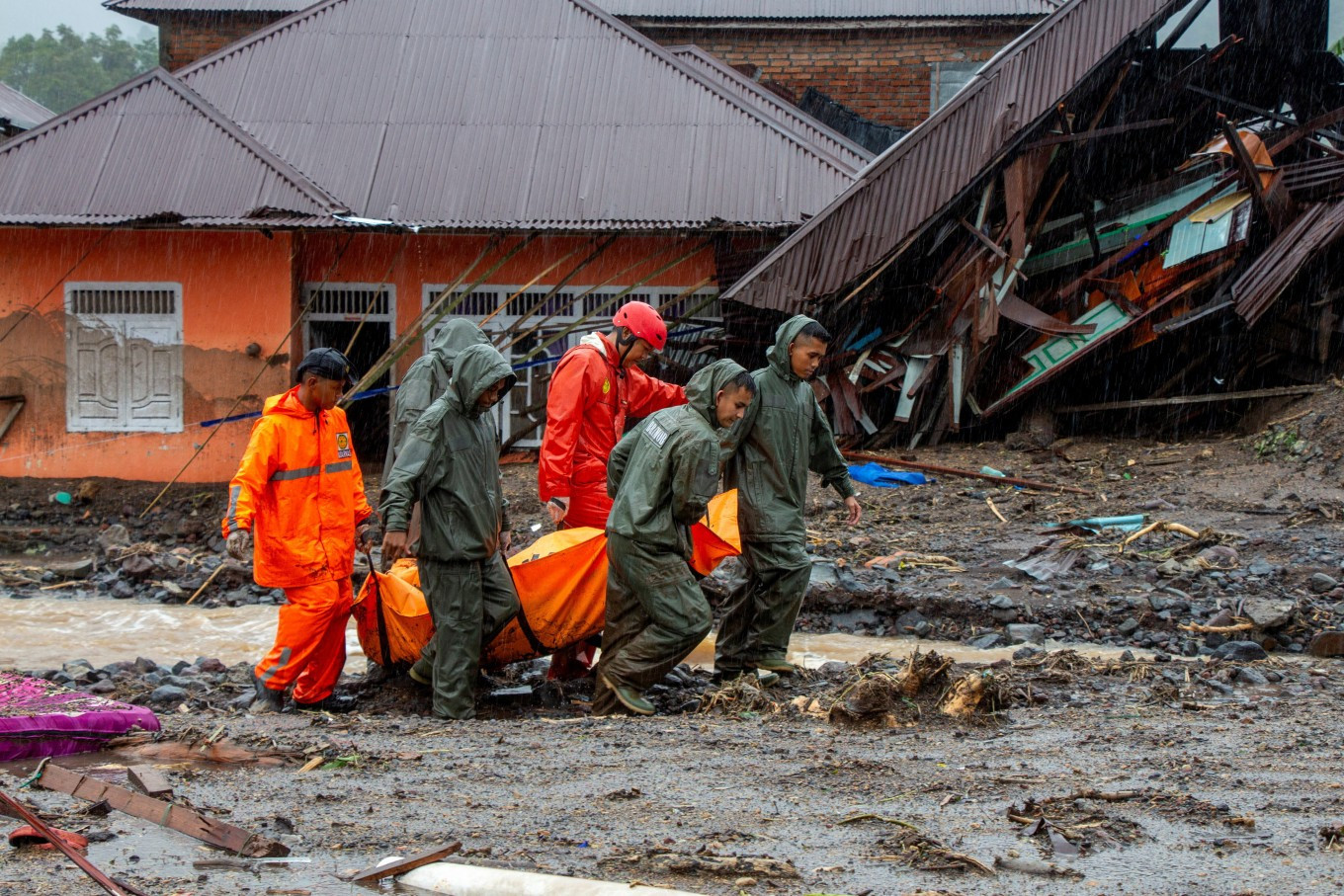 Rescuers carry a body bag of a victim recovered on Friday from an area hit by flash floods following heavy rains in Malalak District, Agam Regency, West Sumatra. (Reuters/Stringer)
G
rief has engulfed Sumatra. Flash floods and landslides have devastated the provinces of Aceh, North Sumatra and West Sumatra, leaving behind not only the ruins of homes and infrastructure but also the deepening realities of hunger, displacement and profound uncertainty. Yet the government's decision to slash disaster funding to its lowest level in years is now testing its ability to help the affected rebuild their lives.
The National Disaster Mitigation Agency (BNPB) estimates that recovery costs could amount to Rp 51.82 trillion (US$3.1 billion). But earlier this year, the BNPB suffered a major budget cut. The catastrophe has cast a harsh spotlight on President Prabowo Subianto's fiscal priorities and raised a troubling question: Were these cuts prudent decisions, or a miscalculation that has left Indonesia's disaster response dangerously underfunded?
The Meteorology, Climatology and Geophysics Agency (BMKG) confirmed that the extreme weather was driven by two active tropical cyclones that intensified moisture supply and triggered hours of heavy rainfall across northern Sumatra. The hydrometeorological disaster swept away homes, crippled communication networks, inundated agricultural land and resulted in hundreds of fatalities and widespread displacement. But the tragedy arrived just as Indonesia tightened its disaster budget, cutting the BNPB's allocation for 2025 and preparing even steeper reductions for 2026.
The BNPB's shrinking budget over the past five years tells a worrying story. In 2021, at the height of the COVID-19 response, the agency received Rp 7.1 trillion. This fell sharply to Rp 5.05 trillion in 2022, rose slightly to Rp 5.43 trillion in 2023, then slipped again to Rp 4.92 trillion in 2024. The deepest drop came in 2025, when the BNPB's budget plunged to just Rp 2.01 trillion. The draft 2026 state budget pushes the trend to an alarming extreme: The BNPB is slated to receive only around Rp 491 billion, its lowest disaster funding level in more than 15 years.
It is not only the BNPB that is affected. The Finance Ministry has also reduced regional transfer funds (TKD), long a vital source of emergency contingency funding (DTT). The cuts further weaken local governments' capacity to respond to disasters. For one of the world's most disaster-prone nations, such decisions demand urgent scrutiny as climate shocks intensify.
Disaster preparedness is clearly not a priority for the current administration, which has funneled the bulk of additional state spending into priority programs such as the Free Nutritious Meal (MBG) program. This initiative alone receives Rp 71 trillion this year. By 2026, the program's allocation is projected to surge to Rp 335 trillion, becoming a major driver of fiscal pressure. Although the MBG program promises economic and welfare gains, it should not come at the cost of weakening Indonesia's already strained disaster response capabilities. Disaster funding cannot be treated as a flexible budget line that can be trimmed to accommodate shifting political agendas.

For now, the response to the massive flooding across Aceh and Sumatra is being shouldered largely by regional budgets, while the central government has focused on distributing social assistance to affected communities. Finance Minister Purbaya Yudhi Sadewa said the BNPB still has Rp 500 billion available and that as much as Rp 60 trillion could be mobilized through state budget "efficiency" measures if necessary. But the source and sustainability of these funds remain unclear. Without transparency over what was trimmed to create these savings, it is difficult to determine whether this represents a genuine commitment to long-term recovery or merely short-term fiscal maneuvering. Emergency re-allocations, however helpful, cannot substitute for a stable and predictable disaster budget.