The Jakarta Post
Please Update your browser
Your browser is out of date, and may not be compatible with our website. A list of the most popular web browsers can be found below.
Just click on the icons to get to the download page.


Popular Reads
Top Results
No results found. Please check your search term and try again
Can't find what you're looking for?
View all search results
Popular Reads
Top Results
No results found. Please check your search term and try again
Can't find what you're looking for?
View all search resultsKartini’s spirit: AI and the quiet reinforcement of gender roles
In viewing the design, development and deployment of artificial intelligence, Kartini’s legacy reminds us that direction is a vital part of progress.
Change text size
Gift Premium Articles
to Anyone
Share the best of The Jakarta Post with friends, family, or colleagues. As a subscriber, you can gift 3 to 5 articles each month that anyone can read—no subscription needed!
 Set as preferred source
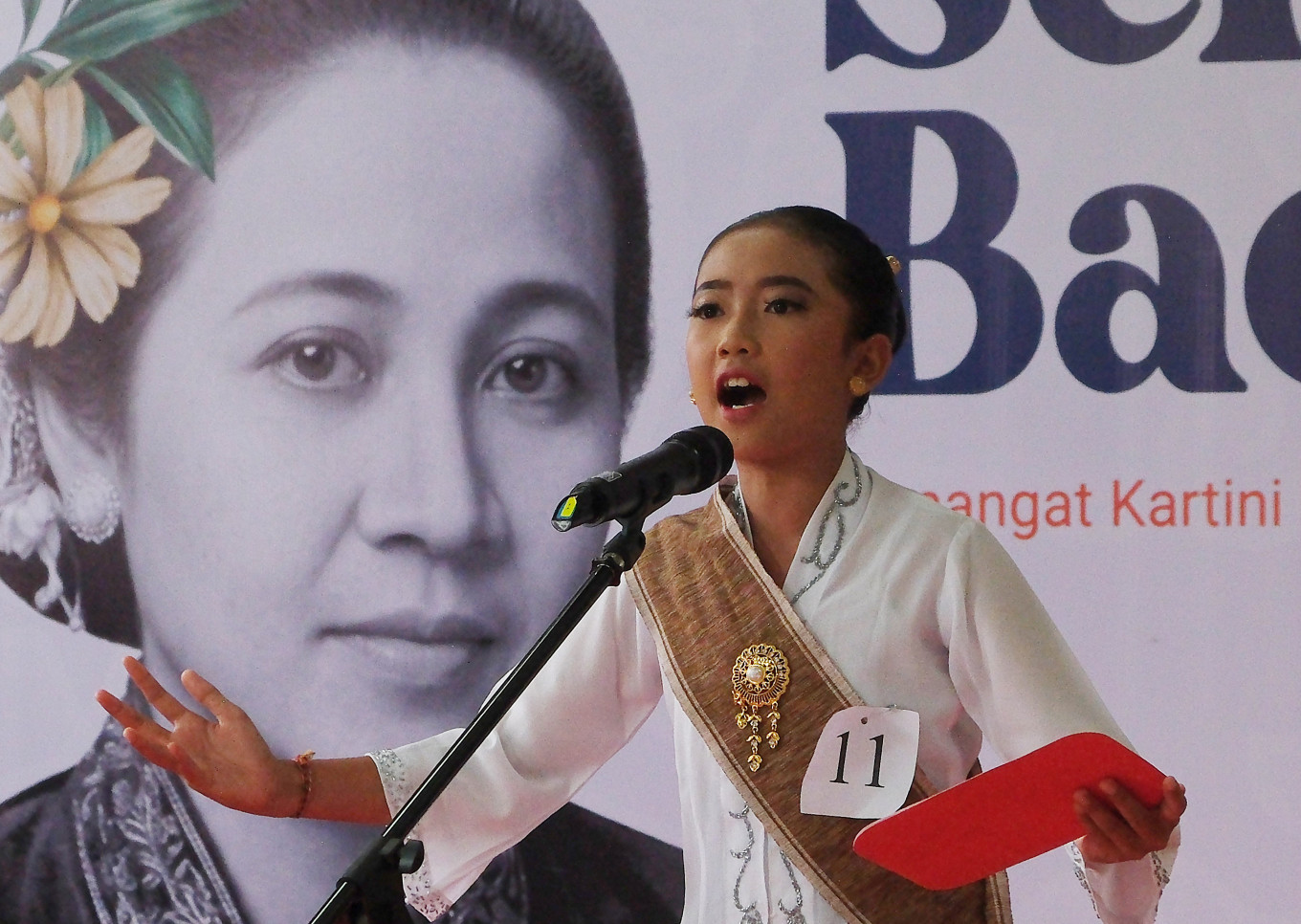 Emancipated voice: A student recites a poem on April 21, 2026, during a poetry reading competition involving 16 top elementary schools to mark Kartini Day in Badung, Bali. (Antara/Nyoman Hendra Wibowo)
A
s we marked Kartini Day on April 21, we might have wondered whether Raden Ajeng Kartini would have used generative artificial intelligence in her writing. Would she have relied on AI translation to refine her voice or turned to it for guidance in moments of uncertainty?
Kartini’s struggle was never confined to women’s emancipation alone. It was a broader call for justice, dignity and humanity. Her letters were deeply personal, grounded in lived experience and attentive to the inequalities surrounding her.
That spirit raises an uncomfortable question today. As AI becomes embedded in our daily lives, are we building technologies that reflect those values or drift further away from them?
Artificial intelligence is often celebrated as a force for democratization. It promises efficiency, accessibility and objectivity. But beneath this promise lies a more complicated reality: AI systems are trained on historical data, shaped by human decisions and deployed within existing social structures. Consequently, AI does not remove bias; rather, it reproduces and even amplifies those biases.
One of the clearest manifestations of this is the feminization of AI. From internationally available digital assistants like Siri and Alexa to locally developed systems such as the Ibu Online avatar, AI interfaces are frequently designed with female names, voices and personalities. They are polite, patient and accommodating. They apologize when misunderstood. They respond without resistance. They perform emotional labor on demand.
At first glance, this design choice seems harmless, even practical. But it is far from neutral. It reflects and reinforces a long-standing association between femininity and service. The expectation that women should be helpful, compliant and emotionally attentive is quietly encoded into the technologies we interact with every day.

This is not just a question of representation. It is a question of power.