The Jakarta Post
Please Update your browser
Your browser is out of date, and may not be compatible with our website. A list of the most popular web browsers can be found below.
Just click on the icons to get to the download page.


Popular Reads
Top Results
No results found. Please check your search term and try again
Can't find what you're looking for?
View all search results
Popular Reads
Top Results
No results found. Please check your search term and try again
Can't find what you're looking for?
View all search resultsPedagogy, the classroom and the banality of violence
When education is weaponized to manufacture hate, classrooms become the breeding grounds for state violence, a sobering reality that demands a radical shift toward a humanizing, critical way of learning.
Change text size
Gift Premium Articles
to Anyone
Share the best of The Jakarta Post with friends, family, or colleagues. As a subscriber, you can gift 3 to 5 articles each month that anyone can read—no subscription needed!
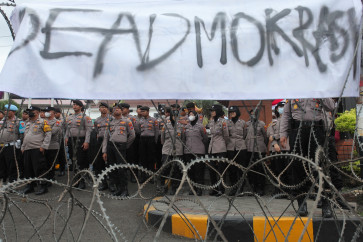
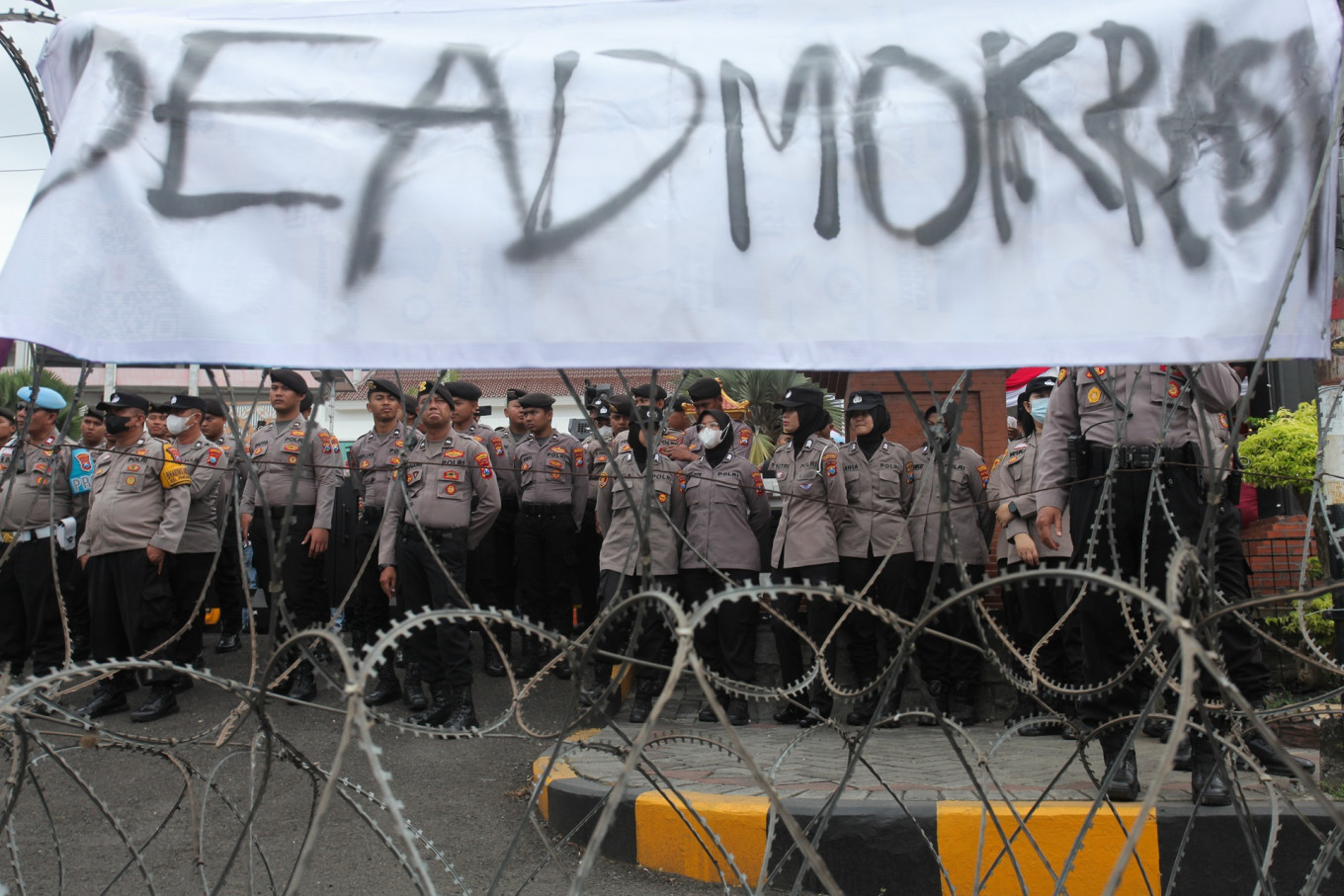 Police officers stand guard during a rally organized by university students in front of the East Java Regional Legislative Council (DPRD) in Surabaya, East Java, on Aug. 19, 2025. During the rally, protesters called for the government to scrap its controversial national history book project and push for protection of freedom of expression. (Antara/Didik Suhartono)
A
mid mounting geopolitical uncertainty fueled by the United States-Israeli war on Iran, the British alternative media channel Double Down News recently released a video monologue by American investigative journalist Abby Martin. The monologue reflects on her visit to Israel in 2016, years before the current war erupted, and is accompanied by footage from her field reporting at the time.
What Martin uncovered was, in many ways, more disturbing than the war itself: the normalization of violence within segments of Israeli society. Her report portrayed a community in which fascistic rhetoric could be expressed openly and without remorse. On the streets of Tel Aviv, she interviewed ordinary citizens who calmly, sometimes even smilingly, called for the annihilation of an ethnic community. The footage also captured a teenager casually declaring that “Jews shouldn’t marry Arabs [...] because Jews are a special nation”. In another clip, two teenage girls laughed as they said, “We need to kill Arabs.”
These encounters led Martin to conclude that the increasingly brutal conduct of the Israeli state and military did not emerge in isolation; rather, it was rooted in a genocidal mindset cultivated within parts of society itself. Such thinking has normalized attacks and unilateral land seizures carried out by illegal Israeli settlers against Palestinian residents. It also helps explain why Israel continues to find moral justification for striking Lebanese civilians even after ceasefire agreements have been signed.
Furthermore, this mindset explains why a senior Israeli minister recently treated the Global Sumud Flotilla activists, who were on a humanitarian mission to Gaza, with utter dehumanization, proudly showcasing his lack of guilt in the media.
How can a country that claims to be the Middle East’s only democracy become dominated by profoundly anti-democratic sentiments? Rather than upholding universal human rights, democracy is instead mobilized to legitimize radical ethnonationalism. It must be acknowledged, however, that there are segments of Israeli Jewish society that continue to oppose this ideology.
Education has played a crucial role in shaping this mindset. In this context, education functions to construct what historian Pierre Nora terms lieux de mémoire (realms of memory), sites where collective narratives are deliberately created, maintained and transmitted to preserve national identity. In Israel, virtually every student is prepared to become a soldier through compulsory military service, meaning schools effectively serve as a pre-military training phase. For an 18-year-old to pull the trigger at a checkpoint without moral hesitation, doctrines of self-supremacy and the dehumanization of the "other" must be instilled long beforehand.

In Palestine in Israeli School Books: Ideology and Propaganda in Education, Israeli academic Nurit Peled-Elhanan exposed how these realms of memory are constructed through school textbooks. Her research focused primarily on geography, history and civics textbooks, which, she argued, present a deeply distorted portrayal of Palestinian Arabs. Visually, Palestinians appear only in three degrading categories: refugees, primitive farmers or terrorists. There are virtually no illustrations depicting them as modern professionals, such as doctors, pilots or architects.