The Jakarta Post
Please Update your browser
Your browser is out of date, and may not be compatible with our website. A list of the most popular web browsers can be found below.
Just click on the icons to get to the download page.


Popular Reads
Top Results
No results found. Please check your search term and try again
Can't find what you're looking for?
View all search results
Popular Reads
Top Results
No results found. Please check your search term and try again
Can't find what you're looking for?
View all search resultsFinally, a truth commission on the Philippines' drug killings
The new truth commission, which has been created independently of government, may finally deliver restitution to the nameless dead and in doing so, restore moral weight to the living.
Change text size
Gift Premium Articles
to Anyone
Share the best of The Jakarta Post with friends, family, or colleagues. As a subscriber, you can gift 3 to 5 articles each month that anyone can read—no subscription needed!
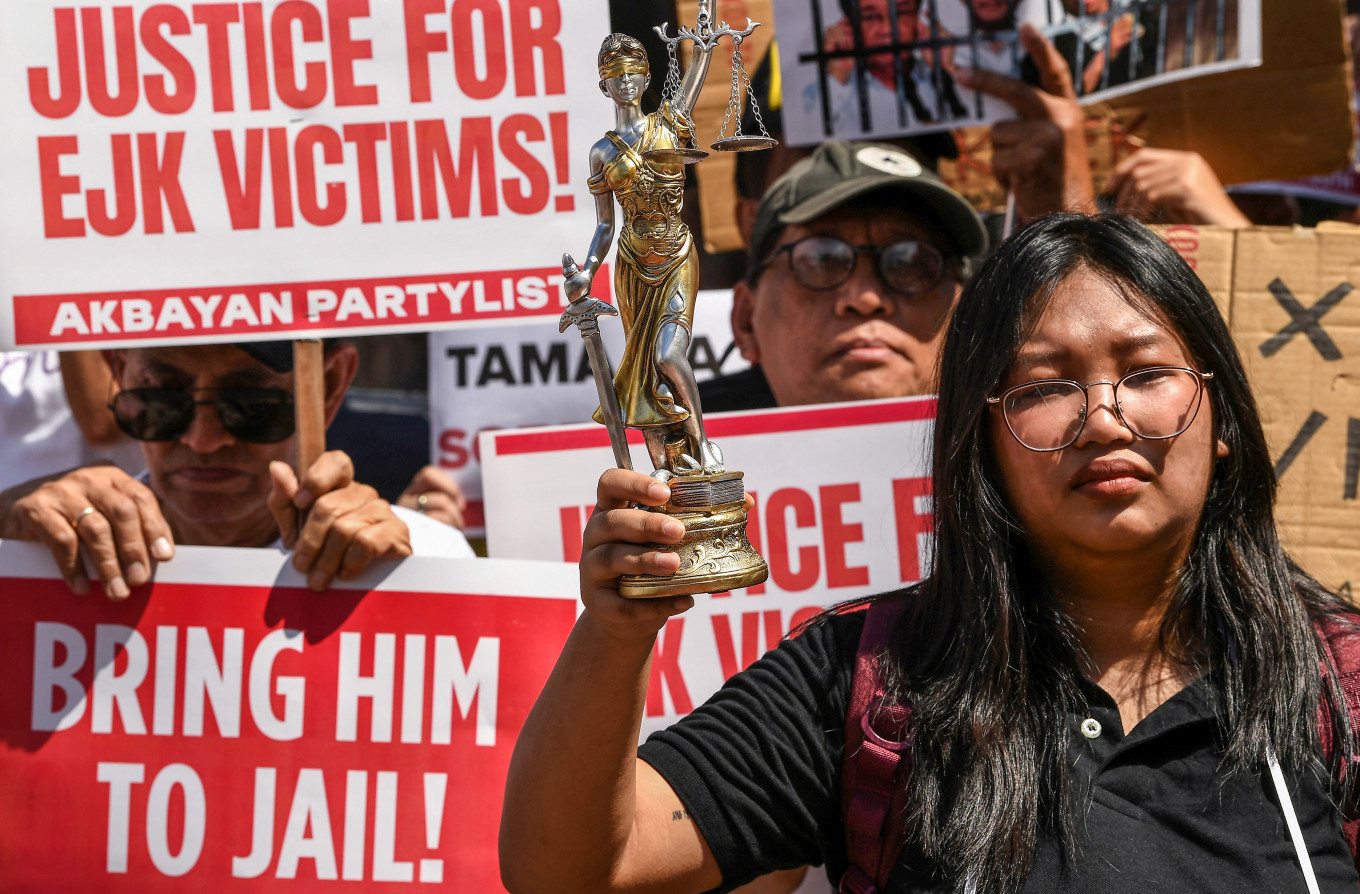 Activists and supporters take part in a protest in Manila on Feb. 23, 2026, to demand justice for the victims of extrajudicial killings during the drug war of former Philippine president Rodrigo Duterte. (AFP/Ted Aljibe)
W
e do not even know exactly how many were killed during former Philippine president Rodrigo Duterte’s violent drug war. Rather than treating this lack of agreement as a reason to abandon inquiry, that single unpleasant fact should be the starting point of any independent commission seeking to uncover the stories behind the killings. It was Carlos Conde, member and executive director of the newly formed Truth and Reconciliation Commission, who made that valuable point at the body’s launch last Wednesday.
Nearly a decade after Duterte announced his war on drugs, followed by extrajudicial killings on a scale never before seen in our country, we are at last taking the first steps toward breaking the silence that has shielded these realities from national scrutiny.
The commission’s creation comes at a time when public attention is riveted on other pressing issues: the power struggle in the Senate, the impending impeachment trial of Vice President Sara Duterte, the flood control corruption scandal and the International Criminal Court (ICC) case against Duterte himself.
Some may think the truth commission’s work is ill-timed, that it could overload the news cycle. But that is precisely the point. The killing spree that marked the Duterte years, and the impunity that defined them, risks being buried beneath the new issues confronting the nation.
We have long been content to move from crisis to crisis, never resolving anything, never learning anything, never doing anything meaningful to prevent recurrence. Sometimes, we even tell ourselves this is what resilience means.
I have written about this before.

In September 2024 at the height of the congressional committee hearings on the drug war, I argued in my column that what the country needed was not endless legislative grandstanding but a properly constituted truth commission. I noted that the hearings, however dramatic, were a poor substitute for the focused work that a body with a clear and specific mandate could achieve.
I called on President Ferdinand Marcos Jr to initiate the formation of such a body. He did not; and in retrospect, I am glad.
Having seen the public skepticism that greeted the government-created Independent Commission for Infrastructure, I am relieved that the Truth and Reconciliation Commission has dispensed with government sponsorship entirely. This assures its autonomy, though without some form of cooperation from state agencies, its fact-finding work may be hampered.
This is why Philippine National Police chief Gen. Jose Melencio Nartatez’s declaration that the police force is prepared to cooperate with the commission “within the bounds of legal protocols” is most welcome. It affirms the country’s commitment to international humanitarian law, embedded in our own statutes under Republic Act No. 9851.
The concept of a truth commission may be relatively new to Filipinos, but it has a long tradition that goes beyond what a legal system can accomplish.
University of the Philippines professor emeritus of law and former ICC judge Raul Pangalangan, who will chair the commission, defined its main goal as simply “to hear the victims tell their stories, to recognize their fundamental humanity and what they went through”. Cardinal Pablo “Ambo” David, who serves as adviser, and whom I proudly identify as my brother, sees it as “an opportunity for a catharsis, so we can recover our dignity as a country”.
The commission’s membership suggests it sees itself not merely as a panel of experts mandated to document victims’ stories but as what the French sociologist Emile Durkheim called the “collective conscience”: the community’s instrument for bearing witness to the unspeakable and renewing commitment to society’s fundamental norms. Its legitimacy derives not from the state but from the moral authority of the institutions and persons who have chosen to stake their credibility on it.
The power of bearing witness, as distinct from the power of prosecuting, is not always well understood. We tend to measure accountability in terms of conviction and punishment.
But the South African Truth and Reconciliation Commission, led by Bishop Desmond Tutu, demonstrated that hearing survivors, and perpetrators, in a formal public setting could achieve something courts cannot: catharsis and the restoration of a shared moral reality.
It is difficult to say what the Philippine truth commission will accomplish in the end. But if in bearing witness, it restores to the nameless dead their names, their faces and their stories, I am certain it will have restored to us, the living, the full moral weight of what was done in our name.
---
The writer is a columnist for the Philippine Daily Inquirer.