TheJakartaPost
Please Update your browser
Your browser is out of date, and may not be compatible with our website. A list of the most popular web browsers can be found below.
Just click on the icons to get to the download page.


Popular Reads
Top Results
No results found. Please check your search term and try again
Can't find what you're looking for?
View all search results
Popular Reads
Top Results
No results found. Please check your search term and try again
Can't find what you're looking for?
View all search resultsAnalysis: Military and police expand further into civilian sectors
Change text size
Gift Premium Articles
to Anyone
Share the best of The Jakarta Post with friends, family, or colleagues. As a subscriber, you can gift 3 to 5 articles each month that anyone can read—no subscription needed!
 Set as preferred source
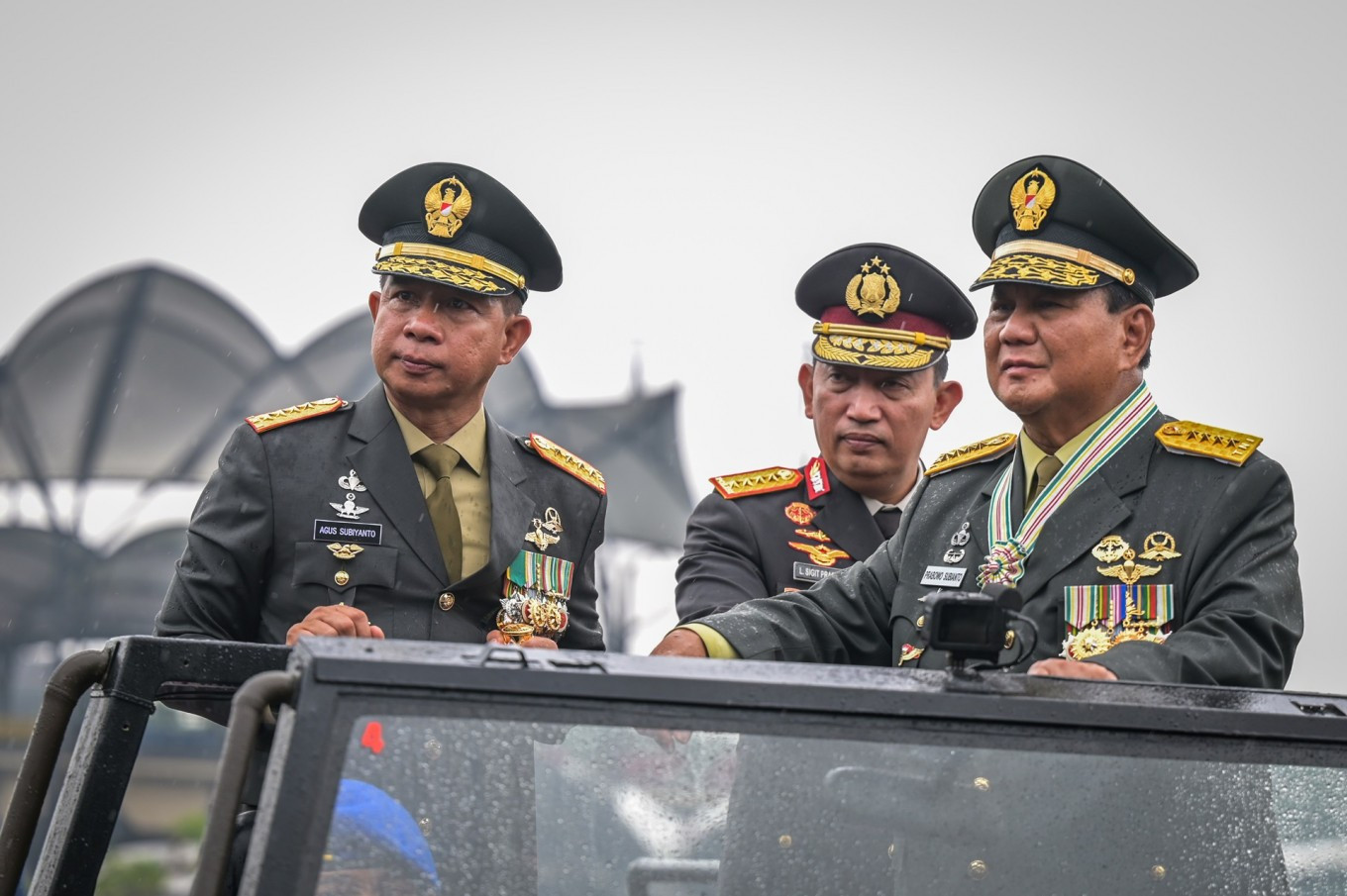 Defense Minister Prabowo Subianto (right) is accompanied by Indonesian Military (TNI) Commander Gen. Agus Subiyanto (left) and National Police Chief Gen. Listyo Sigit Prabowo on Feb. 28, 2024, while inspecting military equipment at the TNI Headquarters in Cilangkap, East Jakarta. (Antara/Bayu Pratama S)
T
he recently passed Police Law revision is difficult to view in isolation. Coming just over a year after the controversial revision of the Indonesian Military (TNI) Law, it forms part of a broader pattern in which Indonesia's security institutions are steadily gaining greater authority, flexibility and access to civilian spheres.
Since the House of Representatives designated the revision of the 2002 Police Law as a legislative initiative on May 20, the deliberation process moved at an unusually rapid pace. Less than three weeks later, lawmakers endorsed it in a plenary session on June 9. With parliamentary approval secured, the revised law is expected to be promulgated and published in the State Gazette in early July.
The amendments revise 10 articles and introduce seven new provisions. One of the most contentious issues concerns the placement of active police officers in civilian institutions. Observers have argued that the law contradicts the spirit of Constitutional Court jurisprudence requiring police officers to resign from active service when occupying positions outside the police institution.
Under the newly enacted law, however, there is no explicit provision requiring active officers assigned to external institutions to resign or retire from the police force. Instead, the law permits such assignments as long as they are deemed related to police functions.
That omission matters. National Police Regulation No. 10/2025 already identifies 17 ministries and state institutions that can be occupied by active police personnel. Yet rather than specifying such institutions in the law itself, lawmakers chose to leave the details to future government regulations.
This approach creates significant ambiguity. Without explicit limitations contained within the body of the law itself, questions inevitably emerge regarding the boundaries of permissible assignments and the mechanisms available to prevent institutional overreach.

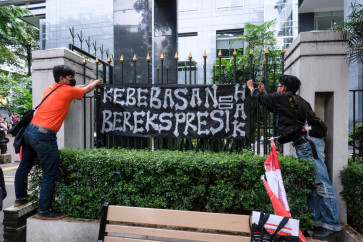
Public resistance has also begun to emerge through both street mobilization and legal channels. The wave of demonstrations that spread across several cities since June 12, initially driven by economic grievances, increasingly incorporated demands related to democratic governance and security-sector reform.