The Jakarta Post
Please Update your browser
Your browser is out of date, and may not be compatible with our website. A list of the most popular web browsers can be found below.
Just click on the icons to get to the download page.


Popular Reads
Top Results
No results found. Please check your search term and try again
Can't find what you're looking for?
View all search results
Popular Reads
Top Results
No results found. Please check your search term and try again
Can't find what you're looking for?
View all search resultsHomeless media: Freedom without accountability is not press freedom
Indonesia recognizes no category called "homeless media," and to this day there is not a single regulation that governs it.
Change text size
Gift Premium Articles
to Anyone
Share the best of The Jakarta Post with friends, family, or colleagues. As a subscriber, you can gift 3 to 5 articles each month that anyone can read—no subscription needed!
 Set as preferred source
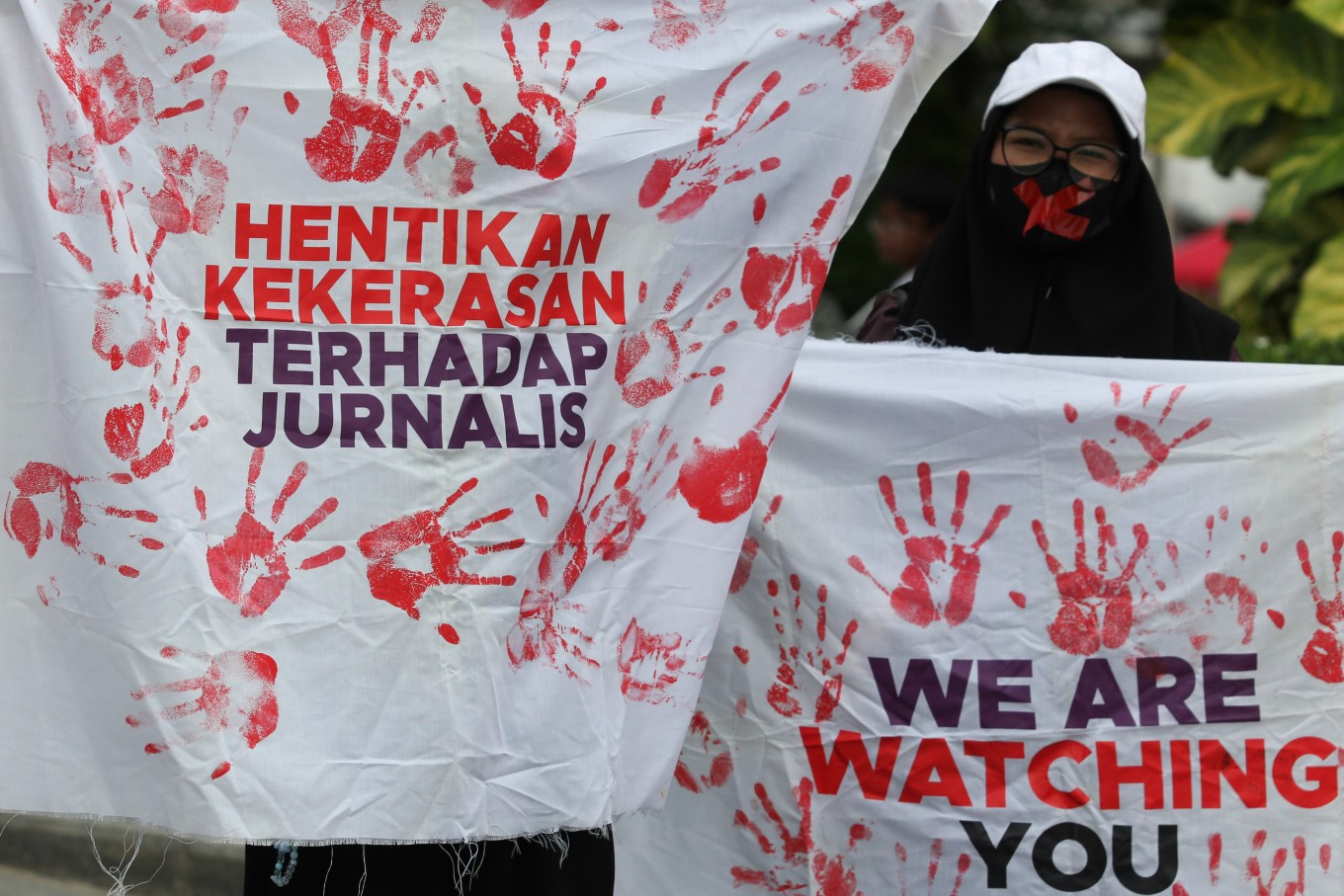 Journalists hold banners during a protest to commemorate World Press Freedom Day in Surabaya, East Java, on May 2, 2025. The protest, organized by the Surabaya chapter of the Alliance of Independent Journalists (AJI Surabaya) and other civic groups, condemned intimidation and violent acts against journalists. (Antara/Didik Suhartono)
A
new term is making the rounds: homeless media. It refers to outlets with no "home" of their own: no website, living entirely on Instagram, TikTok, X and YouTube. Some command millions of followers and have become the primary source of news for young people. The issue peaked this past May, when the government, through the Government Communications Agency (Bakom), floated a plan to enlist them as communication partners, which immediately triggered a wave of denials from several of the very outlets it had named.
I do not dismiss their creativity or their speed. But as a member of House of Representatives Commission I, which oversees communications, I must state my position plainly: Indonesia recognizes no category called "homeless media," and to this day there is not a single regulation that governs it. Leaving this vacuum unaddressed, let alone hastily granting these outlets the status of the press, is not press freedom. It is a path to informational chaos.
Our press, in fact, operates under clear rules. Law No. 40/1999 requires a press company to be a legal entity, to name a responsible editor, and to abide by the Journalistic Code of Ethics. The Press Council guards the dignity of the profession. The whole edifice rests on one word: accountability. When an outlet errs, there is a name that answers for it, a legal entity that can be sued, a forum where the public can complain. The press is protected by law precisely because it agrees to be bound by responsibility.
Imagine if anyone, armed with nothing more than a social media account, could claim to be the press, without registering, without knowing the code of ethics, without ever being answerable. What, then, is the point of the Press Law? What is the point of professional journalists laboring to verify facts and exercise restraint?
Many assume that as long as an outlet has its own website and a legal entity, it is automatically a protected member of the press. That is wrong. What determines an outlet's legal fate is whether it is registered and verified with the Press Council. Without that, it remains outside the regime of the Press Law, and this is not a matter of mere administration; it decides whether the outlet is protected or not.
Under the Memorandum of Understanding and Cooperation Agreement between the Press Council and the National Police, when a police report targets an outlet over its reporting, the police must first coordinate with the Press Council and seek an expert press opinion. Two things are examined first: whether the reported party is a legitimate outlet or journalist, and whether the disputed content is a journalistic work.

If the outlet is legitimate and verified and its content is a journalistic product, the reporting dispute is handled first through the mechanisms of the Press Law, namely the rights of reply and correction and complaints to the Press Council, before any criminal option is considered. This is the shield the Press Law provides.