The Jakarta Post
Please Update your browser
Your browser is out of date, and may not be compatible with our website. A list of the most popular web browsers can be found below.
Just click on the icons to get to the download page.


Popular Reads
Top Results
No results found. Please check your search term and try again
Can't find what you're looking for?
View all search results
Popular Reads
Top Results
No results found. Please check your search term and try again
Can't find what you're looking for?
View all search resultsDon't shoot the messengers
In trying to manage the optics of the recent student protests instead of responding to the legitimate public grievances they convey, the government is certainly not putting itself in any democratic light.
Change text size
Gift Premium Articles
to Anyone
Share the best of The Jakarta Post with friends, family, or colleagues. As a subscriber, you can gift 3 to 5 articles each month that anyone can read—no subscription needed!
 Set as preferred source
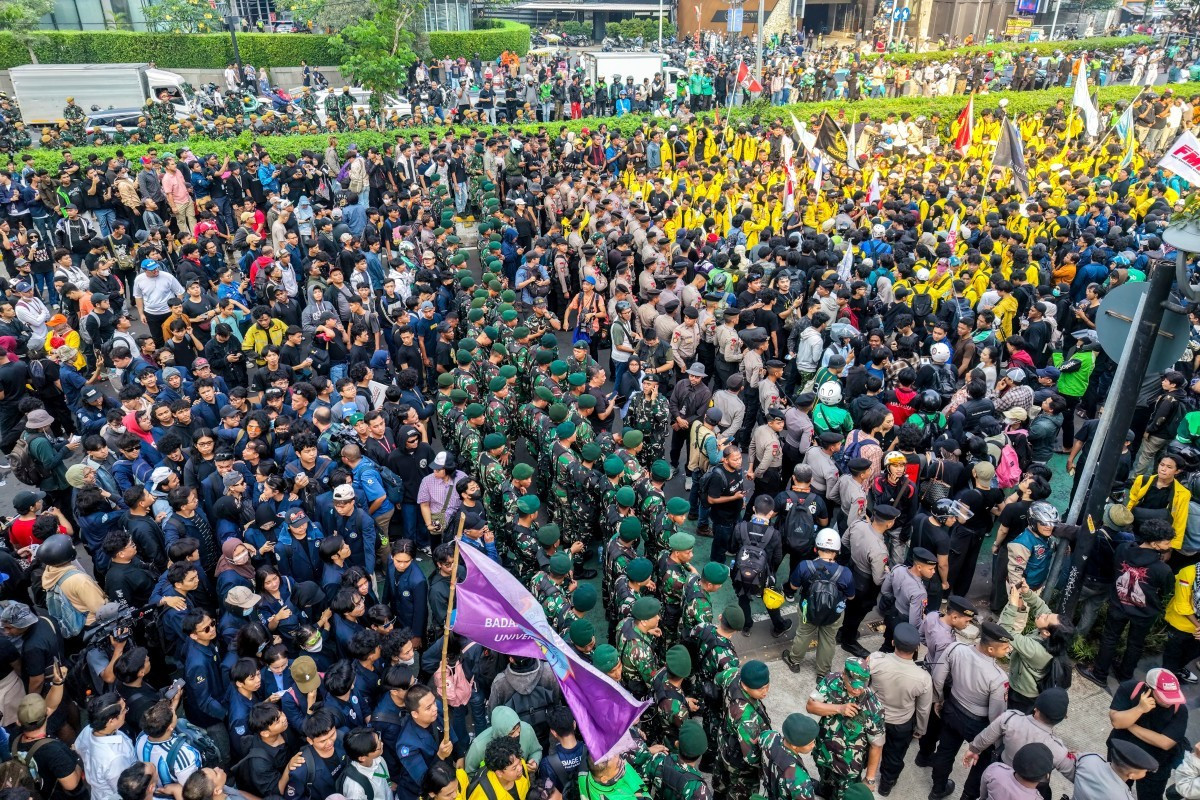 Soldiers (center, in green) are deployed on June 12 to reinforce a row of police officers (in tan tops) in Jakarta as they block the path of student protesters demanding a reduction in fuel prices and a halt to wasteful spending. (AFP/Bay Ismoyo)
W
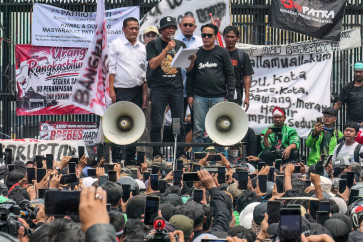
hen students from dozens of universities marched to the Hotel Indonesia traffic circle in Central Jakarta on June 12 under the banner "Menuju Indonesia Bangkrut" (Toward a bankrupt Indonesia), the government's first instinct was not to engage in what they were saying but to manage the optics of their presence.
More than 6,000 police officers and soldiers were deployed, partly to help block routes to the Presidential Palace Complex. The intelligence chief, Muhammad Herindra, called on citizens to "guard national unity": a phrase in the political lexicon that is rarely directed at those doing the suppressing.
The students' demands are reasonable: lower fuel and food prices, be transparent about the free nutritious meal program (whose former head the President fired in early June after he was named a graft suspect) and return the military to the barracks.
These are the demands of ordinary people watching the rupiah collapse to record lows, household costs rise and fuel hiked 32 percent, absorbing whatever goodwill subsidy the government had left. Whether we agree with every demand is beside the point. These are legitimate public grievances expressed through legitimate public action.
Yet from multiple directions, the response has been to discredit the messengers rather than listen to the actual message.
On June 19, counterprotesters were deployed to convey support for Prabowo's flagship programs. While politicians insinuated that the protests were the work of an opposition seeking to exploit public discontent, a claim that circulates because it is politically useful, the State Intelligence Agency waded in with its unity rhetoric.

These are the familiar instruments of a political class that has learned across several administrations that it is easier to question the legitimacy of dissent than to respond to its substance.