The Jakarta Post
Please Update your browser
Your browser is out of date, and may not be compatible with our website. A list of the most popular web browsers can be found below.
Just click on the icons to get to the download page.


Popular Reads
Top Results
No results found. Please check your search term and try again
Can't find what you're looking for?
View all search results
Popular Reads
Top Results
No results found. Please check your search term and try again
Can't find what you're looking for?
View all search resultsWhy Malaysia must join Taiwan's semiconductor supply chain
If Malaysia continues to focus on domestic platforms and generalized talent cultivation without forging deep, structural links with Taiwan's market leaders, its economic spillovers will remain limited.
Change text size
Gift Premium Articles
to Anyone
Share the best of The Jakarta Post with friends, family, or colleagues. As a subscriber, you can gift 3 to 5 articles each month that anyone can read—no subscription needed!
 Set as preferred source
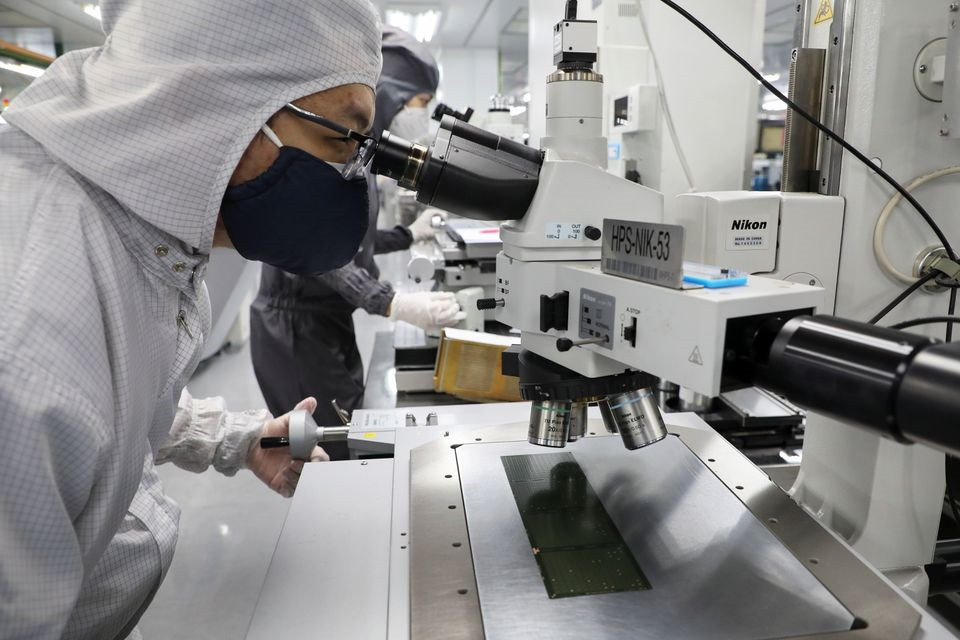 A worker inspects semiconductor chips at the chip packaging firm Unisem Berhad plant in Ipoh, Malaysia, on Oct. 15, 2021. (Reuters/Lim Huey Teng)
S
ince the global boom in artificial intelligence, Malaysia has viewed the advanced technology sector as a vital ladder to escape the middle-income trap. The National Semiconductor Strategy (NSS), launched in 2024, serves as the country's flagship policy, explicitly aiming to position Malaysia as a top-tier global player in the semiconductor ecosystem.
However, to achieve true prominence, Malaysia must align itself with the undisputed vanguard of the industry: Taiwan.
Taiwan's semiconductor and ICT exports have surged to a historic high of over US$640 billion, elevating the island to 12th in global export rankings. Today, Taiwan controls over 90 percent of the world's leading-edge chip production. Driven by a structural upgrade powered by the AI revolution, Taiwan’s economy is projected to expand by as much as 9.64 percent in 2026, significantly outpacing China’s projected growth of around 5 percent.
This industrial dominance was on full display at the NVIDIA GTC event in Taipei in June. Global tech leaders from across the AI, robotics and defense sectors arrived at a single, decisive consensus: Taiwan is the indispensable core node of the global AI supply chain. From chip design and advanced fabrication to server assembly and system integration, Taiwan dictates the process that transforms AI from an abstract concept into physical reality.
NVIDIA CEO Jensen Huang has praised Taiwan for possessing the world's most comprehensive AI ecosystem, while Arm’s CEO acknowledged that its architecture could not exist without Taiwanese manufacturing. Indeed, between 20 and 30 major Taiwanese companies are directly embedded in the production of every single NVIDIA AI server, anchoring a broader network of over 500 local ecosystem partners.
Advanced fabrication and packaging are so heavily concentrated on the island that global AI computing power would simply stall without it. Taiwan is no longer just a participant; it is the manufacturing infrastructure of the AI age.

Against this backdrop, Malaysia’s current policy framework reveals a problematic strategic mismatch. While the government has successfully focused on establishing integrated circuit (IC) design parks, attracting foreign direct investment (FDI), and cultivating engineering talent, these initiatives are rooted in a foundational "platform-building" logic rather than a "supply chain-embedding" strategy.





Your Opinion Matters
Share your experiences, suggestions, and any issues you've encountered on The Jakarta Post. We're here to listen.
Enter at least 30 characters
0
/ 30
Thank you
Thank you for sharing your thoughts. We appreciate your feedback.