The Jakarta Post
Please Update your browser
Your browser is out of date, and may not be compatible with our website. A list of the most popular web browsers can be found below.
Just click on the icons to get to the download page.


Popular Reads
Top Results
No results found. Please check your search term and try again
Can't find what you're looking for?
View all search results
Popular Reads
Top Results
No results found. Please check your search term and try again
Can't find what you're looking for?
View all search resultsJustice at the barrel of a gun: The anticlimax of antigraft policy
When institutional rivalries push heavily armed soldiers to negotiate the return of seized evidence, Indonesia faces a critical choice: uphold the civilian rule of law or allow justice to be dictated by the barrel of a gun.
Change text size
Gift Premium Articles
to Anyone
Share the best of The Jakarta Post with friends, family, or colleagues. As a subscriber, you can gift 3 to 5 articles each month that anyone can read—no subscription needed!
 Set as preferred source
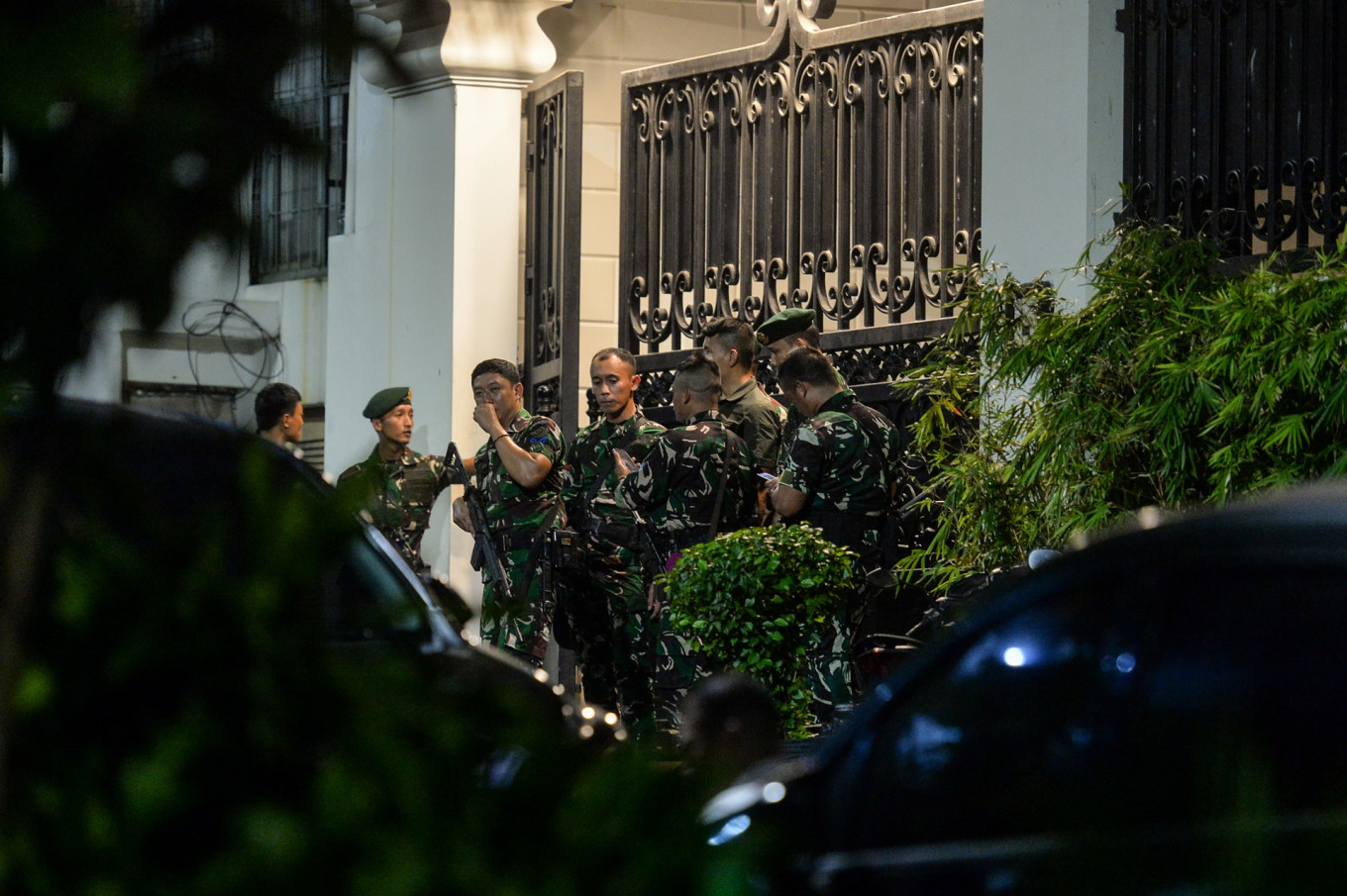 Indonesian Military (TNI) personnel stand guard in front of the house of Assistant Attorney General for Special Special Crimes (Jampidsus) Febrie Ardiansyah in Kebayoran Baru, Jakarta on July 8, 2026. (Antara/Putra M. Akbar)
T
he July 9 standoff between law enforcement and the military exposed a devastating systemic contradiction within the nation's post-reform polity, shattering the illusion of a unified constitutional order. The ultimate paradox manifested when a police anticorruption task force, executing its lawful mandate against then Junior Attorney General for Special Crimes Febrie Ardiansyah was met not by due process but by the kinetic defiance of heavily armed Indonesian Military (TNI) platoons.
This catastrophic institutional fracture pitted civilian law enforcement against the state's own defense apparatus, which launched an extralegal intervention to shield elite criminality from judicial accountability. By weaponizing national defense instruments to actively sabotage the rule of law, the confrontation revealed how deeply the state’s mechanisms can be coopted to subvert the very republic they are sworn to protect.
What followed was not a standard legal procedure of evidence collection, prosecution, and adjudication. Military platoons in full combat gear appeared at two locations in South Jakarta: Febrie’s private residence and the Jakarta Police headquarters. While the first military group was deployed to guard the prosecutor’s home, the second group’s stated mission was to "negotiate" the return of seized evidence, hundreds of billions of rupiah in multi-currency cash and approximately 74 kilograms of gold bar, and to secure the release of a suspect and key witness already in police custody.
This incident was more than a friction between two law enforcement agencies; it marked a visible "securitization" of the legal realm. Securitization describes a political process in which a civilian issue is framed as an existential threat to national stability, thereby justifying emergency measures outside normal legal constraints.
In this context, a criminal matter was treated as a military security issue, allowing the armed forces to encroach upon a domain constitutionally reserved for police and prosecutors. The episode emerged from a deeper matrix of institutional rivalry, political embarrassment and a gradual expansion of the military’s self-defined role in domestic affairs.
The friction intensified after the Attorney General’s Office (AGO) named a senior police general as a suspect in a corruption case linked to the government’s free nutritious meals program. Notably, the announcement came just one day after the National Police anniversary on July 1, during which President Prabowo Subianto had publicly praised the police for administering his flagship program.

The police viewed the accusation as a direct affront; the AGO interpreted the subsequent police raid on a senior prosecutor as retaliation. Armed troops then intervened, not as neutral mediators, but as protectors of the prosecutor’s interests.