The Jakarta Post
Please Update your browser
Your browser is out of date, and may not be compatible with our website. A list of the most popular web browsers can be found below.
Just click on the icons to get to the download page.


Popular Reads
Top Results
No results found. Please check your search term and try again
Can't find what you're looking for?
View all search results
Popular Reads
Top Results
No results found. Please check your search term and try again
Can't find what you're looking for?
View all search resultsHow soccer breeds tribalism
Why do players and teams inspire not merely admiration or disappointment, but also an intensity of resentment that often appears strangely detached from what actually happens on the soccer field?
Change text size
Gift Premium Articles
to Anyone
Share the best of The Jakarta Post with friends, family, or colleagues. As a subscriber, you can gift 3 to 5 articles each month that anyone can read—no subscription needed!
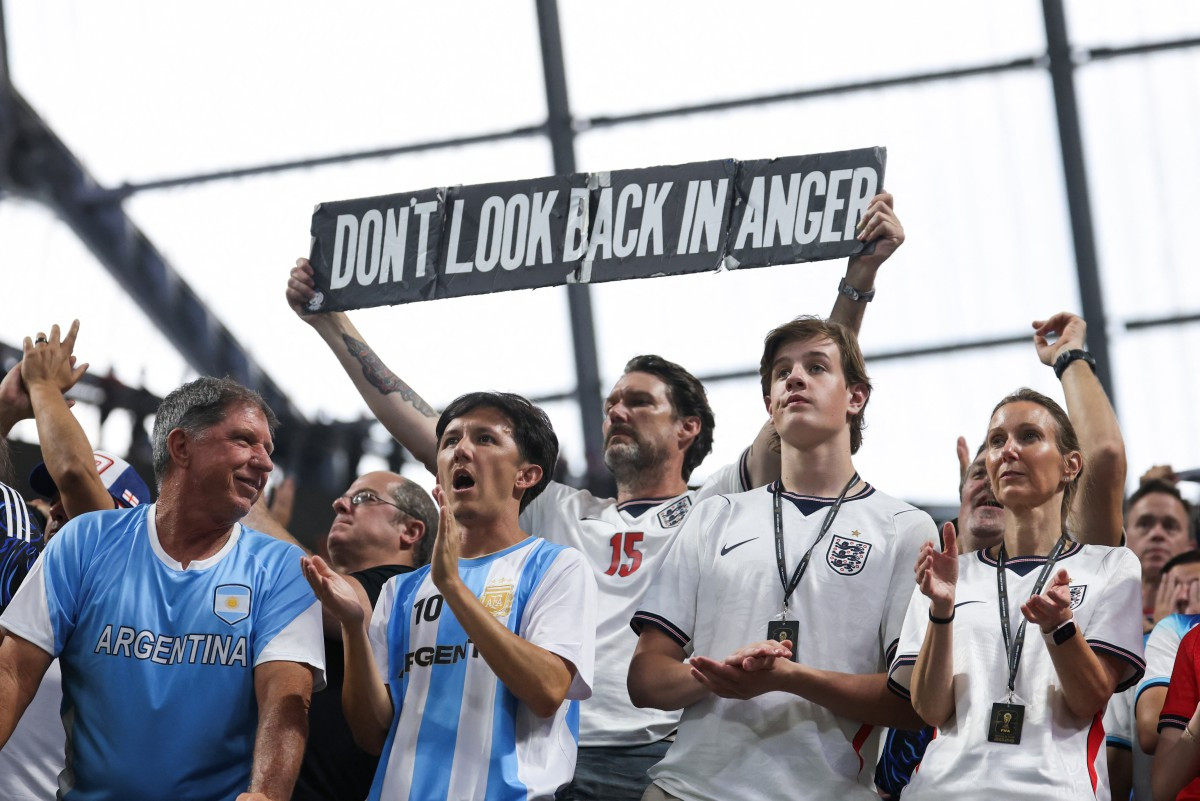 Fans react after the 2026 World Cup soccer tournament semi-final match between England and Argentina at the Atlanta Stadium in Atlanta, the United States on July 15, 2026. (AFP/Odd Andersen)
A
s the FIFA World Cup enters its closing stages and the arguments flow fast and thick as fevered as the soccer itself, one question intrigues me with increasing insistence. Why do certain players and teams provoke emotions that seem to far exceed the game? Why do they inspire not merely admiration or disappointment, the natural companions of sport, but also an intensity of resentment that often appears strangely detached from what actually happens on the soccer field? In many of these debates, soccer takes a back seat.
England inevitably gets labeled as a symbol of colonialism. Argentina becomes entangled in contemporary geopolitics. Lionel Messi becomes the favorite whipping boy, dismissed as overrated or undeserving despite repeatedly demonstrating his impossible brilliance. Some of these views spring from sincerely held political convictions; others reflect genuine differences in aesthetic taste. Most of them seldom explain the emotional force of the hostility. While trying to figure out an explanation for this behavior, I think the best place to begin is with ourselves.
Half a century of psychological research points in an intriguing direction. In one of the most influential experiments in social psychology, conducted by Henri Tajfel, volunteers divided into entirely arbitrary groups quickly began favoring their own side, despite sharing no meaningful differences. It took remarkably little for “us” and “them” to emerge. Soccer, of course, has never needed such artificial divisions. It inherited them generations ago. The anthem is rolling around the stadium. The collective intake of breath before a decisive penalty.
By then, the match had already become something more than a game. Somewhere between childhood and adulthood, a club or a national team slips quietly into our emotional vocabulary. We celebrate victories we played no part in securing and mourn defeats suffered by people we have never met. Eleven strangers become an extension of ourselves. Nothing in soccer is ever only soccer. Once that happens, another individual’s or team’s success is rarely neutral. This is where greatness acquires an unexpected burden. Soccer promises uncertainty. It thrives on the possibility that today’s underdog may humble yesterday’s champion. Yet ever so often, a player arrives whose brilliance proves unnervingly durable.
What ought to inspire uncomplicated admiration often produces something more conflicted. Behavioral science has long shown that we understand ourselves through comparison. Most of those comparisons pass unnoticed because they occur among equals. Exceptional greatness is different. It quietly alters the scale, and the standards begin to shift. Before long, a merely excellent performance is greeted with disappointment because excellence has become routine. That may be the hidden price of genius. Soccer exposes this behavior with remarkable clarity. Once we have reached a verdict, we instinctively begin collecting evidence to defend it.
This is perhaps what eminent psychologist Daniel Kahneman refers to as WYSIATI (What You See Is All There Is). The supporter who believes that Messi is overrated notices every misplaced pass as an affirmation of his conviction. His disguised through-ball that unlocks a defense, the first touch that is almost invisible, the subtle change of rhythm that creates space where none appeared to exist and the sublime goal-scoring get subconsciously glossed over. The digital age has simply amplified these instincts. Every contentious tackle, disputed penalty and every stunning goal now lives several lives: first on the pitch, then on television, and finally in the endless courtroom of social media. There, certainty travels faster than curiosity.

Algorithms reward conviction more generously than reflection. To defend a celebrated player is to join one tribe; to dismiss him can become a badge of independence. Before long, opinions harden into identities, and changing one’s mind begins to feel like changing sides. Politics adds another layer. National teams inevitably carry histories that stretch far beyond sport. These are real, and they deserve neither dismissal nor simplification. Yet once a soccer team becomes a symbol, every tackle and every trophy begins to absorb meanings that tactics and statistics alone can never explain.
The French thinker René Girard observed that rivals often become bound together by the intensity of their opposition. They define themselves against one another until the rivalry becomes part of their identity. Spend a few minutes reading debates about Messi and Cristiano Ronaldo, or about England and Argentina, and the pattern becomes unmistakable. The participants often have more in common than either side would care to admit. Their emotional investment is identical; only the direction of their loyalty differs. Perhaps this is inevitable. Soccer occupies a unique place in modern life because it is at once intensely personal and profoundly communal.
Millions watch the same match, yet no two people carry away quite the same memory. One recalls the missed chance. One cannot forget the referee’s decision. A third remembers only the first touch that changed the rhythm of the game. That may explain why the fiercest soccer arguments are never settled by goals, trophies or statistics. Those things illuminate performance, but they cannot fully explain attachment. The deeper argument concerns identity, memory, loyalty and the quiet ways in which we seek ourselves in the triumphs and disappointments of others.
The greatest soccer players become more than athletes, just as the greatest teams become more than collections of players. They become symbols on which entire generations project hope, grievance, pride and longing. Their brilliance does not simply illuminate the game; it illuminates the people watching it. The referee blows for full time. Around the world, millions have watched the same 90 minutes.
One supporter leaves exhilarated, another resentful, a third is already composing an indignant post online. Curiously, each believes the match has confirmed what he knew all along. The ball has traveled only one path across the grass. Our minds have traveled many more. Perhaps that is soccer’s greatest mystery. Not why greatness divides us, but why it so faithfully reveals who we already are.
---
The writer is a former CEO and independent commentator on socio-cultural issues.