TheJakartaPost
Please Update your browser
Your browser is out of date, and may not be compatible with our website. A list of the most popular web browsers can be found below.
Just click on the icons to get to the download page.


Popular Reads
Top Results
No results found. Please check your search term and try again
Can't find what you're looking for?
View all search results
Popular Reads
Top Results
No results found. Please check your search term and try again
Can't find what you're looking for?
View all search resultsSuperpower rivalry in space: The invisible battlefield of the Iran war
Beijing’s space technology is actively helping Tehran control the course of the war, while the Pentagon is rapidly losing its expensive, slow-to-replenish anti-missile arsenal.
Change text size
Gift Premium Articles
to Anyone
Share the best of The Jakarta Post with friends, family, or colleagues. As a subscriber, you can gift 3 to 5 articles each month that anyone can read—no subscription needed!
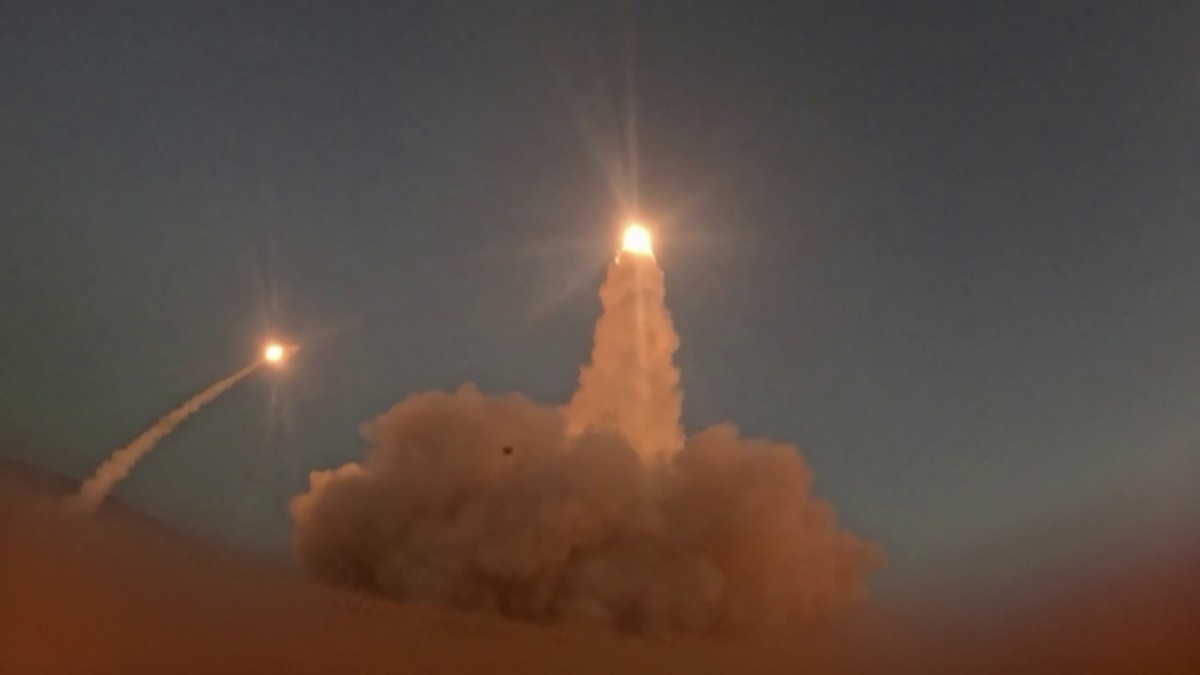 This screen grab taken on July 15, 2026 from video footage released by Iran's Revolutionary Guards' Sepah News website on July 14, 2026, allegedly shows missiles being launched from an undisclosed location toward United States targets in Bahrain and Kuwait. (AFP/Sepahnews.com)
T
he Pentagon has relocated its Triton drones from Jordan to Italy after they were hit by Iranian missiles. These drones provided high-altitude maritime surveillance platforms for United States military operations in the ongoing war against Iran. This relocation reflects a change in the Pentagon’s strategy of the forward deployment of military and surveillance assets in Jordan in the run-up to and during the first few weeks of the Israel–US joint military operations.
In sharp contrast to the 12-day war in July last year, Iranian missiles have demonstrated deadly precision and effectiveness this time, regularly striking strategic facilities in Jordan, Kuwait and elsewhere across the Middle East. These targets are often highly specific, undisclosed or restricted locations, detectable only by an advanced space surveillance system capable of continuously monitoring military movements. This has drawn attention to the growing sophistication of those missiles’ navigation and guidance systems and to the increasingly crucial role of an invisible component of this war: space.
Tehran certainly has a large arsenal of missiles and drones, but their impact on the course of the war would have been insignificant without vital support from space. These weapons must be precisely locked onto their targets and guided through hostile skies under constant enemy surveillance. They must also protect themselves from signal jamming and spoofing while simultaneously sending deceptive signals to potentially hostile systems. This is why the space component of the war is indispensable, with Beijing playing a key role on Tehran’s behalf.
Until recently, the US has been the undisputed leader in space technologies, including global navigation satellite systems (GNSS), electronic warfare with wide coverage across Low Earth Orbit (LEO) and Very Low Earth Orbit (VLEO) constellations and anti-satellite weapons (ASAT).
However, this balance has been shifting steadily in Beijing’s favor since BeiDou, its indigenous GNSS, became fully operational in 2020. China has long considered space a strategic arena and has invested in advancing across all branches of this seminal technology, as several American studies have reported. That means it is the deployment of Beijing’s space technology, not Tehran’s missiles and drones themselves, that has decisively altered the course of the war, marking what may be called history’s first proxy war in space.
The war has pitted the two space superpowers against each other in a fierce battle that will profoundly shape how they confront one another in potential geopolitical flashpoints elsewhere.

Ironically, China’s breathtaking ascent as a space superpower capable of rivalling the US’ position is rooted in Operation Desert Storm, launched on Jan. 17, 1991. The Pentagon began with a devastating air assault on Iraqi forces in Kuwait and followed through with a massive ground offensive on Feb. 24, crushing Iraqi resistance in less than 100 hours. The swift and complete success of that mission, often called the first space war, owed largely to the use of space technologies, including the Global Positioning System (GPS, the American version of GNSS), satellite communications, intelligence and reconnaissance by spy satellites, early warning systems to detect Iraqi Scud missiles and weather forecasting by meteorological satellites to track sandstorms and cloud cover.
The Chinese leadership of the time was deeply alarmed by this awesome demonstration of the American military’s speed, precision, firepower and global reach, prompting the fast-track modernization of the People’s Liberation Army (PLA).
The outcome of that modernization drive by Beijing is what is being played out in Iran, where Tehran has made the war painfully expensive for Washington, which is bogged down in an untenable situation and is groping for a face-saving exit. Beijing’s space technology is actively helping Tehran control the course of the war, while the Pentagon is rapidly losing its expensive, slow-to-replenish anti-missile arsenal. At the same time, the war is revealing where and how space technology, regardless of its sophistication, can be vulnerable to low-cost weaponry, thereby making a prolonged war effort in a distant land economically unsustainable for a superpower.
This will undoubtedly help Beijing’s strategists prepare their Taiwan game plan and protect their energy supply routes through the South China Sea and the Strait of Malacca. The free flow of ships through these waterways and the Strait of Hormuz is vital to Beijing’s economy; these chokepoints carry the vast majority of China’s imported crude oil, liquefied natural gas and manufactured exports.
Yet Tehran’s ability to block the Strait of Hormuz, despite having a far smaller naval force than Washington’s, has shown that military might or space technology cannot ensure uninterrupted shipping through contested waters; control of a dominant commercial fleet of oceangoing ships is also essential.
That leads to another front in the superpower rivalry: commercial shipping. Beijing has developed a large dual-use shipbuilding industry to support its ongoing naval modernization. In response, Washington adopted a maritime action plan in February to “restore its maritime dominance”. The battle for the seas is already brewing.
---
The writer is a lead consultant at Sydney-based consultancy Tasman Analytics.