The Jakarta Post
Please Update your browser
Your browser is out of date, and may not be compatible with our website. A list of the most popular web browsers can be found below.
Just click on the icons to get to the download page.


Popular Reads
Top Results
No results found. Please check your search term and try again
Can't find what you're looking for?
View all search results
Popular Reads
Top Results
No results found. Please check your search term and try again
Can't find what you're looking for?
View all search resultsThe middle-income health trap
When a country crosses the World Bank’s threshold from low- to middle-income status, it is deemed too rich to qualify for aid, even though it is not yet rich enough to cover its health costs.
Change text size
Gift Premium Articles
to Anyone
Share the best of The Jakarta Post with friends, family, or colleagues. As a subscriber, you can gift 3 to 5 articles each month that anyone can read—no subscription needed!
 Set as preferred source
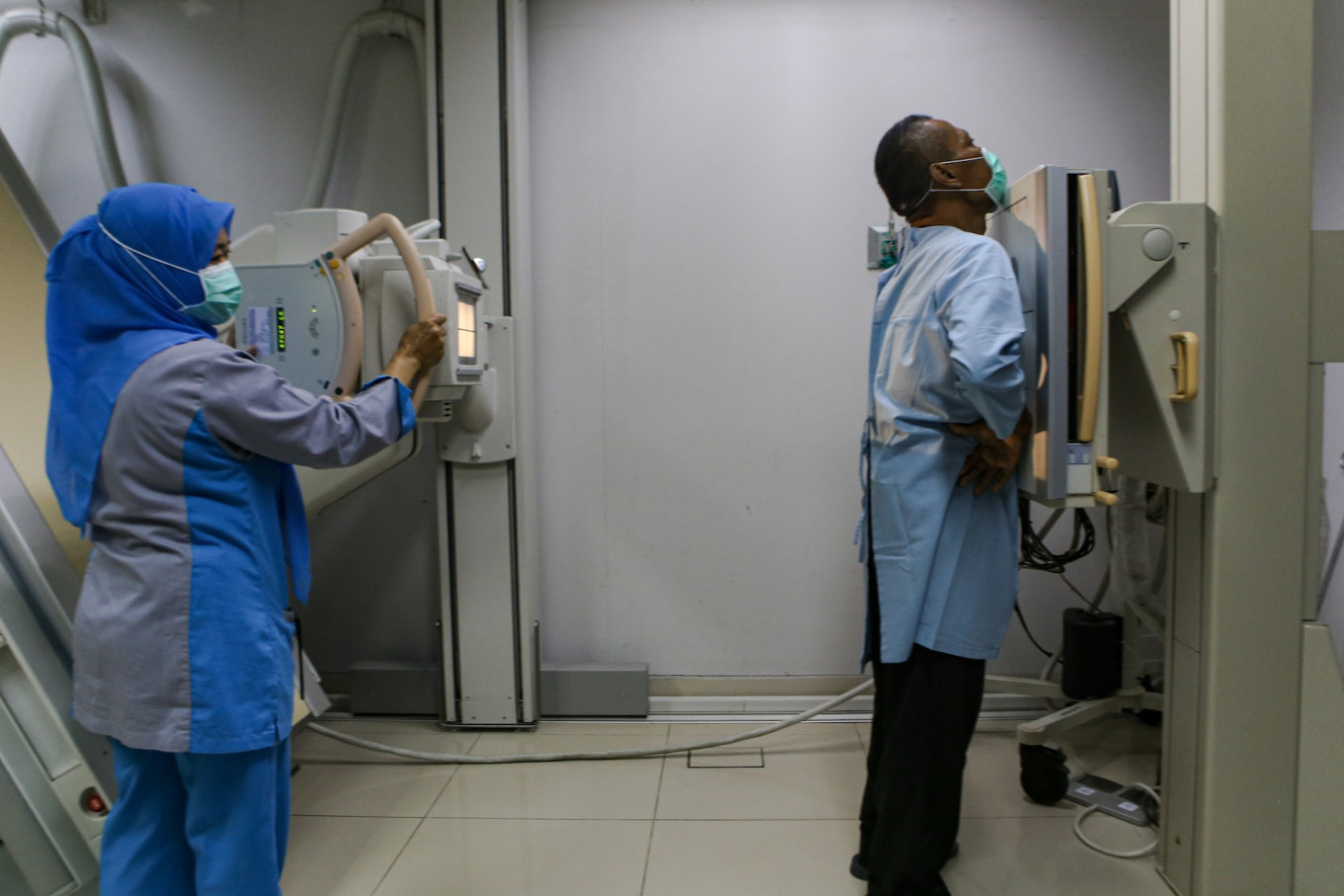 A health worker conducts a chest X-ray scanning at Tangerang City General Hospital, Banten, on March 21, 2023. Antara/Fauzan (Antara/Fauzan)
I
n the lexicon of development, few words sound as reassuring as “graduation,” which suggests progress past critical milestones and an escape from dependency. In global health, however, graduation increasingly creates a trap. When a country crosses the World Bank’s threshold from low- to middle-income status, it is deemed too rich to qualify for aid, even though it is not yet rich enough to cover its health costs.
The implications of reaching this milestone (which is based on gross national income per capita) are therefore profound. Achieving middle-income status means that concessional loans will increasingly have to be replaced by market-rate borrowing, and that grants will shrink or disappear as global health programs wind down.
But pathogens do not recognize income thresholds, and the resources available to health systems do not necessarily grow smoothly with GDP. In many countries, disease burdens remain stubbornly high long after aid eligibility has expired. If there is any lag in the growth of the government’s fiscal capacity, the result will be a widening gap between health needs and health financing. Neither markets nor donors are well equipped to fill it.
This is a massive problem. Middle-income countries now account for over 70 percent of the world’s poor, for most deaths from tuberculosis, and for a still-high share of deaths from HIV and non-communicable diseases. Yet they receive a shrinking share of global health assistance, which is increasingly concentrated in a small number of fragile, low-income states.
If graduation to middle-income status reliably coincided with robust tax systems, deep capital markets and comprehensive insurance schemes, it would make sense for recent grads to fend for themselves. But many middle-income countries face rising debt-service costs and collect less than 15 percent of GDP in taxes, owing to their large informal sectors. They may be richer on paper, but their health ministries are often poorer in practice.
When donor-funded programs supported by institutions such as Gavi or the Global Fund taper off, governments are expected to assume full financial responsibility for vaccines, antiretrovirals and malaria control, often within the space of a few budget cycles. But such costs are often large, recurrent and have low visibility, which weakens political incentives to prioritize them over other spending.

Consider Romania. Following its entry into the European Union in 2007, its economy started to grow, creating a key condition for the withdrawal of Global Fund support for HIV preventative services in June 2010. When the government failed to cover this new funding gap, harm-reduction services collapsed, and the country experienced a resurgence of infections among vulnerable populations.