The Jakarta Post
Please Update your browser
Your browser is out of date, and may not be compatible with our website. A list of the most popular web browsers can be found below.
Just click on the icons to get to the download page.


Popular Reads
Top Results
No results found. Please check your search term and try again
Can't find what you're looking for?
View all search results
Popular Reads
Top Results
No results found. Please check your search term and try again
Can't find what you're looking for?
View all search resultsMaking a fuss about LGBT: A moral panic
The moral panic over private LGBT lives misdirects state power away from genuine threats like corruption and pervasive sexual abuse. In a civilized society, citizens deserve privacy and safety in their homes, while public spaces continue to honor shared cultural norms
Change text size
Gift Premium Articles
to Anyone
Share the best of The Jakarta Post with friends, family, or colleagues. As a subscriber, you can gift 3 to 5 articles each month that anyone can read—no subscription needed!
 Set as preferred source
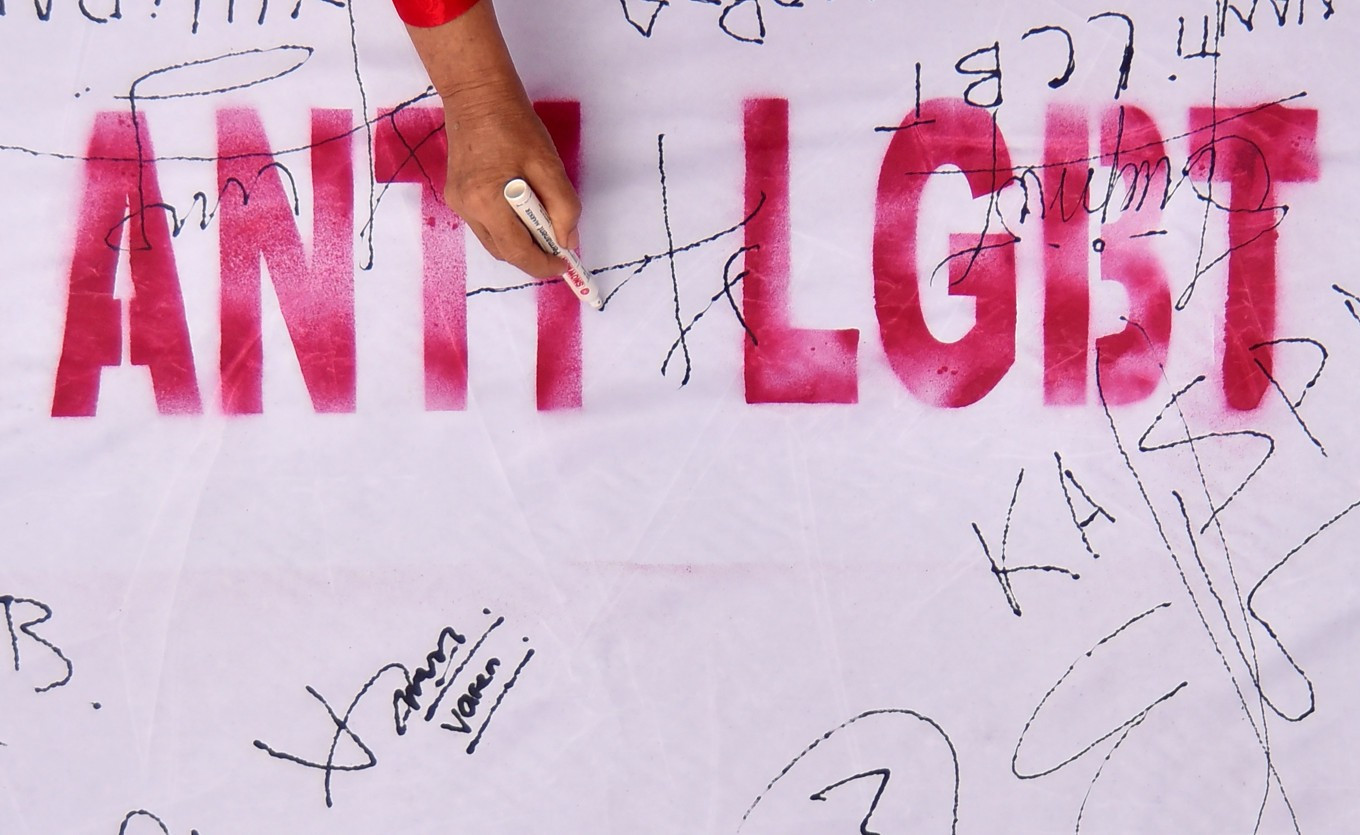 Residents sign a white banner during an anti-LGBT rally on June 21 in Padang, West Sumatra. (Antara/Fitra Yogi)
W
hy does the public outcry surrounding the so-called "LGBT culture" in Indonesia persist so relentlessly? Is the existence of citizens with lesbian, gay, bisexual, transgender or queer orientations genuinely a threat to the nation? The answer is clear: What threatens Indonesia is not the private sexual orientation of its citizens, but the pervasive corruption within its ruling class.
If there were public demonstrations akin to Christopher Street Day festivals or provocative displays of rainbow flags, public pushback might be understandable given local norms. But in Indonesia, LGBT individuals are ordinary citizens integrated into daily life. When meeting someone, one does not inquire about their sexual orientation. Why, then, are people with non-normative sexual orientations framed as a threat to national culture?
Sexual identity is not a deliberate choice. Just as young boys do not choose for their voices to deepen during puberty, sexual orientation is a natural development discovered as an individual matures. If one believes human nature is divinely created, it follows that diverse sexual orientations are part of that creation. What God has created must be accepted.
An estimated 9 percent of the global population experiences a sexual orientation different from the heterosexual norm. Realizing during adolescence or young adulthood that one’s sexual attraction differs from that of one's peers can be a daunting experience. Scientific consensus has long established that sexual orientation is not something an individual can alter at will; it is neither a disease nor a defect, but a natural human variation.
For Catholics, a significant theological shift occurred in 1979 when Pope John Paul II affirmed that homosexuality, attraction between people of the same sex, is neither a disease nor a conscious choice, but a condition of nature. Consequently, he noted, homosexuality in itself is not a sin. LGBT individuals possess the exact same human dignity as heterosexual citizens.
It is reasonable to expect that LGBT individuals adapt to the public norms of the society in which they live. In Indonesia, public displays of affection between men and women remain rare and are generally confined to married couples. Thus, LGBT citizens should respect local public decorum and refrain from overt public displays of intimacy.

However, what two consenting adults do in private is entirely outside the purview of the state. When two adults share a private residence, the state has no right to monitor, restrict or police them. Neither do local neighborhood leaders, community elders or religious figures. Private life is a fundamental human right, as recognized in Article 12 of the Universal Declaration of Human Rights: "No one shall be subjected to arbitrary interference with his privacy."