The Jakarta Post
Please Update your browser
Your browser is out of date, and may not be compatible with our website. A list of the most popular web browsers can be found below.
Just click on the icons to get to the download page.


Popular Reads
Top Results
No results found. Please check your search term and try again
Can't find what you're looking for?
View all search results
Popular Reads
Top Results
No results found. Please check your search term and try again
Can't find what you're looking for?
View all search resultsBI governor's exit signals a shift from markets to command?
Connect the dots and a deeper question emerges: Is the country shifting toward a command model of economic governance?
Change text size
Gift Premium Articles
to Anyone
Share the best of The Jakarta Post with friends, family, or colleagues. As a subscriber, you can gift 3 to 5 articles each month that anyone can read—no subscription needed!
 Set as preferred source
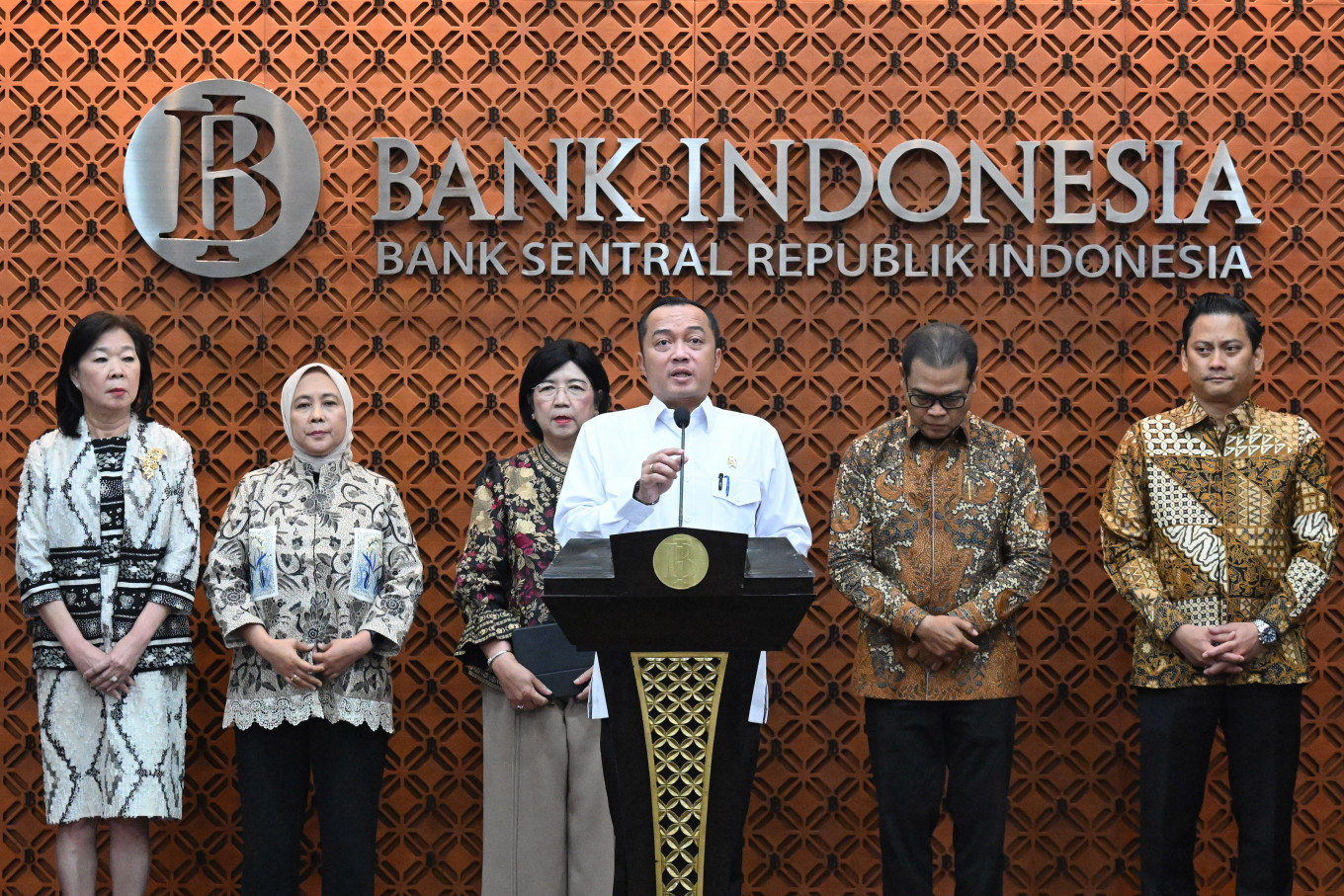 State Secretary Prasetyo Hadi, third right, accompanied by Bank Indonesia (BI) deputy governors, speaks on July 27 during a press conference on the resignation of BI Gov. Perry Warjiyo in Jakarta. (Antara/Marco)
T
he sudden resignation of Perry Warjiyo from Bank Indonesia (BI) governor post should not be written off as routine personnel turnover. In politics, the real story rarely lies in the event itself, it’s in the surrounding landscape. What looks like a standard administrative change can actually signal a fundamental shift in how a country intends to govern.
Over the past few months, President Prabowo Subianto’s administration has revealed a distinct pattern. The free nutritious meal program operates through a centralized chain of command, pushing uniform national targets down to local officials. The Red and White Village Cooperatives initiative follows the exact same top-down blueprint from policy design to nationwide execution. Meanwhile, sovereign wealth fund Danantara has assumed a far more strategic role within the economic ecosystem, including a seat within the country's financial stability coordination framework.
Taken individually, these look like standalone policy choices. Connect the dots, though, and a deeper question emerges: Is the country shifting toward a command model of economic governance?
It’s a question worth asking carefully. Indonesia hasn’t abandoned market capitalism. Prices are still largely dictated by market forces, the private sector remains the primary engine of growth and foreign and domestic investment remain foundational to national strategy.
What is changing isn’t the market system itself; it’s how directly the state intends to steer it. In political economy terms, this is less about creating a command economy and more about introducing command governance. The state isn’t replacing markets; it’s building muscle to direct investment, set strategic priorities, launch sweeping new institutions, and align the bureaucracy behind national goals.
This model isn't unprecedented. Singapore under Lee Kuan Yew maintained a fiercely open market while allowing the state to guide long-term growth, manage strategic investments and build a world-class civil service. South Korea under Park Chung-hee orchestrated rapid industrialization through tight coordination between the state, financial institutions and major conglomerates. China built its "socialist market economy" by keeping market mechanisms intact while retaining firm state control over strategic sectors and national planning.

Indonesia’s constitutional framework and democratic system are fundamentally different. Yet these examples show a clear pattern: A stronger state hand doesn't automatically mean abandoning market principles.