The Jakarta Post
Please Update your browser
Your browser is out of date, and may not be compatible with our website. A list of the most popular web browsers can be found below.
Just click on the icons to get to the download page.


Popular Reads
Top Results
No results found. Please check your search term and try again
Can't find what you're looking for?
View all search results
Popular Reads
Top Results
No results found. Please check your search term and try again
Can't find what you're looking for?
View all search resultsMore nuclear states may be better; more strategic ambiguity never is
Indonesia's contribution should be to insist on what actually makes nuclear peace hold: declaratory transparency, no-first-use commitments, verified command-and-control safeguards and working crisis hotlines between adversaries.
Change text size
Gift Premium Articles
to Anyone
Share the best of The Jakarta Post with friends, family, or colleagues. As a subscriber, you can gift 3 to 5 articles each month that anyone can read—no subscription needed!
 Set as preferred source
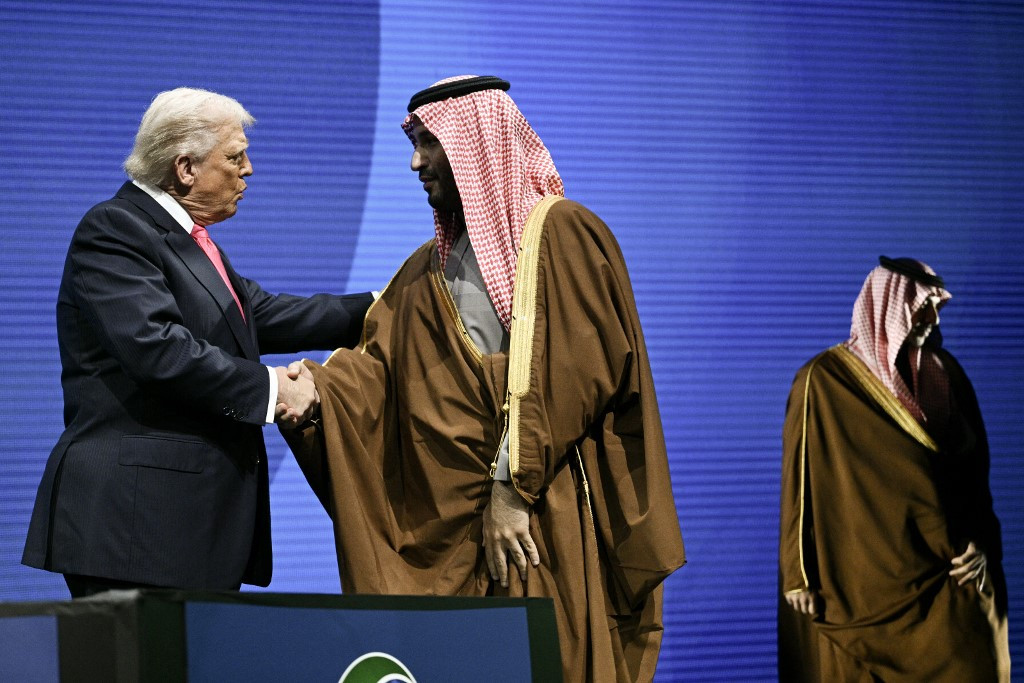 United States President Donald Trump shakes hands with Crown Prince and Prime Minister of the Kingdom of Saudi Arabia Mohammed bin Salman on Nov. 19, 2025, at the US-Saudi Investment Forum at the John F. Kennedy Center for the Performing Arts in Washington, DC. (AFP/Brendan Smialowski)
P
resident Prabowo Subianto told the country's business leaders at Istana Negara on July 31 that his evenings now follow a grim liturgy. "Every evening, every night, we watch the news: escalation, escalation, escalation." He then named the sequence now organizing the Middle East: Iran is said to have the bomb, Saudi Arabia wants one, and if Riyadh acquires one, the Emirates, Qatar and Egypt will not stay behind.
On July 23, Washington and Riyadh signed what the United States Department of Energy called a peaceful nuclear co-operation agreement, opening the Saudi civilian nuclear program to US firms. The word doing the heaviest lifting there is "peaceful."
The President's anxiety is structurally correct. But it contains two very different propositions, and Indonesian diplomacy will be effective only if we stop conflating them. The first — that more nuclear states are inherently more dangerous — is contested, and the evidence is not on the alarmist side. The second — that ambiguity about who holds what, under what doctrine, is destabilizing — is not contested at all. It is the one we should be pressing.
Start with the structure. In an anarchic system, security must be self-generated. States cross the nuclear threshold when two conditions converge: a proximate adversary they cannot balance conventionally, and a patron whose extended deterrence they no longer believe. Both now hold across the Gulf. Washington's guarantees have been tested and found conditional; Iran's reach has been demonstrated. Riyadh is behaving predictably.
Kenneth Waltz drew the heretical conclusion. In his 1981 Adelphi Paper, The Spread of Nuclear Weapons: More May Be Better, and again in his 2012 Foreign Affairs essay arguing that Iran should get the bomb, he called nuclear weapons the most powerful pacifying instrument ever invented. They do not make war winnable; they make it unaffordable.
Since 1945, no two states in a mature nuclear dyad have fought a full-scale war. India and Pakistan, nuclear since 1998, have brawled at Kargil, Pulwama and Balakot — and each time stopped short. The bomb does not eliminate conflict, but it caps it.

But Waltz was never a simple optimist about numbers, and this is where most readings of him fail. He preferred bipolarity because two poles produce clear attribution and legible thresholds. Five or six Middle Eastern arsenals with overlapping enmities and no fixed pairings is not the Waltzian ideal; it is his nightmare.