The Jakarta Post
Please Update your browser
Your browser is out of date, and may not be compatible with our website. A list of the most popular web browsers can be found below.
Just click on the icons to get to the download page.


Popular Reads
Top Results
No results found. Please check your search term and try again
Can't find what you're looking for?
View all search results
Popular Reads
Top Results
No results found. Please check your search term and try again
Can't find what you're looking for?
View all search resultsRegional action is a must to combat human trafficking
Rather than delivering justice to victims, authorities have normalized, and often downplayed, their suffering, frequently misclassifying victims as perpetrators.
Change text size
Gift Premium Articles
to Anyone
Share the best of The Jakarta Post with friends, family, or colleagues. As a subscriber, you can gift 3 to 5 articles each month that anyone can read—no subscription needed!
 Set as preferred source
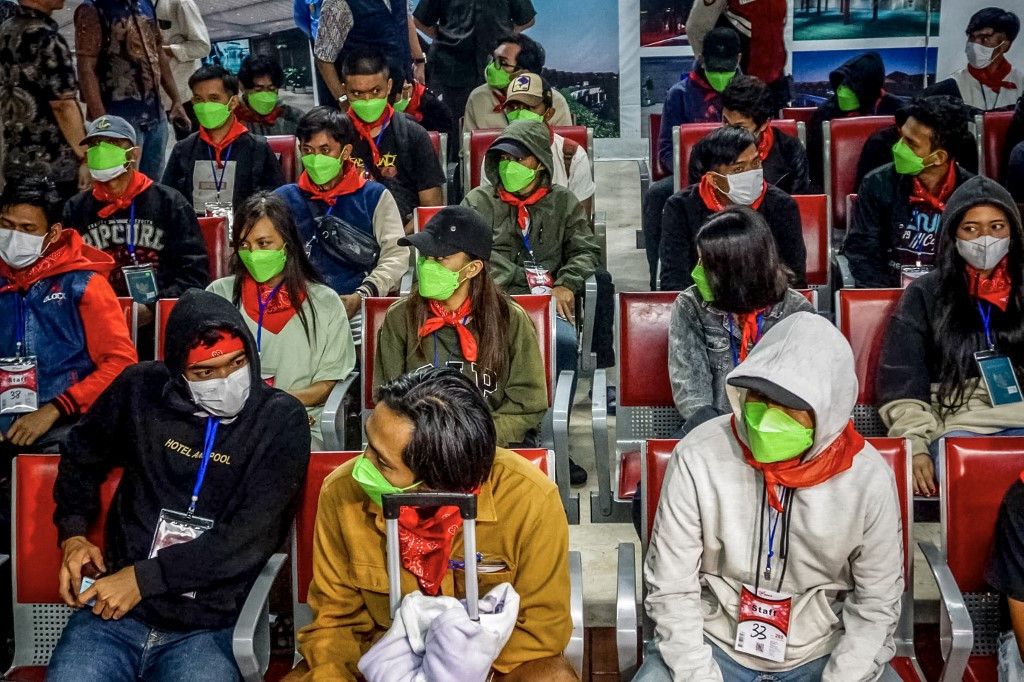 Indonesian victims of human trafficking in Myanmar arrive at the Soekarno-Hatta International Airport in Tangerang, Banten on Feb. 28, 2025, after being flown from Thailand following their handover by the Myanmar regime to Thailand. Myanmar handed over 84 Indonesians to Thailand on Feb. 27, officials said, the latest group of alleged scam center workers set to be repatriated from the region. (AFP/Dennys)
E
very July 30, the global community commemorates World Day Against Trafficking in Persons. The year 2026 marks the centenary of the League of Nations' Anti-Slavery Convention, a milestone that United Nations Secretary-General António Guterres urged must serve as a catalyst for a firm, renewed commitment to eradicating slavery in all its forms. Yet, rather than being consigned to history, slavery over the past century has simply modernized, evolving to align with contemporary economic trends and technology.
Reflecting this shift, the 2026 theme for World Day Against Trafficking in Persons is “Trapped Behind The Scam.” This theme directly addresses the grim reality facing hundreds of thousands of Indonesians, mostly young people, trapped in forced criminality.
According to the Foreign Ministry, as of late 2024, there were 166,745 Indonesians living in Cambodia, but only 131,184 held valid residence permits. Meanwhile, reported cases of individuals trapped in online scamming compounds reached roughly 5,008, and the ministry recorded 291 deaths of Indonesian nationals in Cambodia between 2020 and August 2025. Tragically, these figures represent merely the tip of the iceberg.
Despite these alarming statistics, the government has shown little resolve to address a crisis categorized by the UN Office on Drugs and Crime (UNODC) as "forced criminality." Rather than delivering justice to victims, authorities have normalized, and often downplayed, their suffering, frequently misclassifying victims as perpetrators. Consequently, despite thousands of victims coming forward, the government has proven either unable or unwilling to dismantle these transnational criminal syndicates.
This inaction stems from a broader lack of political will to prevent and eradicate human trafficking. The National Action Plan for the Prevention and Eradication of Human Trafficking expired in 2024 and up until now is not updated. Similarly, Indonesia's core legal framework, Law No. 21/2007 on the eradication of the crime of human trafficking, is ill-equipped to counter modern trafficking tactics, yet lawmakers have shown no intention of revising it. Compounding the issue, recent budget austerity measures have severely weakened local government efforts to combat trafficking at the grassroots level.
This failure of state intervention is particularly dangerous because the nature of the crime itself has shifted. Forced criminality, a scheme that coerces victims into executing digital fraud, has spiked dramatically during and after the COVID-19 pandemic. The victim profile has expanded beyond traditional demographics to encompass educated, digitally literate youth from urban areas. Driven by pandemic-induced job losses and an increasingly precarious labor market, these young jobseekers fall target to sophisticated cyber-trafficking networks.

At the same time, long-standing trafficking patterns in traditional sectors show no sign of abatement. Reports from global organizations like Walk Free and the International Justice Mission, alongside data from migrant worker advocacy groups and labor unions, confirm that sectors such as domestic work, palm oil, mining (especially nickel) and marine fisheries continue to be rife with modern slavery.