The Jakarta Post
Please Update your browser
Your browser is out of date, and may not be compatible with our website. A list of the most popular web browsers can be found below.
Just click on the icons to get to the download page.


Popular Reads
Top Results
No results found. Please check your search term and try again
Can't find what you're looking for?
View all search results
Popular Reads
Top Results
No results found. Please check your search term and try again
Can't find what you're looking for?
View all search resultsHow much state intervention is too much for Indonesia?
Prabowo could hope to relive Soeharto’s era by recentralizing the government and strengthening the military, two pillars that had defined Soeharto’s New Order, while slowly erasing regional autonomy and freedom of speech, the two key achievements during the post-Soeharto democratization, also known as the Reform Era.
Change text size
Gift Premium Articles
to Anyone
Share the best of The Jakarta Post with friends, family, or colleagues. As a subscriber, you can gift 3 to 5 articles each month that anyone can read—no subscription needed!
 Set as preferred source
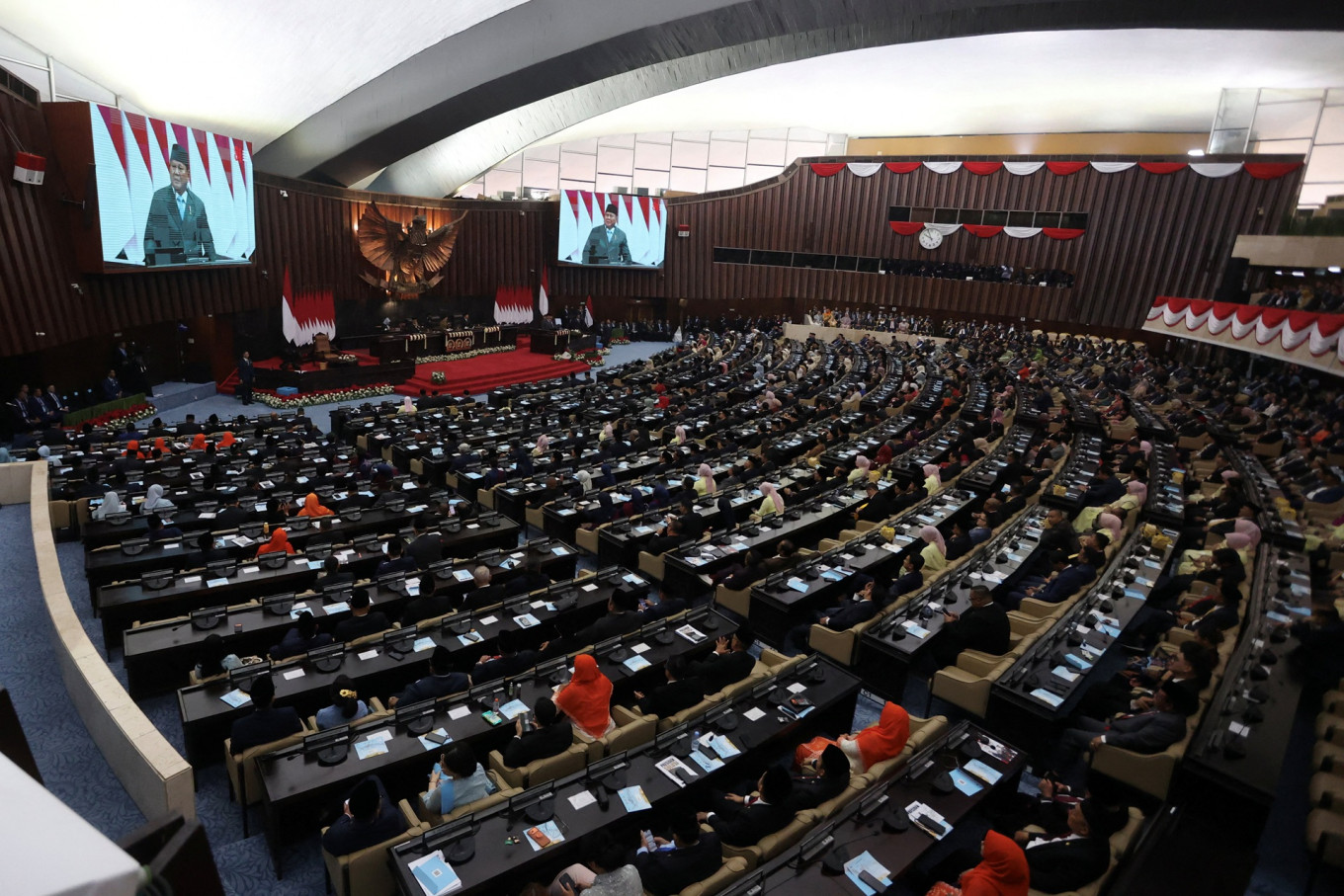 President Prabowo Subianto is displayed on screens as he delivers his annual State of the Nation address ahead of the country's 81st Independence Day anniversary in front of the members of the legislative bodies during the People's Consultative Assembly (MPR) plenary session at the Senayan legislative complex in Central Jakarta on Aug. 14, 2026. (Reuters/Stringer)
I
f critics consider President Prabowo Subianto’s policies disruptive, the head of government himself has already offered an explanation for why that might be the case.
In his recent State of the Nation Address, Prabowo pointed to the blistering pace of his transformation agenda. Just 21 months into his presidency, he noted, his administration had rolled out 121 “transformative” policies, averaging one new policy every five days, all aimed at unraveling problems left untouched for decades.
From a macroeconomic standpoint, state intervention is hardly unprecedented. Government activism has anchored some of the most consequential developmental turnarounds since World War II in response to inequality, labor movement and market failures associated with postwar capitalism.
Across Europe, state intervention expanded social safety nets and rebuilt basic industries, creating the institutional bedrock of modern welfare systems. In East Asia, state-led coordination transformed largely agrarian societies into industrial heavyweights. The rise of South Korea and China illustrated how concerted state planning could build productive capacity, mobilize capital, and sharpen international competitiveness.
If Prabowo wants Indonesia to chart a more interventionist path, the ambition itself is not outlandish. The real question is what kind of transformation his government is engineering and whether it honors the democratic foundations built since the fall of Soeharto more than 25 years ago.
In less than two years, Prabowo appears increasingly drawn to the playbook of the late autocrat, who also happens to be his former father-in-law, rather than advancing the democratic gains of the Reform Era.

This backward-looking approach risks delivering, at best, a pale imitation of the results Soeharto achieved three decades ago. At worst, the fallout could be far more severe. Indonesia today operates in a radically different environment. The abundant oil and gas revenues that bankrolled the New Order's 1980s boom are largely depleted, and the contemporary global landscape presents entirely new geopolitical and economic constraints.