The Jakarta Post
Please Update your browser
Your browser is out of date, and may not be compatible with our website. A list of the most popular web browsers can be found below.
Just click on the icons to get to the download page.


Popular Reads
Top Results
No results found. Please check your search term and try again
Can't find what you're looking for?
View all search results
Popular Reads
Top Results
No results found. Please check your search term and try again
Can't find what you're looking for?
View all search resultsThe quiet crisis of Indonesia's shrinking middle class
Beneath Indonesia’s booming headline growth lies a dangerous paradox: its middle class is quietly collapsing, threatening both the nation’s economic dream and its democratic stability.
Change text size
Gift Premium Articles
to Anyone
Share the best of The Jakarta Post with friends, family, or colleagues. As a subscriber, you can gift 3 to 5 articles each month that anyone can read—no subscription needed!
 Set as preferred source
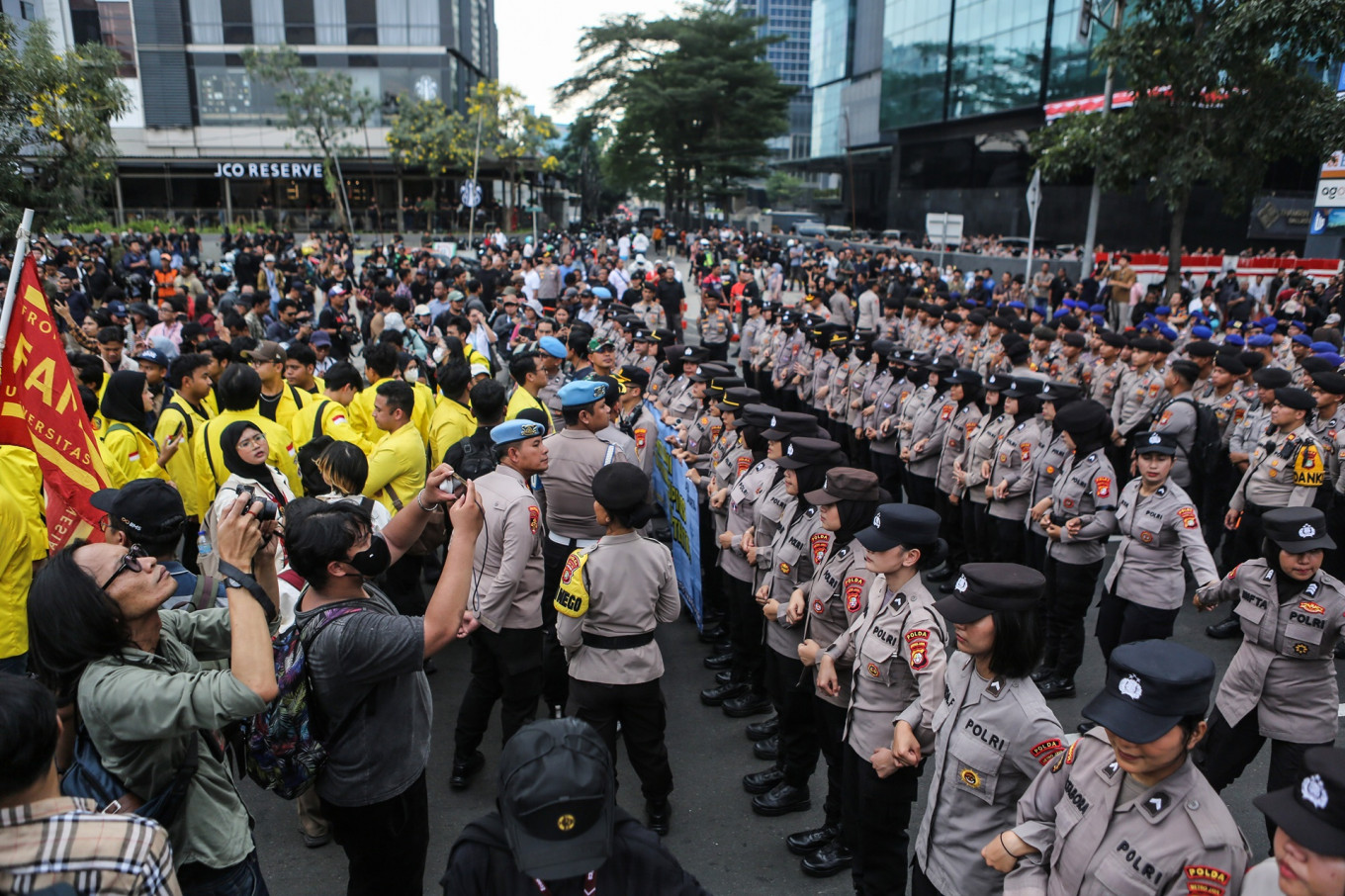 Lines of police officers hold off student protesters from reaching the Hotel Indonesia traffic circle on Jl. Sudirman in Jakarta on Aug. 18, 2026. (Antara/Asprilla Dwi Adha)
T
hrough targeted investment and leaner spending, President Prabowo Subianto has set bold targets in the 2027 state budget: 6 percent growth and an unemployment rate between 4.3 and 4.87 percent.
On paper, the momentum is already there. Indonesia’s economy is expanding at a steady 5 percent, unemployment sits at a decade-low 4.68 percent, and Jakarta’s shopping malls are packed. Yet the real issue is not the pace of growth, it is the nature of that growth, and who actually benefits from it.
Beneath these reassuring headline figures lies a troubling paradox: the country is expanding, but its people are not growing more prosperous. The middle class, the very engine meant to propel Indonesia into high-income status, is quietly shrinking.
The numbers tell an alarming story. Since 2019, Indonesia’s middle class has shed nearly 10 million people, sliding from 21.5 percent of the population to 17.1 percent by 2023. More striking still, the share of workers earning middle-class wages collapsed from 14.5 percent in 2018 to just 7.1 percent by 2025.
This is no statistical fluke; it is an alarm bell. Between 2019 and 2024, four out of every five new jobs emerged in the informal sector, insecure, low-paying roles devoid of safety nets. The typical informal worker brings home just Rp 1.9 million (US$107) a month, compared with Rp 2.9 million in the formal sector. As a result, university graduates increasingly find themselves driving ride-hailing bikes or piecing together gig work, putting in longer hours while falling behind on housing, health care and education.
At its core, the problem is structural. Manufacturing, the traditional ladder to middle-class security across East Asia, accounted for nearly 32 percent of Indonesia’s GDP in 2002. By 2025, that figure had withered to roughly 19 percent. Compounding this deindustrialization, an influx of cheap imports from China since 2023 has triggered domestic factory shutdowns, pushing laid-off workers directly into precarious informal labor.

This dynamic echoes the "Chilean paradox", where stellar macroeconomic performance and falling poverty rates masked deep middle-class discontent that ultimately boiled over into mass unrest. Chile offers an unmistakable warning: without high-quality, inclusive public services for working families, economic growth alone cannot guarantee social peace. Indonesia would be wise to heed the lesson before its own cracks widen into a rupture.