The Jakarta Post
Please Update your browser
Your browser is out of date, and may not be compatible with our website. A list of the most popular web browsers can be found below.
Just click on the icons to get to the download page.


Popular Reads
Top Results
No results found. Please check your search term and try again
Can't find what you're looking for?
View all search results
Popular Reads
Top Results
No results found. Please check your search term and try again
Can't find what you're looking for?
View all search resultsAnalysis: Rosy labor figures conceal deeper cracks
Change text size
Gift Premium Articles
to Anyone
Share the best of The Jakarta Post with friends, family, or colleagues. As a subscriber, you can gift 3 to 5 articles each month that anyone can read—no subscription needed!
 Set as preferred source
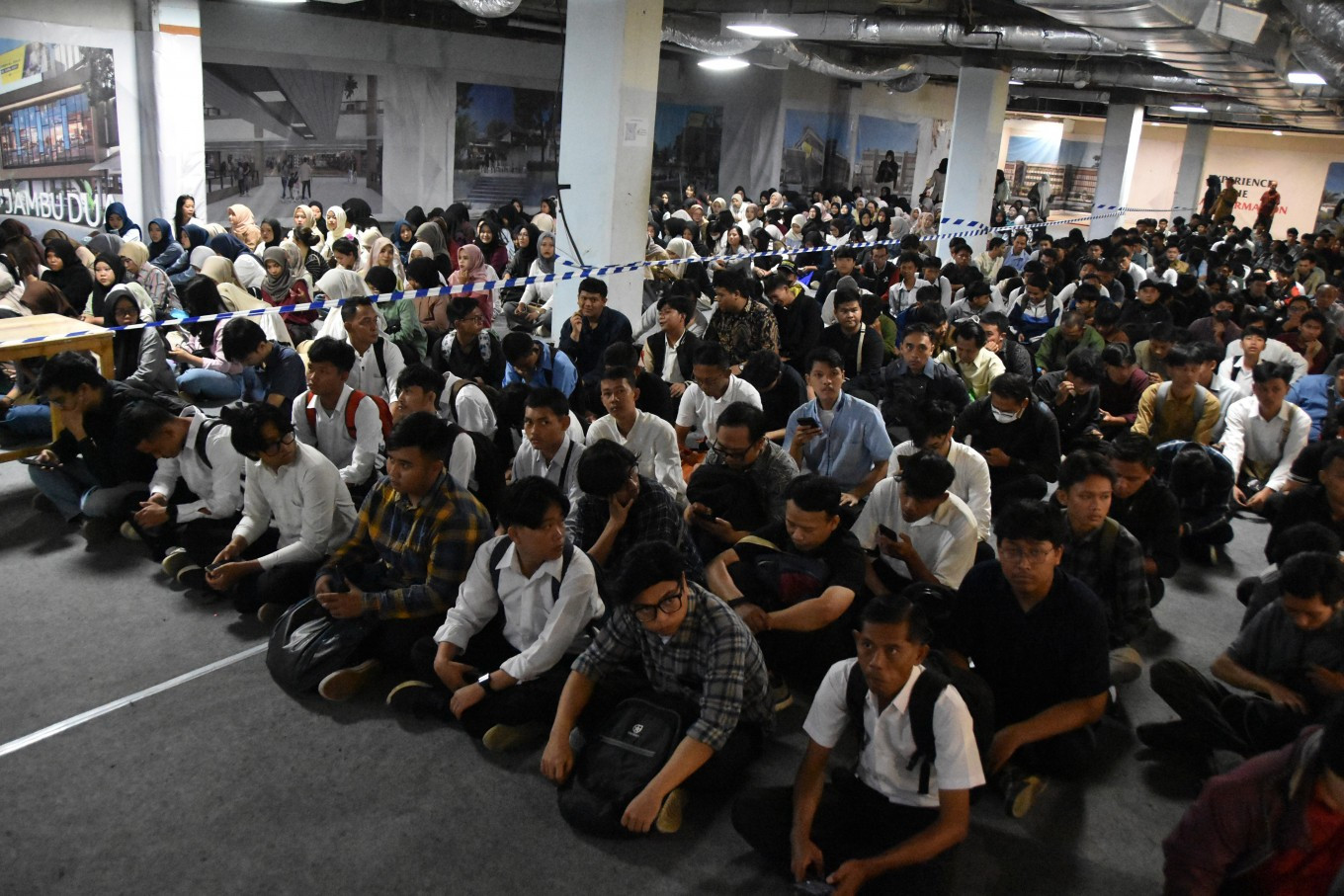 Jobseekers wait in line during the opening of the 2026 Bogor Job Fair at Plaza Jambu Dua in Bogor, West Java, on June 8, 2026.) (Antara/Arif Firmansyah)
I
ndonesia’s labor market resembles a polished façade concealing deeper cracks. Official figures show headline unemployment falling, yet the recovery has not created enough quality jobs for the country’s growing educated workforce. Education has long been seen as the first step up the social ladder, opening the way to secure employment and a better life. Today, however, more than 1 million university graduates are unemployed, exposing a troubling reality: A degree no longer reliably opens the doors it once promised.
The contrast becomes clearer in the latest data from Statistics Indonesia (BPS). The open unemployment rate edged down to 4.65 percent in May 2026, while the number of unemployed people fell by around 24,000 over three months to 7.22 million. Yet more than 1 million of those without work, or 14.3 percent, held a university degree. Their share has nearly doubled from around 8 percent in August 2022.
The unemployment rate among people with at least a bachelor’s degree has also moved in the opposite direction, rising from 4.80 percent in 2022 to 5.39 percent in 2025. The divergence suggests that Indonesia’s labor market may be improving in aggregate, but it is not creating enough suitable jobs to keep pace with the country’s expanding pool of university-educated workers.
Graduates from some of Indonesia’s largest fields dominate the jobless pool. The Institute for Economic and Social Research at the University of Indonesia (LPEM UI) found that management, law, economics, education, accounting and computer science together accounted for around 40 percent of unemployed university graduates in August 2025. This does not necessarily mean that these fields have the highest unemployment rates, as many of them also produce large numbers of graduates.
Rather, it shows how graduates from broad and popular disciplines are increasingly competing for a limited pool of similar entry-level jobs. Even computer science, long associated with strong employment prospects, is not immune, as rapidly changing industry demands and uneven training quality complicate graduates’ transition into the workforce.
These concerns echo broader complaints from employers about the mismatch between the skills available and those businesses require. Indonesian Employers Association (Apindo) chair Shinta W. Kamdani has cited this mismatch alongside weak formal job creation and the continued dominance of informal employment, while an Apindo survey found that only 26 percent of businesses considered the available workforce suited to their needs.

Graduate unemployment, therefore, reflects both sides of the equation. Universities are not always equipping students with relevant skills, while the economy is not generating enough suitable jobs even for those who possess them.