The Jakarta Post
Please Update your browser
Your browser is out of date, and may not be compatible with our website. A list of the most popular web browsers can be found below.
Just click on the icons to get to the download page.


Popular Reads
Top Results
No results found. Please check your search term and try again
Can't find what you're looking for?
View all search results
Popular Reads
Top Results
No results found. Please check your search term and try again
Can't find what you're looking for?
View all search resultsHow village-led parenting offers a new hope to communities
In the face of climate shocks and systemic neglect, rural Indonesian communities are rewriting the rules of parental care from the ground up.
Change text size
Gift Premium Articles
to Anyone
Share the best of The Jakarta Post with friends, family, or colleagues. As a subscriber, you can gift 3 to 5 articles each month that anyone can read—no subscription needed!
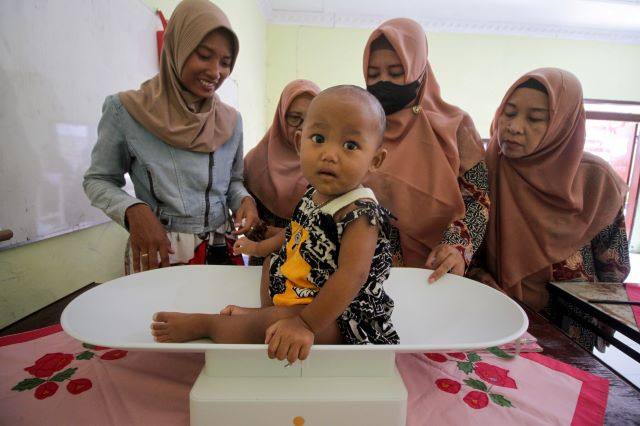 Community health workers weigh a toddler during a regular mother-and-child checkup at an integrated health post (Posyandu) in South Celep district, Sidoarjo, East Java, on Oct. 12, 2023. (Antara/Umarul Faruq)
R
ecent research in rural Indonesian villages revealed an alarming reality: 37 percent of mothers surveyed showed symptoms of post-traumatic stress disorder (PTSD), while 35 percent experienced anxiety or depression.
Indonesia did introduce a national policy for early childhood development in 2003, followed by a 2013 Presidential Regulation on holistic-integrative early childhood education. Yet, like most countries, it still lacks a cohesive framework dedicated to parental mental health.
This absence of support hits rural areas hardest. Families there face compound pressures: sparse medical infrastructure alongside mounting climate disruptions.
According to United Nations data, more than a third of Indonesian farming families are projected to become vulnerable to climate impacts. In these communities, ongoing environmental uncertainty heightens daily parental strain, leaving many caregivers struggling to cope while their distress goes largely unnoticed.
Globally, the picture is similarly sobering. Perinatal anxiety and depression affect roughly one in five parents in low- and middle-income countries. Neuroscience helps explain why: parenthood triggers massive neurological and hormonal shifts that fundamentally alter how the brain operates. Compounding these biological shifts is the erosion of traditional community networks, leaving about a third of new parents worldwide feeling isolated and unsupported.
When biological vulnerability, social isolation and climate disruptions collide, rural Indonesian parents bear the brunt. Yet the gap between public policy and community need is sparking grassroots ingenuity.

Rather than waiting for top-down interventions, community-led initiatives are tapping into local culture and existing networks to deliver care where formal health systems fall short.