The Jakarta Post
Please Update your browser
Your browser is out of date, and may not be compatible with our website. A list of the most popular web browsers can be found below.
Just click on the icons to get to the download page.


Popular Reads
Top Results
No results found. Please check your search term and try again
Can't find what you're looking for?
View all search results
Popular Reads
Top Results
No results found. Please check your search term and try again
Can't find what you're looking for?
View all search resultsThe Dec. 15 deadline keeps Indonesia’s political pressure cooking
By putting a Dec.15 deadline in writing, lawmakers didn't just defuse a street protest—they handed the public a ticking timer on their own integrity.
Change text size
Gift Premium Articles
to Anyone
Share the best of The Jakarta Post with friends, family, or colleagues. As a subscriber, you can gift 3 to 5 articles each month that anyone can read—no subscription needed!
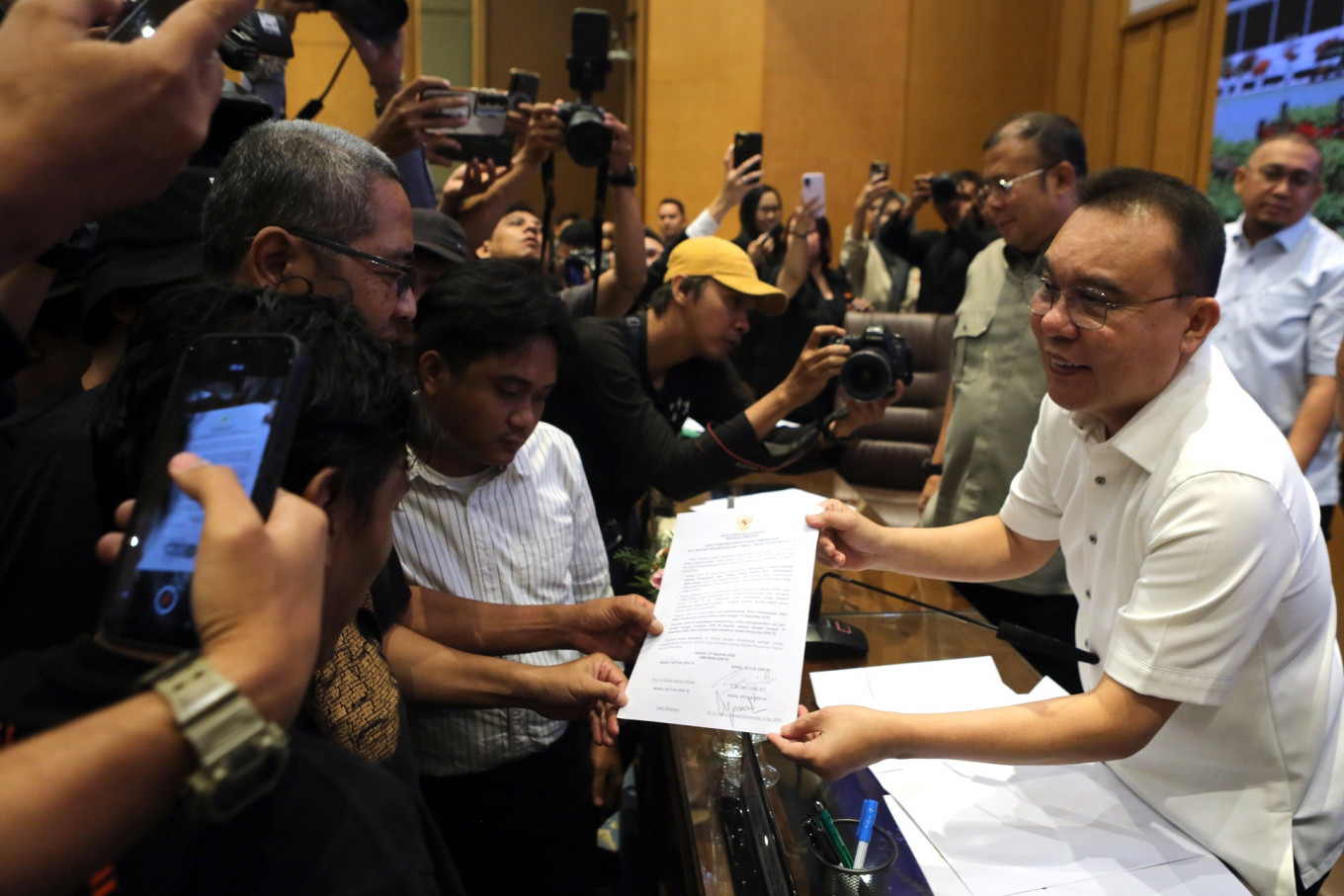 House of Representatives Deputy Speaker Sufmi Dasco Ahmad (right) of the Gerindra Party shows a copy of the legislature's commitment letter to pass the asset forfeiture bill to representatives of the United Pati People's Alliance (AMPB) on Aug. 27 at the Senayan Legislative Complex in Central Jakarta. The AMPB staged a protest in front of the legislative complex to demand the passage of the long-awaited asset forfeiture bill and harsher punishment for corrupt officials. (Antara/Asprilla Dwi Adha)
T
he street demonstration outside the House of Representatives on Aug. 27 risked being remembered only for the tear gas and broken barricades that followed. In the immediate fallout, the substantive demands of the crowd took a back seat to standard security hand-wringing. Yet one quiet breakthrough from that afternoon is set to outlast the tear gas by months.
Inside the complex, House leaders—led by Deputy Speaker Sufmi Dasco Ahmad, who is also Gerindra Party executive chairman—sat down with representatives of the Pati People’s United Alliance (AMPB). Out of that room came an unusually concrete commitment: the long-stalled asset forfeiture bill would pass no later than Dec. 15.
Crucially, they put it in writing.
That was the moment street agitation shifted into a binding political contract. The bill was no longer an abstract talking point drifting through committee rooms; it now had a hard deadline, an expectant public and named politicians on the hook.
Dec. 15 sets off an audible countdown. Every missed session invites suspicion. Any quiet tweak to key clauses prompts immediate questions about who benefits. By attaching a firm date to a signature reform, lawmakers effectively handed the public a yardstick to measure their sincerity—and a timer to watch while they work.
The bill itself is an old ghost. It has kicked around parliamentary dockets and presidential speeches for well over a decade without ever crossing the finish line. A changing of the guard at the Merdeka Palace didn't magically break the gridlock, because the roadblock has never been administrative. It cuts straight to the rawest nerve in Indonesian politics: where state authority collides with private wealth.

No tycoon or senior party boss ever goes on record opposing the confiscation of dirty money. Taking that stance in public would be political suicide. Instead, resistance operates through the fine print.